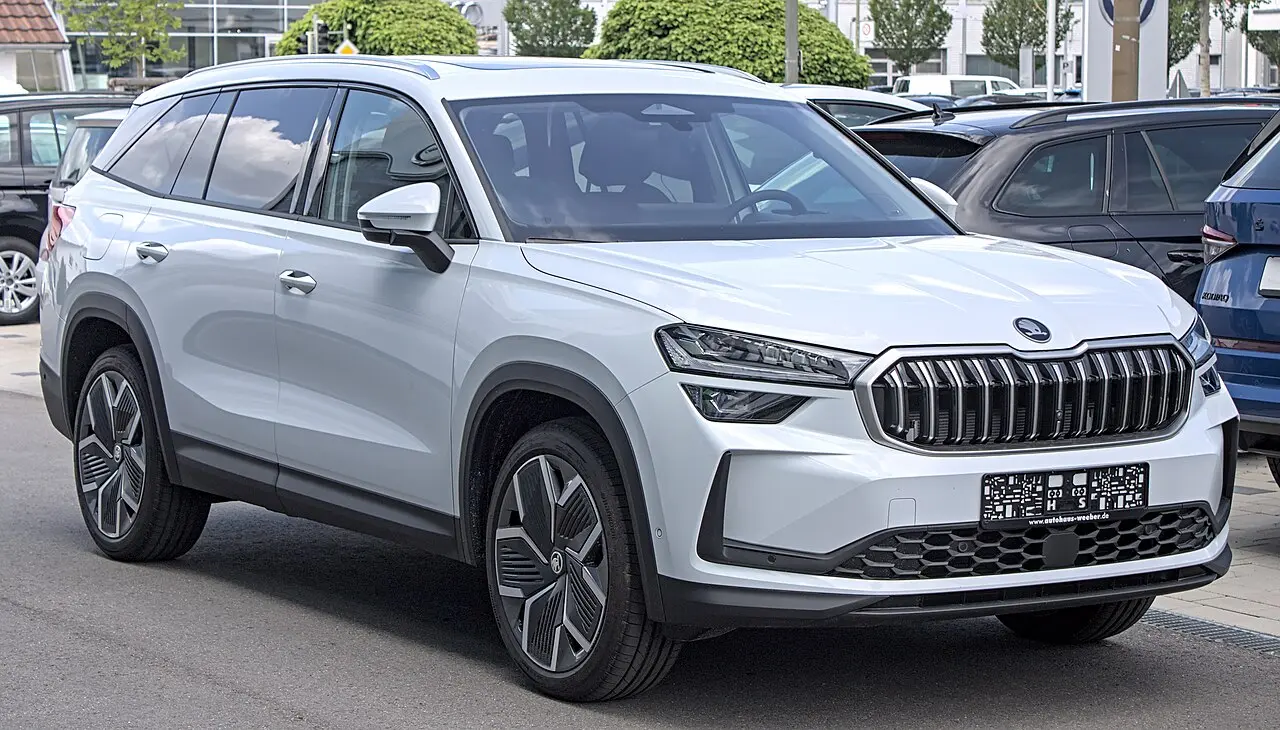
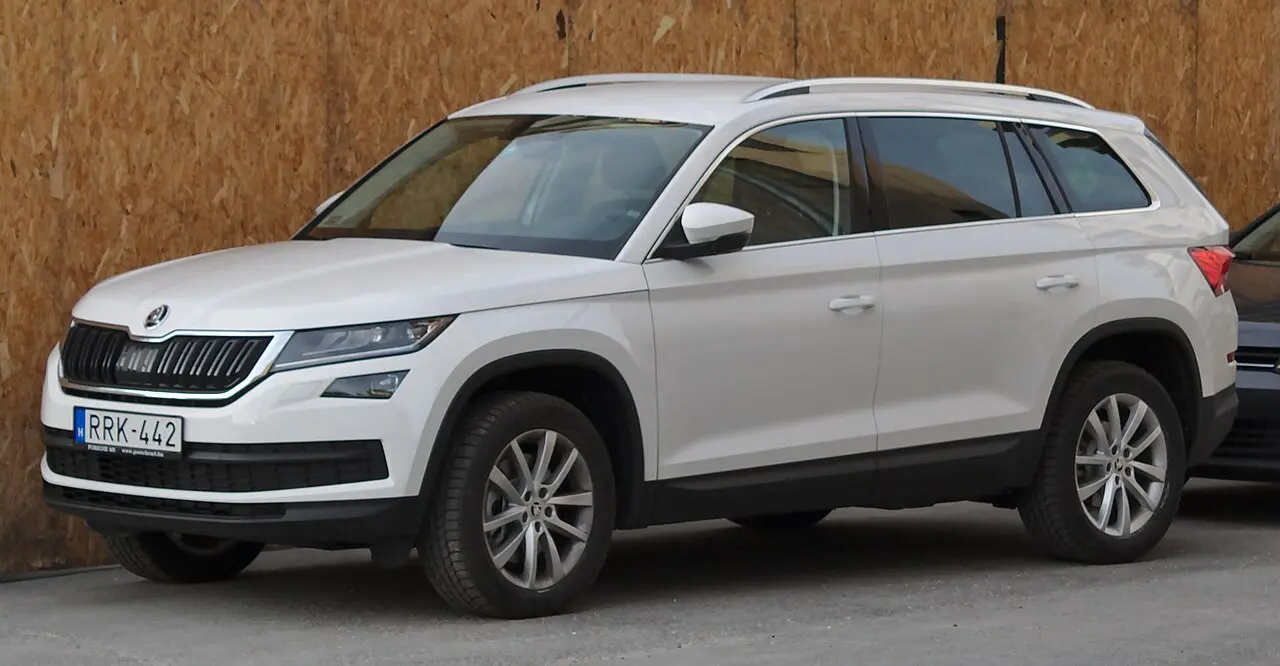
The official data lists 147 versions of the Škoda Kodiaq (2016–2026), in the European Union, the United Kingdom, and France. Each market publishes its own figures, measured on its own test procedure.
At a glance
Years in the data
2016–2026
Markets
European Union, United Kingdom, France
Engines
1.4 L to 2.0 L
Power
67 kW (91 PS) to 195 kW (265 PS)
Fuels
Diesel, Petrol, Plug-in hybrid, Hybrid, LPG
Lowest consumption (France)
5.0 L/100 km (WLTP)
Lowest consumption (United Kingdom)
5.0 L/100 km (NEDC)
Lowest consumption (European Union)
5.4 L/100 km (WLTP)
Plug-in hybrid, weighted (European Union)
0.6 L/100 km (WLTP)
Plug-in hybrid, weighted (United Kingdom)
5.7 L/100 km (WLTP)
New registrations in the EU
910,778
What is the Škoda Kodiaq?
The Kodiaq is Škoda’s large SUV and the flagship of its SUV range. It is offered in five-seat and seven-seat form, with a spacious cabin suited to family use. The model reflects Škoda’s focus on practical space, while each generation has brought a fresh take on the large SUV.
Kodiaq I ran from 2016 to 2023; Kodiaq II followed in 2024 and continues today. The second generation brought a redesigned exterior with early elements of Škoda’s Modern Solid design language, a roomier interior and new cabin controls. Its powertrain range introduced plug-in hybrid and mild-hybrid options.
Engines and power
Across EU registrations, the Kodiaq spans 1.4 L to 2.0 L engines and 67 kW (91 PS) to 198 kW (269 PS). Fuel types include diesel, plug-in hybrid, hybrid, petrol, LPG and other entries. UK figures cover 1.3 L to 2.0 L engines producing 92 kW (125 PS) to 195 kW (265 PS), with hybrid, plug-in hybrid, diesel and petrol options. French listings show 2.0 L petrol and diesel engines, with power from 110 kW (150 PS) to 180 kW (245 PS).
How economical is the Škoda Kodiaq?
For petrol, diesel and hybrid versions, the lowest listed EU consumption is 5.4 L/100 km on WLTP. The EU plug-in hybrid’s weighted figure is 0.6 L/100 km WLTP; this calculation assumes that part of the driving is electric. UK listings give 5 L/100 km under NEDC for petrol, diesel and hybrid versions, and 5.7 L/100 km WLTP as the weighted plug-in hybrid figure. France lists a lowest figure of 5 L/100 km WLTP. WLTP and NEDC are different European test procedures, so figures from those markets are not directly comparable.
Official EU registration figures record 910,778 Kodiaqs from 2016 to 2025. The most registered entries shown are 2.0 L diesel versions rated at 110 kW (150 PS), in 2018, 2019 and 2020.
Questions and answers
When did the second-generation Kodiaq arrive?
Kodiaq II began in 2024 and continues today.
What is the lowest listed EU Kodiaq plug-in hybrid consumption?
Its official weighted WLTP figure is 0.6 L/100 km, assuming some driving is electric.
Model codes: PS · Sold in: European Union, United Kingdom, and France · References: skoda.co.uk, en.wikipedia.org
European Union 18 versions
New cars registered in the EU (plus Norway and Iceland), from the European Environment Agency. Figures on the NEDC procedure until 2020 and on WLTP from 2021; versions are grouped by engine and power, with their number of registrations.
Years and version
Engine
Power
Fuel
Consumption (combined)
CO₂
Electric range
EU registrations
2025
2.0 L
142 kW (193 PS)
Diesel
6.2 L/100 km WLTP
162 g/km
–
25,558
2025
1.5 L
110 kW (150 PS)
Plug-in hybrid
0.6 L/100 km WLTP17.6 kWh/100 km WLTP
15 g/km
115 km
23,666
2025
2.0 L
110 kW (150 PS)
Diesel
5.5 L/100 km WLTP6.0 kWh/100 km WLTP
144 g/km
–
14,438
2025
1.5 L
110 kW (150 PS)
Hybrid
6.1 L/100 km WLTP
140 g/km
–
13,637
2025
2.0 L
195 kW (265 PS)
Petrol
8.3 L/100 km WLTP
189 g/km
–
8,427
2025
2.0 L
150 kW (204 PS)
Petrol
7.6 L/100 km WLTP6.0 kWh/100 km WLTP
173 g/km
–
3,371
2025
1.5 L
110 kW (150 PS)
Petrol
6.4 L/100 km WLTP
146 g/km
–
1,104
2025
2.0 L
195 kW (265 PS)
Petrol
8.3 L/100 km WLTP
188 g/km
–
52
2025
2.0 L
147 kW (200 PS)
Diesel
6.6 L/100 km WLTP
172 g/km
–
50
2024
2.0 L
142 kW (193 PS)
Diesel
6.2 L/100 km WLTP
164 g/km
–
21,306
2024
2.0 L
110 kW (150 PS)
Diesel
5.6 L/100 km WLTP
145 g/km
–
15,485
2024
1.5 L
110 kW (150 PS)
Hybrid
6.3 L/100 km WLTP
141 g/km
–
9,410
2024
2.0 L
147 kW (200 PS)
Diesel
6.5 L/100 km WLTP
171 g/km
–
9,188
2024
1.5 L
110 kW (150 PS)
Plug-in hybrid
0.8 L/100 km WLTP18.0 kWh/100 km WLTP
13 g/km
114 km
7,251
2024
1.5 L
110 kW (150 PS)
Petrol
7.0 L/100 km WLTP
158 g/km
–
6,804
2024
2.0 L
140 kW (190 PS)
Petrol
7.9 L/100 km WLTP
179 g/km
–
3,795
2024
2.0 L
180 kW (245 PS)
Petrol
8.5 L/100 km WLTP
193 g/km
–
3,168
2024
2.0 L
150 kW (204 PS)
Petrol
7.6 L/100 km WLTP
173 g/km
–
58
United Kingdom 24 versions
New cars on sale in the UK, from the Vehicle Certification Agency. NEDC figures until 2018 and WLTP figures after; years are the editions a version appeared in.
Years and version
Engine
Power
Fuel
Gearbox
Consumption (combined)
CO₂
Electric range
2025–2026SE (5 seats) 1.5 TSI e-TEC 150 PS DSG
1.5 L
110 kW (150 PS)
Hybrid
7-speed automatic
5.9 L/100 km WLTP
133 g/km
–
2025–2026SE (5 seats) 1.5 TSI e-TEC 150 PS DSG
1.5 L
110 kW (150 PS)
Hybrid
7-speed automatic
6.1 L/100 km WLTP
140 g/km
–
2025–2026SE (7 seats) 1.5 TSI e-TEC 150 PS DSG
1.5 L
110 kW (150 PS)
Hybrid
7-speed automatic
6.0 L/100 km WLTP
137 g/km
–
2025–2026SE (7 seats) 1.5 TSI e-TEC 150 PS DSG
1.5 L
110 kW (150 PS)
Hybrid
7-speed automatic
6.3 L/100 km WLTP
143 g/km
–
2025–2026SE L (7 seats) 1.5 TSI e-TEC 150 PS DSG
1.5 L
110 kW (150 PS)
Hybrid
7-speed automatic
6.1 L/100 km WLTP
139 g/km
–
2025–2026SE L (7 seats) 1.5 TSI e-TEC 150 PS DSG
1.5 L
110 kW (150 PS)
Hybrid
7-speed automatic
6.4 L/100 km WLTP
145 g/km
–
2025–2026SportLine (7 seats) 1.5 TSI e-TEC 150 PS DSG
1.5 L
110 kW (150 PS)
Hybrid
7-speed automatic
6.2 L/100 km WLTP
140 g/km
–
2025–2026SportLine (7 seats) 1.5 TSI e-TEC 150 PS DSG
1.5 L
110 kW (150 PS)
Hybrid
7-speed automatic
6.3 L/100 km WLTP
145 g/km
–
2025–2026SE (5 seats) 1.5 TSI iV 204 PS DSG
1.5 L
150 kW (204 PS)
Plug-in hybrid
6-speed automatic
5.7 L/100 km WLTP17.4 kWh/100 km WLTP
–
119 km
2025–2026SE L (5 seats) 1.5 TSI iV 204 PS DSG
1.5 L
150 kW (204 PS)
Plug-in hybrid
6-speed automatic
5.9 L/100 km WLTP17.7 kWh/100 km WLTP
–
117 km
2025–2026SportLine (5 seats) 1.5 TSI iV 204 PS DSG
1.5 L
150 kW (204 PS)
Plug-in hybrid
6-speed automatic
5.9 L/100 km WLTP17.9 kWh/100 km WLTP
–
115 km
2025–2026SE (5 seat) 2.0 TDI 150 PS DSG · SE L (7 seats) 2.0 TDI 150 PS DSG
2025–2026SE L (7 seats) 2.0 TSI 204 PS DSG 4x4 · SportLine (7 seats) 2.0 TSI 204 PS DSG 4x4
2.0 L
150 kW (204 PS)
Petrol
7-speed automatic
7.9 L/100 km WLTP
179 g/km
–
2025–2026SportLine (7 seats) 2.0 TSI 204 PS DSG 4x4
2.0 L
150 kW (204 PS)
Petrol
7-speed automatic
7.7 L/100 km WLTP
175 g/km
–
2025–2026vRS (7 seats) 2.0 TSI 265 PS DSG 4x4
2.0 L
195 kW (265 PS)
Petrol
7-speed automatic
8.3 L/100 km WLTP
189 g/km
–
2025–2026vRS (7 seats) 2.0 TSI 265 PS DSG 4x4
2.0 L
195 kW (265 PS)
Petrol
7-speed automatic
8.5 L/100 km WLTP
192 g/km
–
2025SE (5 seat) 2.0 TDI 150 PS DSG
2.0 L
110 kW (150 PS)
Diesel
7-speed automatic
5.3 L/100 km WLTP
138 g/km
–
France 7 versions
New cars on sale in France, from ADEME Car Labelling. NEDC figures until 2015, WLTP figures in the current catalogue.
Years and version
Engine
Power
Fuel
Gearbox
Consumption (combined)
CO₂
2026Kodiaq 2.0 TDI (150ch) DSG7 4*2 nAP 7PL clA Full LED et alt 140A (uniqt b auto) famA · Kodiaq 2.0 TDI (150ch) DSG7 4*2 norme AP 7PL clA Full LED (uniqt boite auto) famA
2.0 L
110 kW (150 PS)
Diesel
7-speed automatic
5.0 L/100 km WLTP
130 g/km
2026Kodiaq Ambition 2.0 TDI (150ch) DSG7 4x4 7PL classe A
2.0 L
110 kW (150 PS)
Diesel
7-speed automatic
5.5 L/100 km WLTP
144 g/km
2026Kodiaq Style 2.0 TDI (150ch) DSG7 4x4 7PL classe B
2.0 L
110 kW (150 PS)
Diesel
7-speed automatic
6.1 L/100 km WLTP
161 g/km
2026Kodiaq Style 2.0 TDI (150ch) DSG7 4x4 7PL classe A
2.0 L
110 kW (150 PS)
Diesel
7-speed automatic
5.5 L/100 km WLTP
144 g/km
2026Kodiaq 2.0 TDI (200ch) DSG7 4*4 norme AP 5PL Pack Sport/L&K clB Full LED et alt 140A famA
2.0 L
147 kW (200 PS)
Diesel
7-speed automatic
5.9 L/100 km WLTP
154 g/km
2026Kodiaq Style 2.0 TDI (200ch) DSG7 4x4 7PL classe A
2.0 L
147 kW (200 PS)
Diesel
7-speed automatic
5.9 L/100 km WLTP
154 g/km
2026Kodiaq RS 2.0 TSI (245ch) DSG7 4x4 7PL classe B
2.0 L
180 kW (245 PS)
Petrol
7-speed automatic
8.7 L/100 km WLTP
198 g/km
Official figures are measured on standard test procedures and differ between markets. Your consumption depends on how, where and in what conditions you drive.