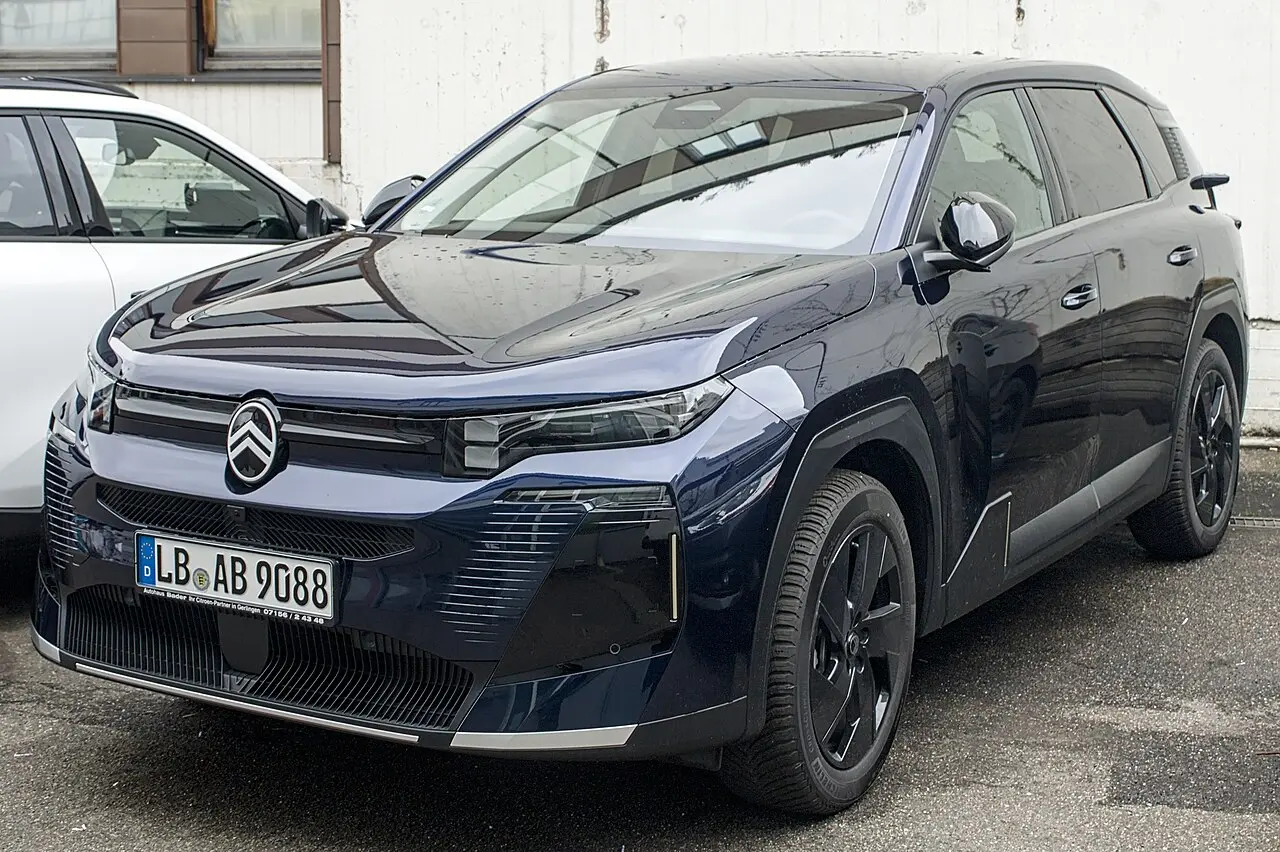
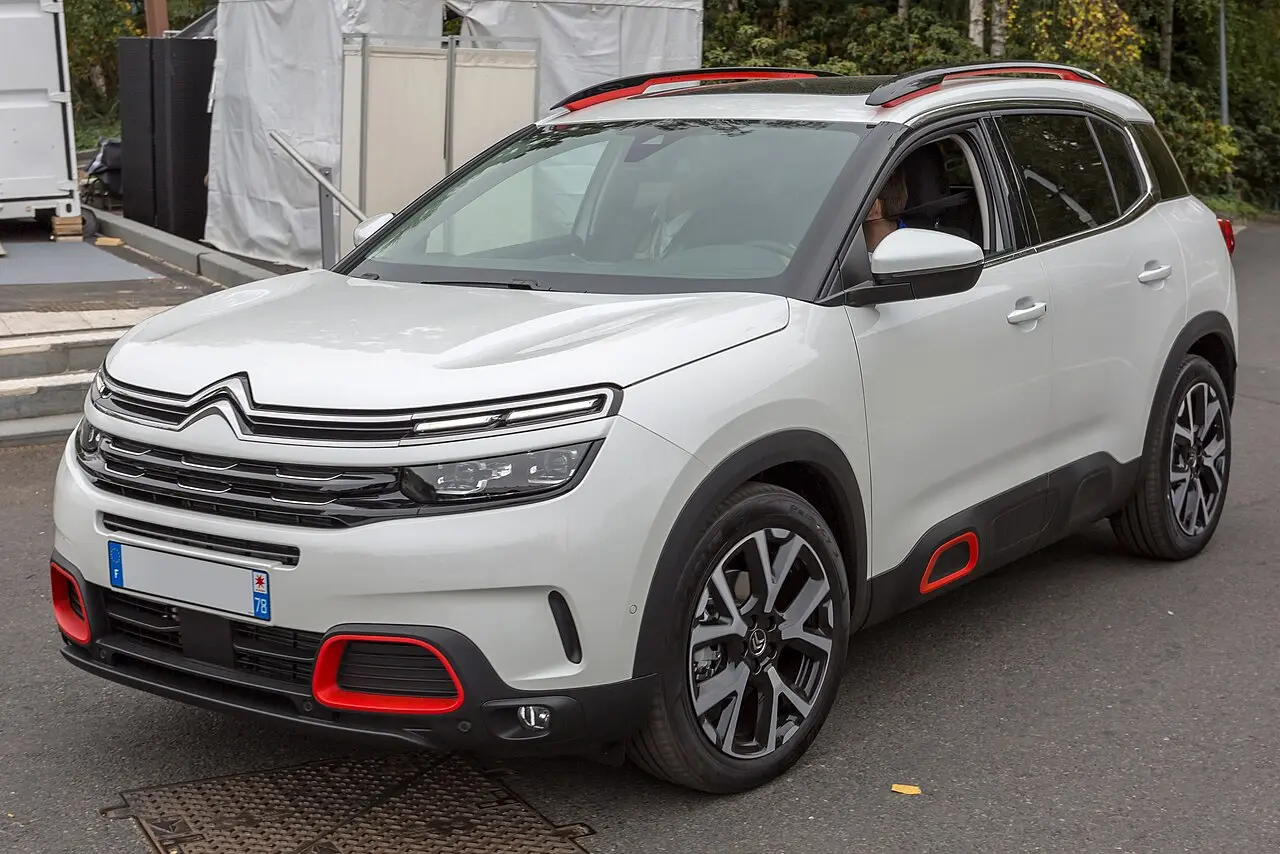
The official data lists 114 versions of the Citroën C5 Aircross (2018–2026), in the European Union, the United Kingdom, and France. Each market publishes its own figures, measured on its own test procedure.
At a glance
Years in the data
2018–2026
Markets
European Union, United Kingdom, France
Engines
1.2 L to 2.0 L
Power
96 kW (131 PS) to 170 kW (231 PS)
Fuels
Plug-in hybrid, Hybrid, Diesel, Electric, Petrol
Lowest consumption (European Union)
1.4 L/100 km (WLTP)
Lowest consumption (United Kingdom)
4.8 L/100 km (WLTP)
Plug-in hybrid, weighted (France)
1.3 L/100 km (WLTP)
Plug-in hybrid, weighted (European Union)
1.3 L/100 km (WLTP)
New registrations in the EU
517,793
What is the Citroën C5 Aircross?
The C5 Aircross is a family SUV with an upright shape and a choice of conventional and electrified powertrains. It brings Citroën’s focus on comfort to a roomy family car, with petrol, diesel, hybrid, plug-in hybrid and electric versions appearing across its European line-up.
The first generation ran from 2018 to 2025. The second began in 2025 on Stellantis’ STLA Medium platform, which supports hybrid and fully electric versions. The new generation keeps the model’s multi-energy approach while adding an all-electric option.
Engines and power
In EU registration figures from 2018 to 2025, engine sizes range from 1.2 to 2.0 litres and power from 96 kW (131 PS) to 170 kW (231 PS). Versions span petrol, diesel, hybrid, plug-in hybrid and electric. UK figures from 2019 to 2026 show the same engine-size range, with power reaching 181 kW (246 PS). France’s 2026 listing is a 1.6-litre plug-in hybrid rated at 133 kW (181 PS).
How economical is the Citroën C5 Aircross?
The lowest listed official consumption for petrol, diesel and hybrid versions is 1.4 L/100 km in the EU, on WLTP. Plug-in hybrids have a separate weighted figure: 1.3 L/100 km in the EU and France, and 5.9 L/100 km in the UK. These figures assume that part of the driving is electric, so they are not directly comparable with conventional-engine results.
The EU recorded 517,793 C5 Aircross registrations from 2018 to 2025. The 1.5-litre diesel rated at 96 kW (131 PS) was the most registered configuration in each of the listed years 2019, 2020 and 2021.
Where was the C5 Aircross sold?
The C5 Aircross appears in EU, UK and French listings. The EU and UK ranges include petrol, diesel, hybrid, plug-in hybrid and electric versions; France’s 2026 listing is a plug-in hybrid. European consumption figures use WLTP, though the years covered and the available versions differ by market.
Questions and answers
When did the C5 Aircross generations run?
The first generation ran from 2018 to 2025; the second began in 2025.
What is the lowest official plug-in hybrid consumption figure?
The lowest listed figure is 1.3 L/100 km on WLTP, in the EU and France. It is a weighted figure that assumes some driving is electric.
How much power does the C5 Aircross have?
EU listings give a range of 96–170 kW (131–231 PS); UK listings give 96–181 kW (131–246 PS).
Sold in: European Union, United Kingdom, and France · References: citroen.ie, largus.fr
European Union 10 versions
New cars registered in the EU (plus Norway and Iceland), from the European Environment Agency. Figures on the NEDC procedure until 2020 and on WLTP from 2021; versions are grouped by engine and power, with their number of registrations.
Years and version
Engine
Power
Fuel
Consumption (combined)
CO₂
Electric range
EU registrations
2025
1.2 L
100 kW (136 PS)
Hybrid
5.6 L/100 km WLTP
127 g/km
–
20,436
2025
1.5 L
96 kW (131 PS)
Diesel
5.5 L/100 km WLTP
144 g/km
–
17,735
2025
1.6 L
133 kW (181 PS)
Plug-in hybrid
1.4 L/100 km WLTP17.8 kWh/100 km WLTP
33 g/km
58 km
1,787
2025
Electric motor
157 kW (213 PS)
Electric
17.9 kWh/100 km WLTP
0 g/km
506 km
1,372
2025
1.2 L
96 kW (131 PS)
Petrol
6.3 L/100 km WLTP
141 g/km
–
687
2025
1.6 L
110 kW (150 PS)
Plug-in hybrid
2.3 L/100 km WLTP15.3 kWh/100 km WLTP
51 g/km
71 km
556
2025
Electric motor
104 kW (141 PS)
Electric
17.4 kWh/100 km WLTP
0 g/km
511 km
85
2025
Electric motor
170 kW (231 PS)
Electric
18.0 kWh/100 km WLTP
0 g/km
672 km
57
2025
1.2 L
100 kW (136 PS)
Plug-in hybrid
5.5 L/100 km WLTP
125 g/km
–
22
2025
1.2 L
100 kW (136 PS)
Petrol
5.7 L/100 km WLTP
128 g/km
–
20
United Kingdom 20 versions
New cars on sale in the UK, from the Vehicle Certification Agency. NEDC figures until 2018 and WLTP figures after; years are the editions a version appeared in.
Years and version
Engine
Power
Fuel
Gearbox
Consumption (combined)
CO₂
Electric range
2025–2026Electric 210 hp Comfort Range · Electric 210 hp Comfort Range (VL)
Electric motor
157 kW (213 PS)
Electric
Automatic
16.2 kWh/100 km WLTP
0 g/km
543 km
2025–2026Electric 210 hp Comfort Range · Electric 210 hp Comfort Range (VH)
Electric motor
157 kW (213 PS)
Electric
Automatic
21.3 kWh/100 km WLTP
0 g/km
412 km
2025–2026Electric 230 hp Long Range · Electric 230 hp Long Range (VL)
Electric motor
170 kW (231 PS)
Electric
Automatic
16.9 kWh/100 km WLTP
0 g/km
708 km
2025–2026Electric 230 hp Long Range · Electric 230 hp Long Range (VH)
Official figures are measured on standard test procedures and differ between markets. Your consumption depends on how, where and in what conditions you drive.