

Chevrolet Tahoe Fifth generation
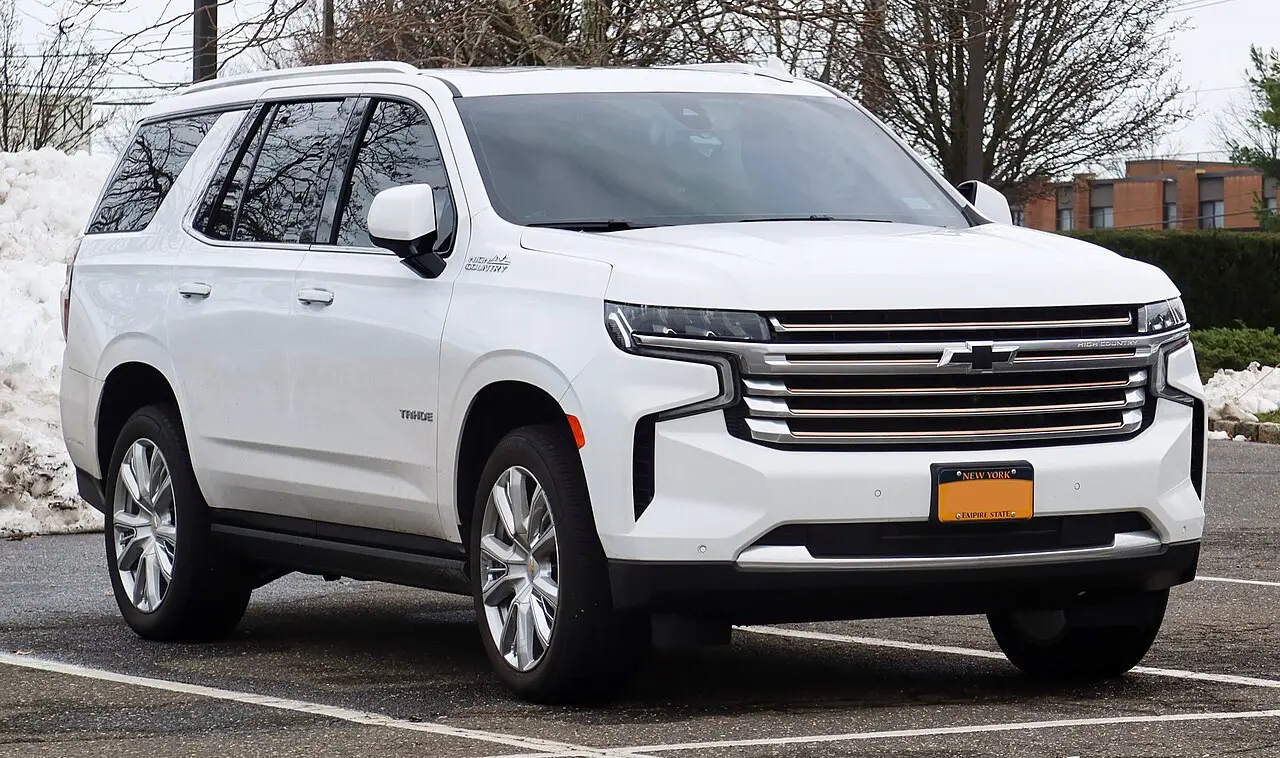
The Chevrolet Tahoe Fifth generation (since 2021): dimensions, weights, reliability and the official figures of its 20 versions in the European Union, the United States, and Canada.
Model codes: T1XX · Sold in: European Union, United States, and Canada
Dimensions, weights and capacity
| Specification | Europe | North America | Wikipedia |
|---|---|---|---|
| Dimensions | |||
| Length | 5,050–5,200 mm Traficom | 5,350 mm TC | 5,334–5,352 mm |
| Width | 2,070 mm Traficom | 2,060 mm TC | 2,060 mm |
| Height | 1,790–1,840 mm Traficom | 1,920 mm TC | 1,923 mm |
| Wheelbase | – | 3,070 mm TC | 3,071 mm |
| Front track | – | 1,740 mm TC | – |
| Rear track | – | 1,730 mm TC | – |
| Weights and towing | |||
| Kerb weight | – | 2,429–2,515 kg TC | 2,483 kg |
| Mass in running order | 2,450–2,520 kg Traficom | – | – |
| Gross vehicle weight | 3,085 kg Traficom | – | – |
| Seats and space | |||
| Seats | 5 Traficom | – | – |
| Doors | 4–5 Traficom | – | – |
NHTSA overall safety rating (US): 2021–2024: ★★★★☆ · 2025–2026: ★★★★★
Ranges cover the generation’s versions and body styles; European and North American versions can differ. Sources: Traficom type approvals (Finland), Transport Canada vehicle specifications, Wikipedia, NHTSA 5-Star Safety Ratings. Wikipedia figures are used under CC BY-SA 4.0.
Reliability and owner reports
Owner complaints to NHTSA (US)
1,014 complaints for model years 2021–2026. 17 crashes · 7 fires · 18 injuries
- Engine 487
- Transmission and drivetrain 184
- Fuel system 156
- Electrical system 150
- Brakes 73
- Driver assistance 50
Complaints are reported by owners and not checked by NHTSA; they are not adjusted for how many cars were sold, so popular models have more. NHTSA owner complaints
All 20 versions of the Chevrolet Tahoe Fifth generation
Show all 20 versions
European Union 5 versions
New cars registered in the EU (plus Norway and Iceland), from the European Environment Agency. Figures on the NEDC procedure until 2020 and on WLTP from 2021; versions are grouped by engine and power, with their number of registrations.
| Years and version | Engine | Power | Fuel | Consumption (combined) | CO₂ | EU registrations |
|---|---|---|---|---|---|---|
| 2024–2025 | 6.2 L | 313 kW (426 PS) | Petrol | 12.3–13.6 L/100 km WLTP | 323–342 g/km | 110 |
| 2024–2025 | 6.2 L | 313 kW (426 PS) | LPG | – | 296–309 g/km | 23 |
| 2024 | 6.2 L | 313 kW (426 PS) | Flex fuel (E85) | – | – | 18 |
| 2023–2024 | 5.3 L | 265 kW (360 PS) | Petrol | – | 335 g/km | 38 |
| 2021–2023 | 6.2 L | 313 kW (426 PS) | Petrol | – | 335–368 g/km | 62 |
United States 12 versions
Model years sold in the USA, from the EPA and the Department of Energy (fueleconomy.gov). MPG on the EPA test; litres per 100 km = 235.215 ÷ MPG.
| Years and version | Engine | Fuel | Gearbox | Drive | Consumption (combined) | CO₂ |
|---|---|---|---|---|---|---|
| 2021–2027 | 3.0 L | Diesel | 10-speed automatic | Rear-wheel drive | 24 MPG (9.8 L/100 km) EPA | 262–266 g/km |
| 2021–2027 | 3.0 L | Diesel | 10-speed automatic | Four-wheel drive | 22 MPG (10.7 L/100 km) EPA | 276–287 g/km |
| 2021–2027SIDI | 5.3 L | Petrol | 10-speed automatic | Rear-wheel drive | 17 MPG (13.8 L/100 km) EPA | 325–332 g/km |
| 2021–2027SIDI | 5.3 L | Petrol | 10-speed automatic | Four-wheel drive | 16–18 MPG (13.1–14.7 L/100 km) EPA | 308–355 g/km |
| 2021–2027SIDI | 6.2 L | Petrol | 10-speed automatic | Rear-wheel drive | 16–17 MPG (13.8–14.7 L/100 km) EPA | 325–345 g/km |
| 2021–2027SIDI | 6.2 L | Petrol | 10-speed automatic | Four-wheel drive | 16 MPG (14.7 L/100 km) EPA | 350–355 g/km |
| 2022–2024SIDI; Stop-Start · SIDI | 5.3 L | Petrol | 10-speed automatic | Rear-wheel drive | 17 MPG (13.8 L/100 km) EPA | 327 g/km |
| 2022–2024SIDI; Stop-Start · SIDI | 5.3 L | Petrol | 10-speed automatic | Four-wheel drive | 17 MPG (13.8 L/100 km) EPA | 327 g/km |
| 2023–2024SIDI; Municipal | 5.3 L | Petrol | 10-speed automatic | Four-wheel drive | 16 MPG (14.7 L/100 km) EPA | 352 g/km |
| 2021–2022SIDI; Stop-Start | 6.2 L | Petrol | 10-speed automatic | Rear-wheel drive | 16–17 MPG (13.8–14.7 L/100 km) EPA | 326–340 g/km |
| 2021–2022SIDI; Stop-Start | 6.2 L | Petrol | 10-speed automatic | Four-wheel drive | 16 MPG (14.7 L/100 km) EPA | 345–347 g/km |
| 2021SIDI; Stop-Start | 5.3 L | Petrol | 10-speed automatic | Rear-wheel drive | 18 MPG (13.1 L/100 km) EPA | 306 g/km |
Canada 3 versions
Model years sold in Canada, from Natural Resources Canada fuel consumption ratings (5-cycle test).
| Years and version | Engine | Fuel | Gearbox | Consumption (combined) | CO₂ |
|---|---|---|---|---|---|
| 2021–2026Sport utility vehicle: Standard | 3.0 L | Diesel | 10-speed automatic | 9.8–10.7 L/100 km 5-cycle | 263–287 g/km |
| 2021–2026Sport utility vehicle: Standard | 5.3 L | Petrol | 10-speed automatic | 13.2–15.1 L/100 km 5-cycle | 309–354 g/km |
| 2021–2026Sport utility vehicle: Standard | 6.2 L | Petrol | 10-speed automatic | 14.7–15.3 L/100 km 5-cycle | 345–357 g/km |
Similar models from other brands



Official figures are measured on standard test procedures and differ between markets. Your consumption depends on how, where and in what conditions you drive.