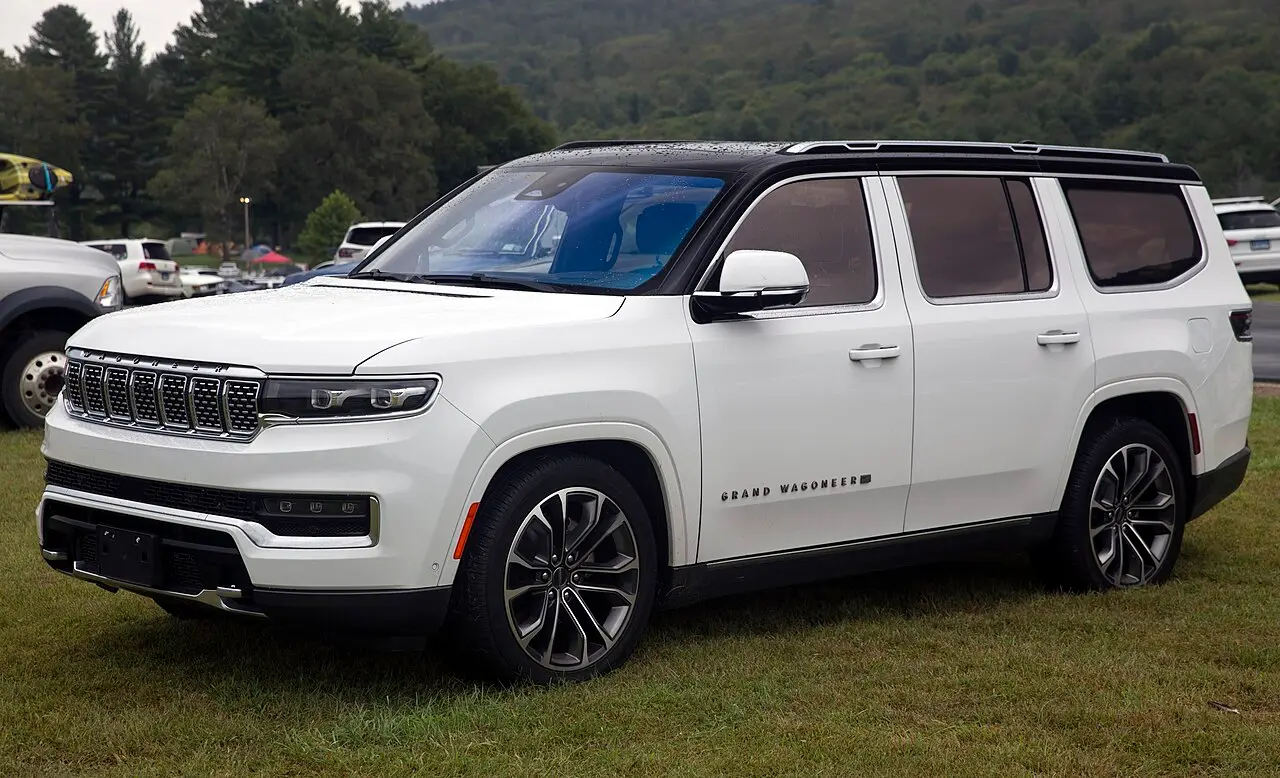
The official data lists 19 versions of the Jeep Grand Wagoneer (1984–2027), in the European Union, the United States, and Canada. Each market publishes its own figures, measured on its own test procedure.
At a glance
Years in the data
1984–2027
Markets
European Union, United States, Canada
Engines
3.0 L to 6.4 L
Fuels
Petrol
Lowest consumption (United States)
12.4 L/100 km (EPA)
Lowest consumption (Canada)
12.5 L/100 km (5-cycle)
New registrations in the EU
10
What is the Jeep Grand Wagoneer?
The Grand Wagoneer is Jeep’s full-size luxury SUV, positioned at the upper end of the brand’s range. The name links the modern model with the original Grand Wagoneer, a comfort-focused full-size SUV. The current WS generation brought the name back as a large, three-row SUV.
Generations and engines
The SJ generation ran from 1984 to 1991. Jeep marketed it as a full-size luxury SUV. The WS generation arrived in 2022, reviving the name with a modern design and a spacious cabin.
US and Canadian listings span petrol engines from 3.0 L to 6.4 L. EU registration figures include a 6.4 L petrol version rated at 351 kW (477 PS) in 2024.
Fuel consumption and markets
The best listed combined US rating is 19 MPG; the listed EPA consumption figure is 12.4 L/100 km. Canada’s lowest listed figure is 12.5 L/100 km on the NRCan 5-cycle test. EPA, Canadian 5-cycle and European WLTP or NEDC procedures differ, so these ratings are market-specific.
The original SJ generation was sold in the United States. The WS generation appears in US and Canadian figures, as well as EU registrations. US figures span 1984–2027, Canadian figures cover 2022–2026, and EU registrations include 2024.
Questions and answers
When did the Grand Wagoneer generations run?
The SJ ran from 1984 to 1991. The WS generation began in 2022.
What is the Grand Wagoneer’s best listed combined EPA rating?
The best listed US rating is 19 MPG combined.
What engines are listed for the modern Grand Wagoneer?
US and Canadian listings span 3.0 L to 6.4 L petrol engines.
Model codes: WS · Sold in: United States, Canada, and European Union · References: jeep.com, en.wikipedia.org
European Union 1 version
New cars registered in the EU (plus Norway and Iceland), from the European Environment Agency. Figures on the NEDC procedure until 2020 and on WLTP from 2021; versions are grouped by engine and power, with their number of registrations.
Years and version
Engine
Power
Fuel
CO₂
EU registrations
2024
6.4 L
351 kW (477 PS)
Petrol
417 g/km
10
United States 8 versions
Model years sold in the USA, from the EPA and the Department of Energy (fueleconomy.gov). MPG on the EPA test; litres per 100 km = 235.215 ÷ MPG.
Years and version
Engine
Fuel
Gearbox
Drive
Consumption (combined)
CO₂
2027SIDI
3.0 L
Petrol
8-speed automatic
Rear-wheel drive
19 MPG (12.4 L/100 km) EPA
291 g/km
2027SIDI
3.0 L
Petrol
8-speed automatic
All-wheel drive
18 MPG (13.1 L/100 km) EPA
301 g/km
2026SIDI
3.0 L
Petrol
8-speed automatic
Rear-wheel drive
19 MPG (12.4 L/100 km) EPA
283 g/km
2026SIDI
3.0 L
Petrol
8-speed automatic
All-wheel drive
19 MPG (12.4 L/100 km) EPA
293 g/km
2022–2025SIDI
3.0 L
Petrol
8-speed automatic
All-wheel drive
17 MPG (13.8 L/100 km) EPA
334 g/km
2022–2024
6.4 L
Petrol
8-speed automatic
All-wheel drive
15 MPG (15.7 L/100 km) EPA
374 g/km
2022SIDI
3.0 L
Petrol
8-speed automatic
Rear-wheel drive
17 MPG (13.8 L/100 km) EPA
324 g/km
2022
6.4 L
Petrol
8-speed automatic
Rear-wheel drive
15 MPG (15.7 L/100 km) EPA
370 g/km
Canada 3 versions
Model years sold in Canada, from Natural Resources Canada fuel consumption ratings (5-cycle test).
Official figures are measured on standard test procedures and differ between markets. Your consumption depends on how, where and in what conditions you drive.