

Chevrolet Blazer S-10 Blazer II
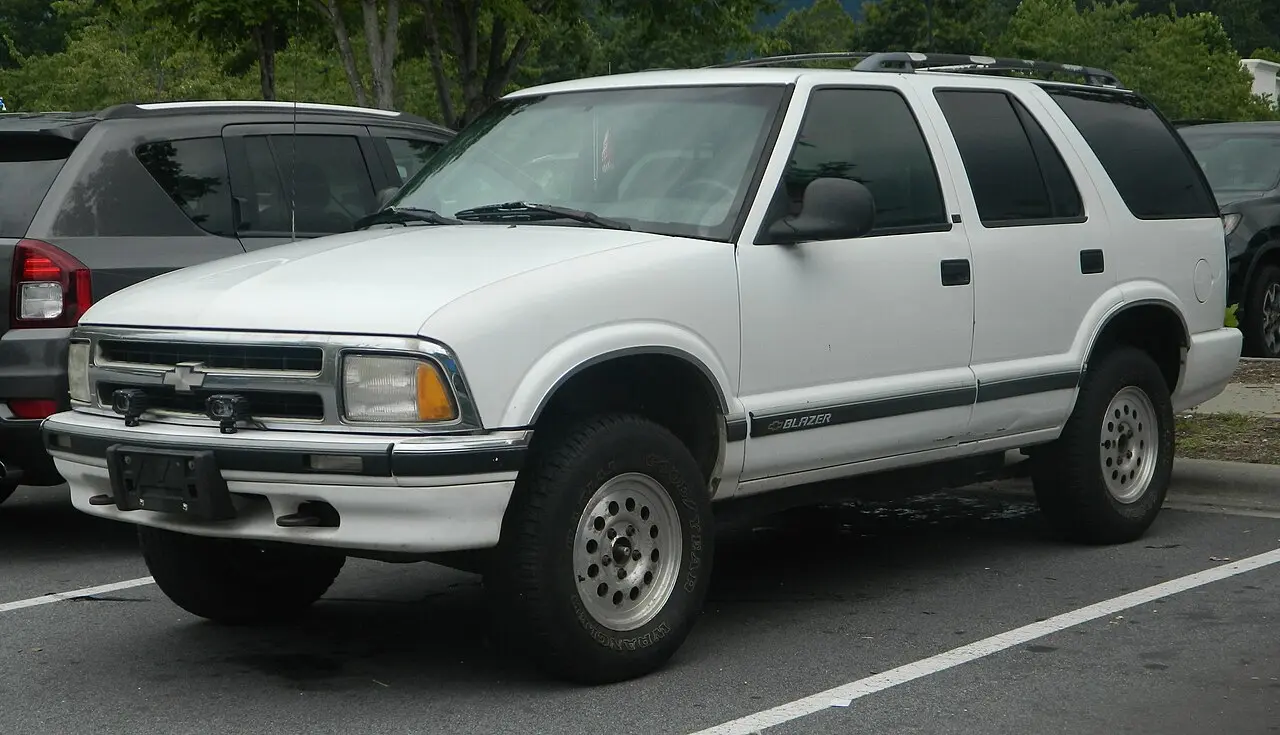
The Chevrolet Blazer S-10 Blazer II (1995–2005): dimensions, weights, reliability and the official figures of its 16 versions in the United Kingdom, the United States, and Canada.
Model codes: S-10 · Sold in: United States, Canada, and United Kingdom
Dimensions, weights and capacity
| Specification | Wikipedia |
|---|---|
| Dimensions | |
| Wheelbase | 2,553–2,718 mm |
Ranges cover the generation’s versions and body styles; European and North American versions can differ. Sources: Wikipedia. Wikipedia figures are used under CC BY-SA 4.0.
Reliability and owner reports
Owner complaints to NHTSA (US)
5,598 complaints for model years 1995–2005. 566 crashes · 130 fires · 411 injuries · 23 deaths
- Brakes 1,035
- Visibility and wipers 606
- Engine 319
- Transmission and drivetrain 297
- Suspension 275
- Airbags 180
Complaints are reported by owners and not checked by NHTSA; they are not adjusted for how many cars were sold, so popular models have more. NHTSA owner complaints
All 16 versions of the Chevrolet Blazer S-10 Blazer II
Show all 16 versions
United Kingdom 5 versions
New cars on sale in the UK, from the Vehicle Certification Agency. NEDC figures until 2018 and WLTP figures after; years are the editions a version appeared in.
| Years and version | Engine | Fuel | Gearbox | Consumption (combined) | CO₂ |
|---|---|---|---|---|---|
| 2001–20044.3L V6 | 4.3 L | Petrol | 5-speed manual | 14.0 L/100 km NEDC | 333 g/km |
| 2001–20044.3L V6 | 4.3 L | Petrol | 4-speed automatic | 14.0 L/100 km NEDC | 335 g/km |
| 20004.3I V6 LS | 4.3 L | Petrol | 5-speed manual | 14.3 L/100 km NEDC | 334 g/km |
| 20004.3I V6 LS | 4.3 L | Petrol | 4-speed automatic | 13.7 L/100 km NEDC | 319 g/km |
| 20004.3l V6 LT | 4.3 L | Petrol | 4-speed automatic | 14.8 L/100 km NEDC | 345 g/km |
United States 9 versions
Model years sold in the USA, from the EPA and the Department of Energy (fueleconomy.gov). MPG on the EPA test; litres per 100 km = 235.215 ÷ MPG.
| Years and version | Engine | Fuel | Gearbox | Drive | Consumption (combined) | CO₂ |
|---|---|---|---|---|---|---|
| 1998–2005CLKUP | 4.3 L | Petrol | 4-speed automatic | Rear-wheel drive | 16–17 MPG (13.8–14.7 L/100 km) EPA | 325–345 g/km |
| 1998–2005SIL | 4.3 L | Petrol | 5-speed manual | Rear-wheel drive | 16–18 MPG (13.1–14.7 L/100 km) EPA | 307–345 g/km |
| 1998–2005CLKUP | 4.3 L | Petrol | 4-speed automatic | Four- or all-wheel drive | 15–16 MPG (14.7–15.7 L/100 km) EPA | 345–368 g/km |
| 1998–2005SIL | 4.3 L | Petrol | 5-speed manual | Four- or all-wheel drive | 14–16 MPG (14.7–16.8 L/100 km) EPA | 345–394 g/km |
| 1995–1997(FFS) (MPFI), CLKUP | 4.3 L | Petrol | 4-speed automatic | Four- or all-wheel drive | 16 MPG (14.7 L/100 km) EPA | 345 g/km |
| 1996–1997(FFS) (MPFI), SIL | 4.3 L | Petrol | 5-speed manual | Four- or all-wheel drive | 17 MPG (13.8 L/100 km) EPA | 325 g/km |
| 1995–1997(FFS) (MPFI), CLKUP | 4.3 L | Petrol | 4-speed automatic | Rear-wheel drive | 17 MPG (13.8 L/100 km) EPA | 325 g/km |
| 1995–1997(FFS) (MPFI), SIL | 4.3 L | Petrol | 5-speed manual | Rear-wheel drive | 18–19 MPG (12.4–13.1 L/100 km) EPA | 291–307 g/km |
| 1995(FFS) (MPFI), SIL | 5.2 L | Petrol | 5-speed manual | Four- or all-wheel drive | 17 MPG (13.8 L/100 km) EPA | 325 g/km |
Canada 2 versions
Model years sold in Canada, from Natural Resources Canada fuel consumption ratings (5-cycle test).
| Years and version | Engine | Fuel | Gearbox | Consumption (combined) | CO₂ |
|---|---|---|---|---|---|
| 2000–2005Sport utility vehicle | 4.3 L | Petrol | 4-speed automatic | 13.6–17.2 L/100 km 5-cycle | 313–396 g/km |
| 2000–2005Sport utility vehicle | 4.3 L | Petrol | 5-speed manual | 14.2–17.6 L/100 km 5-cycle | 327–405 g/km |
Similar models from other brands




Official figures are measured on standard test procedures and differ between markets. Your consumption depends on how, where and in what conditions you drive.