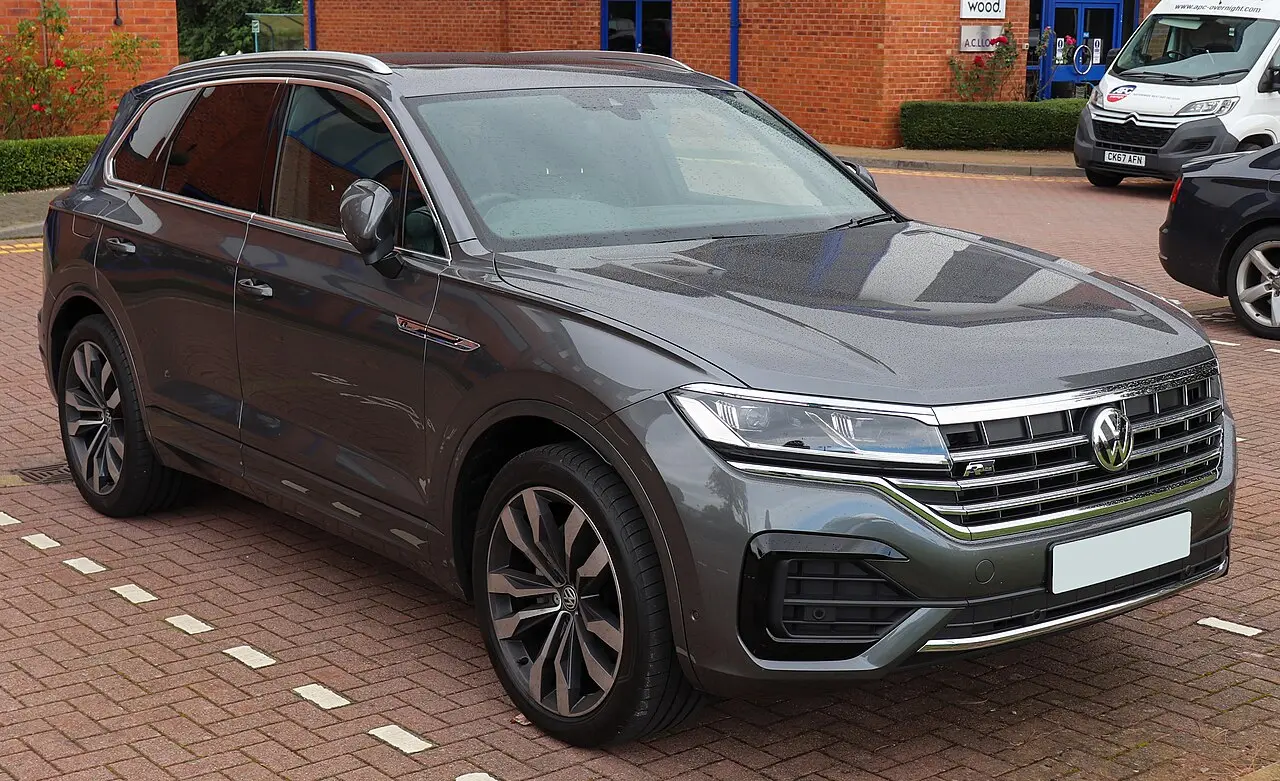
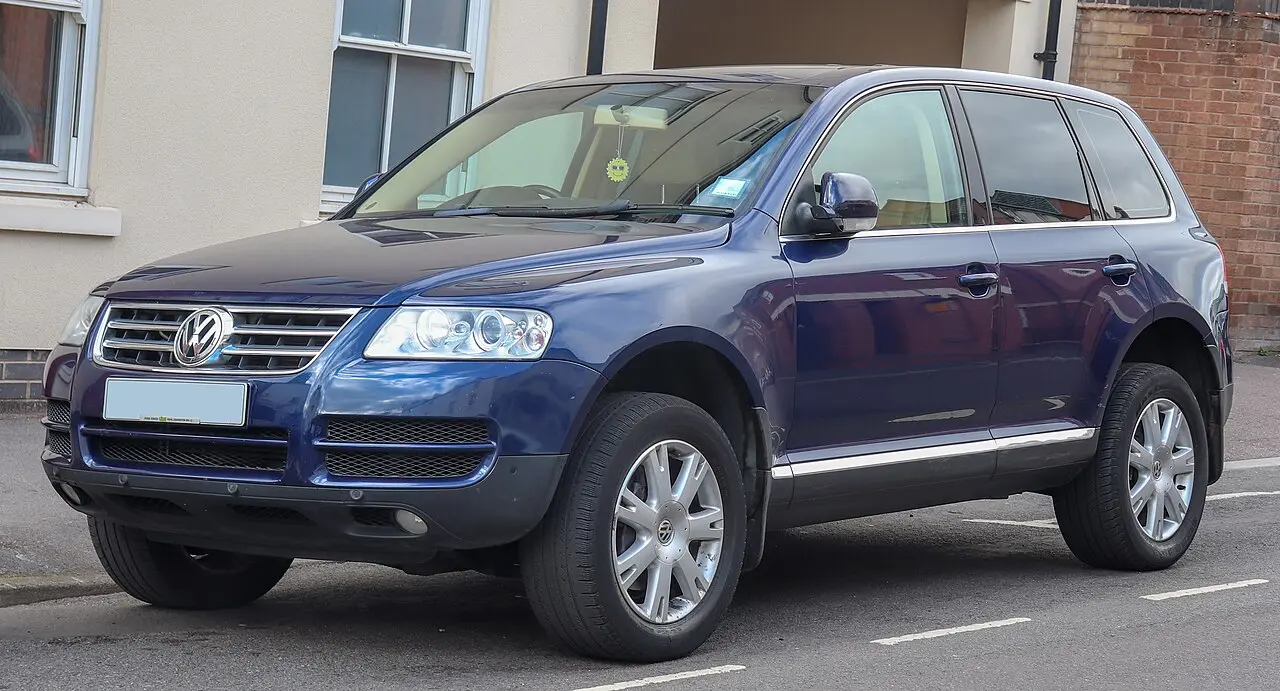
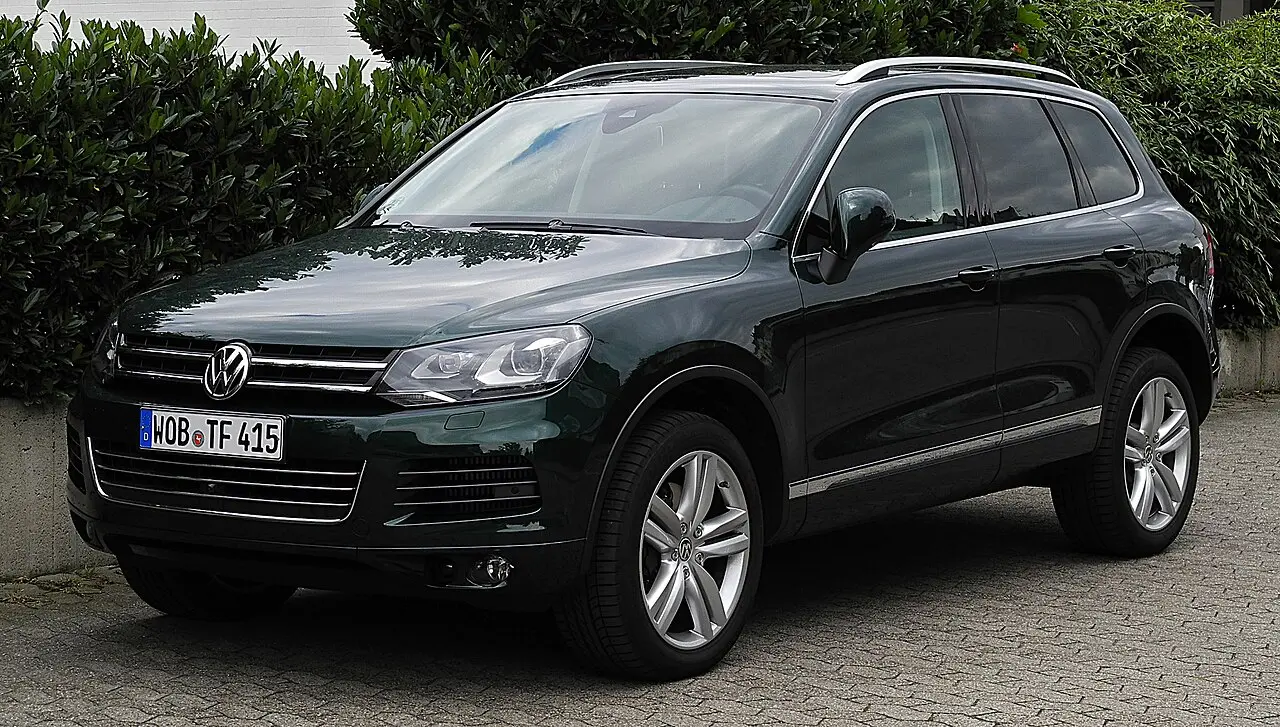
The official data lists 223 versions of the Volkswagen Touareg (2003–2026), in the European Union, the United Kingdom, France, the United States, and Canada. Each market publishes its own figures, measured on its own test procedure.
At a glance
Years in the data
2003–2026
Markets
European Union, United Kingdom, France, United States, Canada
Engines
2.5 L to 4.9 L
Power
85 kW (116 PS) to 310 kW (421 PS)
Fuels
Diesel, Hybrid, Petrol, Plug-in hybrid, Electric
Lowest consumption (France)
6.6 L/100 km (NEDC)
Lowest consumption (United Kingdom)
6.6 L/100 km (NEDC)
Lowest consumption (European Union)
8.0 L/100 km (WLTP)
Plug-in hybrid, weighted (European Union)
2.2 L/100 km (WLTP)
Plug-in hybrid, weighted (United Kingdom)
9.6 L/100 km (WLTP)
New registrations in the EU
441,331
What is the Volkswagen Touareg?
The Touareg is Volkswagen’s large SUV, with a cabin and road manners shaped for comfortable travel as well as the ability to handle rough terrain. Launched in 2002, it was Volkswagen’s first SUV and became the top model in the brand’s range.
The first generation paired comfort with off-road capability. The second generation, introduced in 2010, put more emphasis on comfort and brought Volkswagen’s first SUV hybrid. The third generation arrived in 2018 with digital cabin technology and the first plug-in hybrid in the Touareg line.
Generations, engines and power
Generation I ran from 2003 to 2010, generation II from 2010 to 2018, and generation III began in 2018.
EU registration figures for 2010–2025 span engines from 1.6 to 4.1 litres and power from 85 kW (116 PS) to 310 kW (421 PS). Listed fuel types include diesel, petrol, hybrid and plug-in hybrid. UK figures for 2003–2026 show 2.5- to 4.9-litre engines and 128 kW (174 PS) to 340 kW (462 PS). Among the leading EU entries are 3.0-litre diesels rated at 193 kW (262 PS) and 210 kW (286 PS).
Fuel consumption and CO₂
The lowest listed EU consumption for petrol, diesel and hybrid versions is 8 L/100 km on WLTP. For plug-in hybrids, the EU minimum is 2.2 L/100 km on WLTP, a weighted official figure that assumes some driving is electric. In the UK, the lowest listed figure for petrol, diesel and hybrid versions is 6.6 L/100 km on NEDC; the plug-in hybrid figure is 9.6 L/100 km on WLTP. The US minimum is 9.8 L/100 km on the EPA test, also listed as 24 MPG combined. Canada’s minimum is 9.8 L/100 km on NRCan’s 5-cycle test. WLTP and NEDC are European procedures, while the EPA and NRCan use different methods, so results across markets are not directly comparable.
Where was the Touareg sold?
EU registration figures for 2010–2025 total 441,331. The UK figures cover 2003–2026, the French figures 2012–2015, and the US and Canadian figures 2004–2017.
Questions and answers
When did each Touareg generation run?
Generation I ran from 2003 to 2010, generation II from 2010 to 2018, and generation III began in 2018.
What is the lowest listed EU consumption?
It is 2.2 L/100 km for plug-in hybrids on WLTP, a weighted figure that assumes some driving is electric. The listed minimum for petrol, diesel and hybrid versions is 8 L/100 km.
How do the US and Canadian figures compare?
Both markets list a lowest figure of 9.8 L/100 km. The US uses the EPA test, while Canada uses NRCan’s 5-cycle procedure, so the results are not directly comparable.
What power range is listed for EU versions?
The EU range for 2010–2025 runs from 85 kW (116 PS) to 310 kW (421 PS).
New cars registered in the EU (plus Norway and Iceland), from the European Environment Agency. Figures on the NEDC procedure until 2020 and on WLTP from 2021; versions are grouped by engine and power, with their number of registrations.
Years and version
Engine
Power
Fuel
Consumption (combined)
CO₂
Electric range
EU registrations
2025
3.0 L
210 kW (286 PS)
Diesel
8.4 L/100 km WLTP
220 g/km
–
5,191
2025
3.0 L
170 kW (231 PS)
Diesel
8.3 L/100 km WLTP
216 g/km
–
3,534
2025
3.0 L
250 kW (340 PS)
Plug-in hybrid
2.4 L/100 km WLTP24.9 kWh/100 km WLTP
56 g/km
49 km
2,242
2025
3.0 L
250 kW (340 PS)
Petrol
11.1 L/100 km WLTP
251 g/km
–
271
2025
3.0 L
250 kW (340 PS)
Hybrid
10.4 L/100 km WLTP
237 g/km
–
58
2024
3.0 L
210 kW (286 PS)
Diesel
8.3 L/100 km WLTP
219 g/km
–
4,937
2024
3.0 L
250 kW (340 PS)
Plug-in hybrid
2.3 L/100 km WLTP24.1 kWh/100 km WLTP
52 g/km
50 km
3,993
2024
3.0 L
170 kW (231 PS)
Diesel
8.1 L/100 km WLTP
216 g/km
–
3,290
2024
3.0 L
250 kW (340 PS)
Petrol
9.9 L/100 km WLTP
254 g/km
–
423
2024
3.0 L
183 kW (249 PS)
Diesel
–
238 g/km
–
70
2023
3.0 L
210 kW (286 PS)
Diesel
8.4 L/100 km WLTP
220 g/km
–
5,877
2023
3.0 L
250 kW (340 PS)
Plug-in hybrid
2.2 L/100 km WLTP23.8 kWh/100 km WLTP
53 g/km
51 km
2,918
2023
3.0 L
170 kW (231 PS)
Diesel
8.3 L/100 km WLTP
217 g/km
–
2,880
2023
3.0 L
250 kW (340 PS)
Petrol
11.3 L/100 km WLTP
260 g/km
–
361
2023
3.0 L
67 kW (91 PS)
Diesel
8.3 L/100 km WLTP
217 g/km
–
91
2023
3.0 L
110 kW (150 PS)
Diesel
8.3 L/100 km WLTP
217 g/km
–
42
2023
3.0 L
81 kW (110 PS)
Diesel
8.3 L/100 km WLTP
216 g/km
–
26
2023
2.0 L
195 kW (265 PS)
Petrol
–
280 g/km
–
19
2023
3.0 L
84 kW (114 PS)
Diesel
8.3 L/100 km WLTP
216 g/km
–
11
2023
3.0 L
70 kW (95 PS)
Diesel
8.3 L/100 km WLTP
216 g/km
–
10
2022
3.0 L
210 kW (286 PS)
Diesel
8.2 L/100 km WLTP
219 g/km
–
3,151
2022
3.0 L
170 kW (231 PS)
Diesel
8.0 L/100 km WLTP
216 g/km
–
2,749
2022
3.0 L
250 kW (340 PS)
Plug-in hybrid
2.3 L/100 km WLTP23.6 kWh/100 km WLTP
58 g/km
56 km
1,142
2022
3.0 L
250 kW (340 PS)
Petrol
11.1 L/100 km WLTP
256 g/km
–
914
2021
3.0 L
210 kW (286 PS)
Diesel
8.3 L/100 km WLTP
220 g/km
–
7,916
2021
3.0 L
170 kW (231 PS)
Diesel
8.0 L/100 km WLTP
217 g/km
–
6,130
2021
3.0 L
250 kW (340 PS)
Plug-in hybrid
4.0 L/100 km WLTP24.3 kWh/100 km WLTP
66 g/km
51 km
5,644
2021
3.0 L
250 kW (340 PS)
Petrol
10.3 L/100 km WLTP24.4 kWh/100 km WLTP
176 g/km
46 km
1,110
2021
4.0 L
310 kW (421 PS)
Diesel
9.4 L/100 km WLTP
247 g/km
–
502
2021
3.0 L
250 kW (340 PS)
Hybrid
24.6 kWh/100 km WLTP
64 g/km
46 km
30
2021
2.0 L
195 kW (265 PS)
Petrol
–
–
–
14
2020
3.0 L
210 kW (286 PS)
Diesel
–
174 g/km
–
13,439
2020
3.0 L
170 kW (231 PS)
Diesel
–
174 g/km
–
6,754
2020
4.0 L
310 kW (421 PS)
Diesel
–
195 g/km
–
2,760
2020
3.0 L
250 kW (340 PS)
Plug-in hybrid
24.6 kWh/100 km NEDC
73 g/km
53 km
2,197
2020
3.0 L
250 kW (340 PS)
Petrol
–
206 g/km
–
1,396
2020
3.0 L
85 kW (116 PS)
Diesel
–
176 g/km
–
1,338
2020
3.0 L
85 kW (116 PS)
Petrol
–
103 g/km
–
57
2020
3.0 L
85 kW (116 PS)
Plug-in hybrid
–
63 g/km
–
41
2020
4.0 L
85 kW (116 PS)
Diesel
–
195 g/km
–
40
2020
2.0 L
185 kW (252 PS)
Plug-in hybrid
–
221 g/km
–
26
2020
3.0 L
280 kW (381 PS)
Plug-in hybrid
24.3 kWh/100 km WLTP
239 g/km
57 km
20
2020
3.0 L
340 kW (462 PS)
Plug-in hybrid
24.7 kWh/100 km WLTP
240 g/km
56 km
14
2020
2.0 L
180 kW (245 PS)
Petrol
–
274 g/km
–
10
2019
3.0 L
210 kW (286 PS)
Diesel
14.8 kWh/100 km NEDC
173 g/km
–
31,790
2019
3.0 L
170 kW (231 PS)
Diesel
–
173 g/km
–
14,070
2019
4.0 L
310 kW (421 PS)
Diesel
–
195 g/km
–
2,728
2019
3.0 L
250 kW (340 PS)
Petrol
–
208 g/km
–
1,396
2019
1.6 L
–
Diesel
–
104 g/km
–
800
2019
2.0 L
185 kW (252 PS)
Plug-in hybrid
–
216 g/km
–
94
2019
3.0 L
250 kW (340 PS)
Plug-in hybrid
–
227 g/km
–
74
2019
2.0 L
180 kW (245 PS)
Petrol
–
295 g/km
–
30
2019
3.0 L
110 kW (150 PS)
Diesel
–
173 g/km
–
20
2019
3.0 L
193 kW (262 PS)
Diesel
–
179 g/km
–
14
2019
2.0 L
180 kW (245 PS)
Plug-in hybrid
–
216 g/km
–
12
2018
3.0 L
210 kW (286 PS)
Diesel
–
175 g/km
–
21,410
2018
3.0 L
193 kW (262 PS)
Diesel
–
180 g/km
–
3,944
2018
3.0 L
170 kW (231 PS)
Diesel
–
173 g/km
–
2,576
2018
3.0 L
150 kW (204 PS)
Diesel
–
176 g/km
–
1,442
United Kingdom 7 versions
New cars on sale in the UK, from the Vehicle Certification Agency. NEDC figures until 2018 and WLTP figures after; years are the editions a version appeared in.
Official figures are measured on standard test procedures and differ between markets. Your consumption depends on how, where and in what conditions you drive.