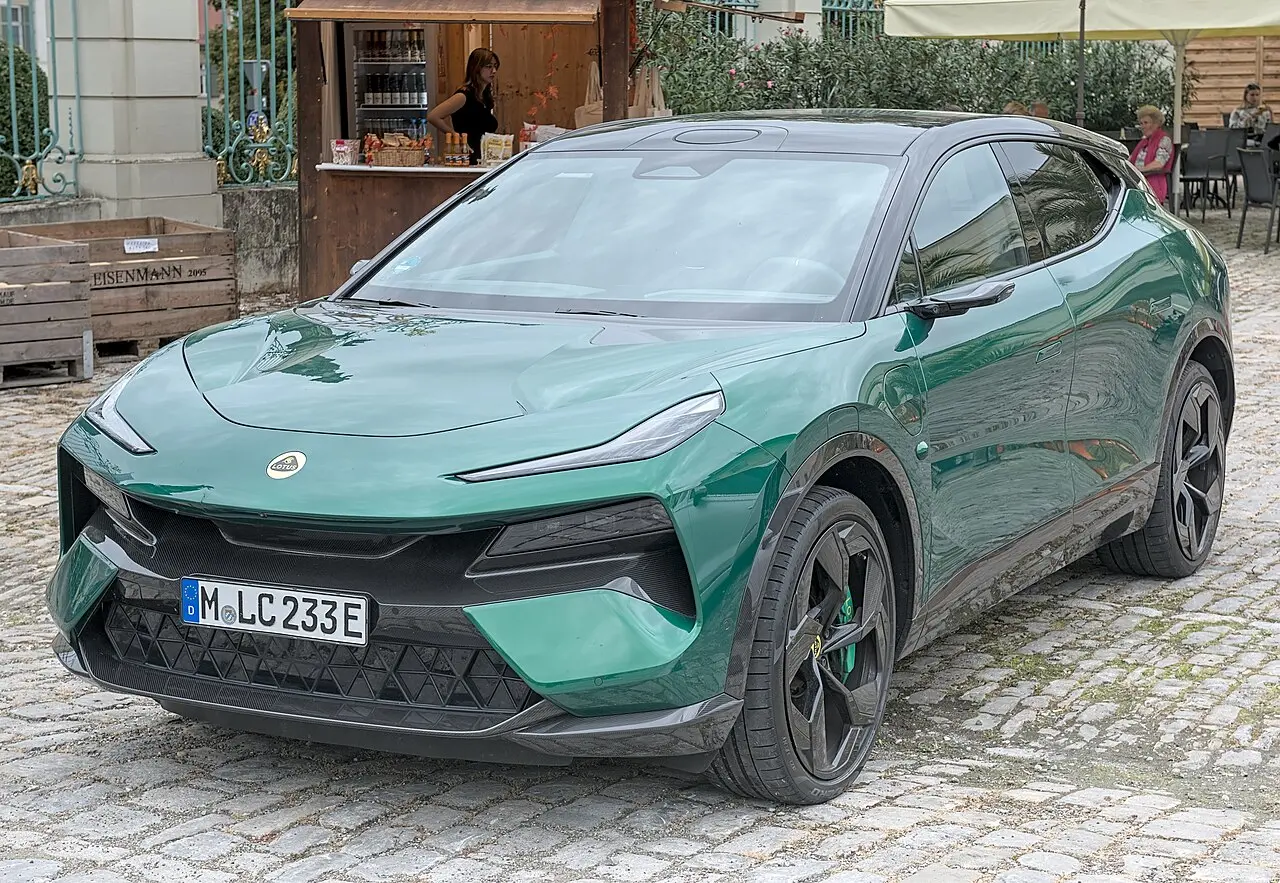
The official data lists 9 versions of the Lotus Eletre (2023 - 2026), in the European Union, the United Kingdom, and Canada. Each market publishes its own figures, measured on its own test procedure.
At a glance
Years in the data
2023 - 2026
Markets
European Union, United Kingdom, Canada
Power
450 kW (612 PS) to 675 kW (918 PS)
Fuels
Electric
New registrations in the EU
2,152
What is the Lotus Eletre?
The Eletre is a large, fully electric SUV that takes Lotus into a roomier format than its traditional sports cars. It brings the brand’s sporting design approach to a vehicle suited to everyday journeys and carrying passengers or luggage. Lotus introduced it as its first electric SUV.
Founded by Colin Chapman, Lotus built its identity around sports cars and motorsport. The Eletre extends that history into an electric SUV.
Generations and design
The first-generation Eletre, known internally as Type 132, dates from 2023 and continues today. Its sculpted body and aerodynamic details give it a purposeful profile.
Engines and power
Every Eletre in the listed markets is electric. In the European Union, official registration figures cover outputs from 450 kW (612 PS) to 675 kW (918 PS). UK and Canadian figures cover versions from 450 kW (612 PS) to 675 kW (918 PS). The 450 kW (612 PS) version leads EU registrations in each of the years shown.
Where was the Eletre sold?
The Eletre appears in European Union (EEA) registration figures from 2023 to 2025, in UK VCA figures for 2026, and in Canadian NRCan figures for 2026. EU registrations total 2,152 cars over the years shown. These are the years covered by each market’s official figures.
Questions and answers
Is the Lotus Eletre fully electric?
Yes. The Eletre versions listed for the EU, UK and Canada are electric.
How much power does the Eletre have?
The EU range is 450 kW (612 PS) to 675 kW (918 PS). UK and Canadian figures start at 450 kW (612 PS).
When did the first Eletre generation begin?
The Type 132 first generation dates from 2023 and continues today.
New cars registered in the EU (plus Norway and Iceland), from the European Environment Agency. Figures on the NEDC procedure until 2020 and on WLTP from 2021; versions are grouped by engine and power, with their number of registrations.
Years and version
Engine
Power
Fuel
Consumption (combined)
CO₂
Electric range
EU registrations
2023 - 2025
Electric motor
450 kW (612 PS)
Electric
23.3 - 24.1 kWh/100 km WLTP
0 g/km
531 - 540 km
1,556
2023 - 2025
Electric motor
675 kW (918 PS)
Electric
28.4 - 30.6 kWh/100 km WLTP
0 g/km
428 - 440 km
298
2023 - 2025
Electric motor
Not listed
Electric
23.5 - 35.9 kWh/100 km WLTP
0 g/km
435 - 539 km
298
United Kingdom 4 versions
New cars on sale in the UK, from the Vehicle Certification Agency. NEDC figures until 2018 and WLTP figures after; years are the editions a version appeared in.
Years and version
Engine
Power
Fuel
Gearbox
Consumption (combined)
CO₂
Electric range
2026600
Electric motor
450 kW (612 PS)
Electric
Automatic
21.4 kWh/100 km WLTP
0 g/km
600 km
2026600 GT · 600 GT SE
Electric motor
450 kW (612 PS)
Electric
Automatic
23.9 kWh/100 km WLTP
0 g/km
535 km
2026600 Sport SE
Electric motor
450 kW (612 PS)
Electric
Automatic
24.1 kWh/100 km WLTP
0 g/km
530 km
2026900 Sport · 900 Sport Carbon
Electric motor
675 kW (918 PS)
Electric
2-speed automatic
25.4 kWh/100 km WLTP
0 g/km
500 km
Canada 2 versions
Model years sold in Canada, from Natural Resources Canada fuel consumption ratings (5-cycle test).
Official figures are measured on standard test procedures and differ between markets. Your consumption depends on how, where and in what conditions you drive.