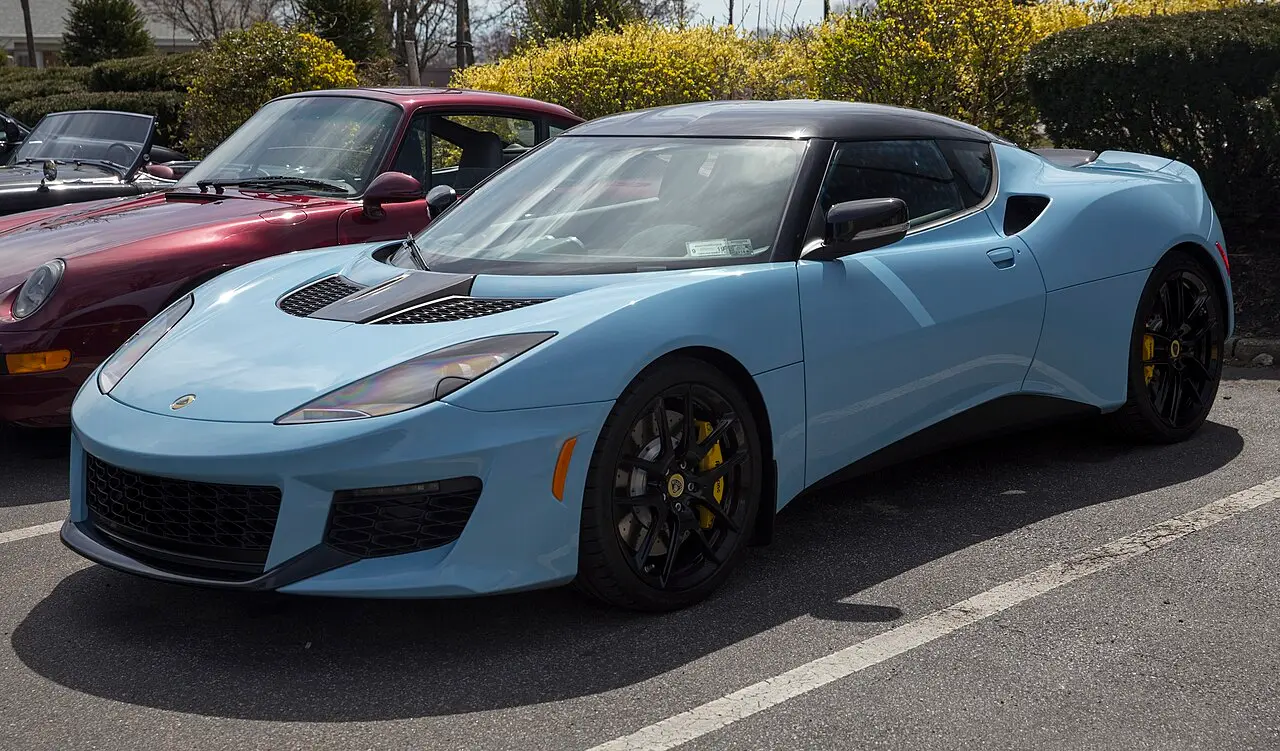
The official data lists 75 versions of the Lotus Evora (2010–2026), in the European Union, the United Kingdom, France, and the United States. Each market publishes its own figures, measured on its own test procedure.
At a glance
Years in the data
2010–2026
Markets
European Union, United Kingdom, France, United States
Engines
3.5 L to 3.5 L
Power
206 kW (280 PS) to 416 kW (566 PS)
Fuels
Petrol
Lowest consumption (United Kingdom)
8.7 L/100 km (NEDC)
Lowest consumption (France)
9.0 L/100 km (NEDC)
Lowest consumption (United States)
10.2 L/100 km (EPA)
New registrations in the EU
3,087
What is the Lotus Evora?
The Evora is a mid-engined sports car with two main seats and a pair of smaller rear seats. It brought a more touring-friendly feel to the Lotus range while retaining the brand’s emphasis on responsive handling. Its aluminium chassis shared bonded technology pioneered on the Elise.
Launched in 2008 and on sale the following year, the Evora introduced a sleeker design and a cabin intended to make the car more usable on longer journeys. The model remained in production through 2021.
Evora generation
The Evora had one generation, sold from 2009 to 2021. It began with a naturally aspirated V6. The supercharged Evora S followed, and later updates such as the Evora 400 brought more power and revised body and chassis components.
Engines, power and fuel consumption
EU figures for 2010–2021 show a 3.5 L petrol engine, with listed power from 206 kW (280 PS) to 306 kW (416 PS). The period includes 3,087 EU registrations. The most registered listed version was the 3.5 L petrol with 258 kW (351 PS) in 2011, with 492 registrations.
UK VCA figures span 2012–2026 and show 3.5 L petrol versions from 306 kW (416 PS) to 416 kW (566 PS); the lowest listed consumption is 8.7 L/100 km on NEDC. France’s ADEME figures for 2013–2014 show power from 206 kW (280 PS) to 258 kW (350 PS), with a lowest listed result of 9 L/100 km on NEDC. US EPA figures span 2010–2021: the best combined result is 23 MPG, with a listed low of 10.2 L/100 km. NEDC is a European test procedure; the EPA uses a different procedure, so their results are not directly comparable.
Where was the Evora sold?
The Evora was sold in Europe, the UK, France and the United States. EU registration figures span 2010–2021, UK VCA figures 2012–2026, French ADEME figures 2013–2014 and US EPA figures 2010–2021.
Questions and answers
How many seats does the Lotus Evora have?
It is a two-plus-two sports car, with two main seats and a pair of smaller rear seats.
What engine does the Evora use?
The listed versions use a 3.5 L petrol engine. EU power figures range from 206 kW (280 PS) to 306 kW (416 PS).
What is the Evora’s lowest listed fuel consumption?
The UK VCA figure is 8.7 L/100 km on NEDC. The US EPA best combined result is 23 MPG, measured under a different procedure.
When was the Evora sold?
Its generation ran from 2009 to 2021. EU registration and US EPA figures both span 2010–2021.
New cars registered in the EU (plus Norway and Iceland), from the European Environment Agency. Figures on the NEDC procedure until 2020 and on WLTP from 2021; versions are grouped by engine and power, with their number of registrations.
Years and version
Engine
Power
Fuel
Consumption (combined)
CO₂
EU registrations
2021
3.5 L
306 kW (416 PS)
Petrol
10.7 L/100 km WLTP
245 g/km
26
2020
3.5 L
306 kW (416 PS)
Petrol
–
242 g/km
56
2019
3.5 L
306 kW (416 PS)
Petrol
–
229 g/km
170
2019
3.5 L
298 kW (405 PS)
Petrol
–
229 g/km
20
2019
3.5 L
321 kW (436 PS)
Petrol
–
234 g/km
10
2018
3.5 L
298 kW (405 PS)
Petrol
–
229 g/km
216
2018
3.5 L
306 kW (416 PS)
Petrol
–
225 g/km
34
2018
3.5 L
321 kW (436 PS)
Petrol
–
236 g/km
18
2017
3.5 L
306 kW (416 PS)
Petrol
–
229 g/km
130
2017
3.5 L
298 kW (405 PS)
Other fuel
–
229 g/km
96
2016
3.5 L
298 kW (405 PS)
Petrol
–
229 g/km
366
2015
3.5 L
258 kW (351 PS)
Petrol
–
224 g/km
222
2015
3.5 L
206 kW (280 PS)
Petrol
–
210 g/km
26
2015
3.5 L
298 kW (405 PS)
Petrol
–
225 g/km
26
2015
3.5 L
257 kW (349 PS)
Petrol
–
227 g/km
24
2014
3.5 L
258 kW (351 PS)
Petrol
–
225 g/km
160
2014
3.5 L
206 kW (280 PS)
Petrol
–
216 g/km
16
2013
3.5 L
258 kW (351 PS)
Petrol
–
226 g/km
226
2013
3.5 L
257 kW (349 PS)
Petrol
–
227 g/km
12
2012
3.5 L
258 kW (351 PS)
Petrol
–
228 g/km
193
2012
3.5 L
206 kW (280 PS)
Petrol
–
210 g/km
20
2011
3.5 L
258 kW (351 PS)
Petrol
–
236 g/km
492
2011
3.5 L
206 kW (280 PS)
Petrol
–
208 g/km
60
2010
3.5 L
–
Petrol
–
212 g/km
468
United Kingdom 21 versions
New cars on sale in the UK, from the Vehicle Certification Agency. NEDC figures until 2018 and WLTP figures after; years are the editions a version appeared in.
Years and version
Engine
Power
Fuel
Gearbox
Consumption (combined)
CO₂
2020–2023GT410
3.5 L
306 kW (416 PS)
Petrol
6-speed automatic
11.0 L/100 km WLTP
248 g/km
2020–2023GT410
3.5 L
306 kW (416 PS)
Petrol
6-speed manual
10.9 L/100 km WLTP
245 g/km
2019Sport 410
3.5 L
306 kW (416 PS)
Petrol
6-speed automatic
11.0 L/100 km WLTP
–
2019Sport 410
3.5 L
306 kW (416 PS)
Petrol
6-speed manual
10.6 L/100 km WLTP
–
2019430
3.5 L
321 kW (436 PS)
Petrol
6-speed automatic
11.0 L/100 km WLTP
–
2019430
3.5 L
321 kW (436 PS)
Petrol
6-speed manual
10.6 L/100 km WLTP
–
2017–2018Evora 400 · Evora Sport 410
3.5 L
–
Petrol
6-speed manual
9.7 L/100 km NEDC
225 g/km
2017–2018Evora 400 Auto
3.5 L
–
Petrol
6-speed automatic
9.9 L/100 km NEDC
230 g/km
2017–2018Evora Sport 410 Auto
3.5 L
–
Petrol
6-speed automatic
10.0 L/100 km NEDC
232 g/km
2015Evora
3.5 L
–
Petrol
6-speed manual
9.3 L/100 km NEDC
217 g/km
2015Evora IPS Auto Gearbox
3.5 L
–
Petrol
6-speed automatic
9.0 L/100 km NEDC
210 g/km
2015Evora S 19" wheels
3.5 L
–
Petrol
6-speed manual
9.9 L/100 km NEDC
229 g/km
2015Evora S 20" wheels
3.5 L
–
Petrol
6-speed manual
9.9 L/100 km NEDC
229 g/km
2015Evora S IPS Auto Gearbox
3.5 L
–
Petrol
6-speed automatic
9.7 L/100 km NEDC
224 g/km
2013–2014Evora
3.5 L
–
Petrol
Manual
9.3 L/100 km NEDC
217 g/km
2013–2014Evora IPS Auto Gearbox
3.5 L
–
Petrol
Automatic
9.0 L/100 km NEDC
210 g/km
2013–2014Evora S (19" wheels) · Evora S 19" wheels
3.5 L
–
Petrol
Manual
9.9 L/100 km NEDC
229 g/km
2013–2014Evora S (20" wheels) · Evora S 20" wheels
3.5 L
–
Petrol
Manual
9.9 L/100 km NEDC
229 g/km
2013–2014Evora S IPS Auto Gearbox
3.5 L
–
Petrol
Automatic
9.7 L/100 km NEDC
224 g/km
2012Evora Sport Gearbox
3.5 L
–
Petrol
6-speed manual
9.5 L/100 km NEDC
224 g/km
2012Evora Standard Gearbox
3.5 L
–
Petrol
6-speed manual
8.7 L/100 km NEDC
205 g/km
France 10 versions
New cars on sale in France, from ADEME Car Labelling. NEDC figures until 2015, WLTP figures in the current catalogue.
Years and version
Engine
Power
Fuel
Gearbox
Consumption (combined)
CO₂
2014Evora (2+0) · Evora (2+2)
–
206 kW (280 PS)
Petrol
6-speed manual
9.3 L/100 km NEDC
217 g/km
2014Evora (IPS) (2+0) · Evora (IPS) (2+2)
–
206 kW (280 PS)
Petrol
6-speed automatic
9.0 L/100 km NEDC
210 g/km
2014Evora S (2+0) · Evora S (2+2)
–
258 kW (350 PS)
Petrol
6-speed manual
9.9 L/100 km NEDC
229 g/km
2014Evora S (2+0) · Evora S (2+2)
–
258 kW (350 PS)
Petrol
6-speed manual
9.9 L/100 km NEDC
229 g/km
2014Evora S (IPS) (2+0) · Evora S (IPS) (2+2)
–
258 kW (350 PS)
Petrol
6-speed automatic
9.7 L/100 km NEDC
224 g/km
2013Evora (2+0) · Evora (2+2)
–
206 kW (280 PS)
Petrol
6-speed manual
9.3 L/100 km NEDC
217 g/km
2013Evora (IPS) (2+0) · Evora (IPS) (2+2)
–
206 kW (280 PS)
Petrol
6-speed automatic
9.0 L/100 km NEDC
210 g/km
2013Evora S (2+0) · Evora S (2+2)
–
258 kW (350 PS)
Petrol
6-speed manual
9.9 L/100 km NEDC
229 g/km
2013Evora S (2+0) · Evora S (2+2)
–
258 kW (350 PS)
Petrol
6-speed manual
9.9 L/100 km NEDC
229 g/km
2013Evora S (IPS) (2+0) · Evora S (IPS) (2+2)
–
258 kW (350 PS)
Petrol
6-speed automatic
9.7 L/100 km NEDC
224 g/km
United States 16 versions
Model years sold in the USA, from the EPA and the Department of Energy (fueleconomy.gov). MPG on the EPA test; litres per 100 km = 235.215 ÷ MPG.
Years and version
Engine
Fuel
Gearbox
Drive
Consumption (combined)
CO₂
2020–2021
3.5 L
Petrol
6-speed manual
Rear-wheel drive
20 MPG (11.8 L/100 km) EPA
274 g/km
2020–2021
3.5 L
Petrol
6-speed automatic
Rear-wheel drive
20 MPG (11.8 L/100 km) EPA
272 g/km
2020
3.5 L
Petrol
6-speed manual
Rear-wheel drive
19 MPG (12.4 L/100 km) EPA
291 g/km
2020
3.5 L
Petrol
6-speed automatic
Rear-wheel drive
20 MPG (11.8 L/100 km) EPA
280 g/km
2017–2018
3.5 L
Petrol
6-speed manual
Rear-wheel drive
19 MPG (12.4 L/100 km) EPA
291 g/km
2017–2018
3.5 L
Petrol
6-speed automatic
Rear-wheel drive
20 MPG (11.8 L/100 km) EPA
280 g/km
2013–2014
3.5 L
Petrol
6-speed manual
Rear-wheel drive
21 MPG (11.2 L/100 km) EPA
261 g/km
2013–2014
3.5 L
Petrol
6-speed manual
Rear-wheel drive
20 MPG (11.8 L/100 km) EPA
269 g/km
2013–2014
3.5 L
Petrol
6-speed automatic
Rear-wheel drive
22 MPG (10.7 L/100 km) EPA
250 g/km
2014
3.5 L
Petrol
6-speed automatic
Rear-wheel drive
22 MPG (10.7 L/100 km) EPA
246 g/km
2013
3.5 L
Petrol
6-speed automatic
Rear-wheel drive
23 MPG (10.2 L/100 km) EPA
242 g/km
2011–2012
3.5 L
Petrol
6-speed manual
Rear-wheel drive
21 MPG (11.2 L/100 km) EPA
263 g/km
2011–2012
3.5 L
Petrol
6-speed manual
Rear-wheel drive
20 MPG (11.8 L/100 km) EPA
276 g/km
2011–2012
3.5 L
Petrol
6-speed automatic
Rear-wheel drive
23 MPG (10.2 L/100 km) EPA
240 g/km
2012
3.5 L
Petrol
6-speed automatic
Rear-wheel drive
22 MPG (10.7 L/100 km) EPA
251 g/km
2010–2011
3.5 L
Petrol
6-speed manual
Rear-wheel drive
21 MPG (11.2 L/100 km) EPA
263 g/km
Versions outside these generations
United Kingdom 4 versions
New cars on sale in the UK, from the Vehicle Certification Agency. NEDC figures until 2018 and WLTP figures after; years are the editions a version appeared in.
Years and version
Engine
Power
Fuel
Gearbox
Consumption (combined)
CO₂
2025–2026GT410
3.5 L
306 kW (416 PS)
Petrol
6-speed automatic
11.0 L/100 km WLTP
248 g/km
2025–2026GT410
3.5 L
306 kW (416 PS)
Petrol
6-speed manual
10.9 L/100 km WLTP
245 g/km
2024GT410
3.5 L
416 kW (566 PS)
Petrol
6-speed manual
10.9 L/100 km WLTP
245 g/km
2024GT410
3.5 L
416 kW (566 PS)
Petrol
6-speed automatic
11.0 L/100 km WLTP
248 g/km
Official figures are measured on standard test procedures and differ between markets. Your consumption depends on how, where and in what conditions you drive.