

Volvo EX30 first generation
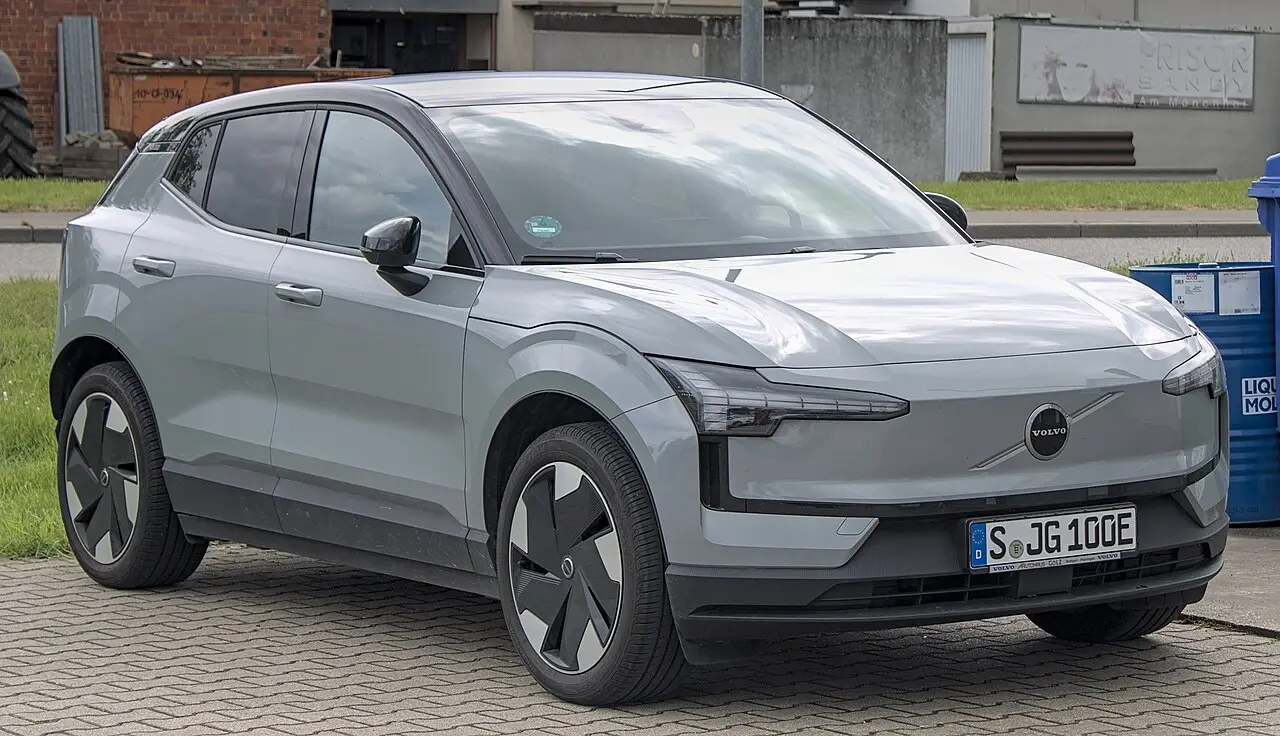
The Volvo EX30 first generation (since 2023): dimensions, weights, reliability and the official figures of its 22 versions in the European Union, the United Kingdom, the United States, and Canada.
Dimensions, weights and capacity
| Specification | Europe | North America | Wikipedia |
|---|---|---|---|
| Dimensions | |||
| Length | 4,230 mm RDW | – | 4,233 mm |
| Width | 1,840 mm RDW | – | 1,836–1,850 mm |
| Height | 1,550 mm RDW | – | 1,550–1,573 mm |
| Wheelbase | 2,650 mm RDW | – | 2,650 mm |
| Front track | 1,590 mm ASTRA | – | – |
| Rear track | 1,595 mm ASTRA | – | – |
| Weights and towing | |||
| Kerb weight | 1,740–1,860 kg RDW | – | 1,830–1,960 kg |
| Mass in running order | 1,840–1,960 kg RDW | – | – |
| Gross vehicle weight | 2,210–2,335 kg RDW | – | – |
| Towing, braked trailer | 1,000–1,600 kg RDW | – | – |
| Towing, unbraked trailer | 750 kg RDW | – | – |
| Seats and space | |||
| Seats | 5 RDW | – | – |
| Doors | 5 RDW | – | – |
| Boot space | 317–318 L EV DB | – | 318 L |
| Performance | |||
| Top speed | 180 km/h RDW | – | 180 km/h |
| 0–100 km/h | 3.6–5.7 s EV DB | – | 5.7 s |
| Torque | 343–543 Nm ASTRA | – | 343–543 Nm |
| Electric motor power | – | 200–315 kW NRCan | – |
| Electric | |||
| Battery capacity (usable) | 49.0–66.0 kWh EV DB | – | 51.0–69.0 kWh |
| Battery capacity (gross) | 51.0–69.0 kWh EV DB | – | – |
| Range (WLTP) | 344–480 km EV DB | – | – |
| Range (EPA/NRCan) | – | 327–420 km EPA | – |
| AC charging power | 11 kW EV DB | – | – |
| DC fast charging power | 134–153 kW EV DB | – | – |
| Charging time at 240 V | – | 8.0 h EPA | – |
Tyre sizes (most common first): 225/55R18, 245/40R20, 245/45R19
Ranges cover the generation’s versions and body styles; European and North American versions can differ. Sources: RDW type approvals (Netherlands), Wikipedia (en, de, fr, pl), ASTRA type approvals (Switzerland), open EV databases (EV Compare, Open EV Data, Gaia EVDB), Natural Resources Canada, US EPA fuel economy data, Traficom type approvals (Finland). Wikipedia figures are used under CC BY-SA 4.0.
Reliability and owner reports
Owner complaints to NHTSA (US)
11 complaints for model years 2025–2026. 2 crashes
Complaints are reported by owners and not checked by NHTSA; they are not adjusted for how many cars were sold, so popular models have more. NHTSA owner complaints
All 22 versions of the Volvo EX30 first generation
Show all 22 versions
European Union 5 versions
New cars registered in the EU (plus Norway and Iceland), from the European Environment Agency. Figures on the NEDC procedure until 2020 and on WLTP from 2021; versions are grouped by engine and power, with their number of registrations.
| Years and version | Engine | Power | Fuel | Consumption (combined) | CO₂ | Electric range | EU registrations |
|---|---|---|---|---|---|---|---|
| 2023–2025 | Electric motor | 200 kW (272 PS) | Electric | 17.0–18.0 kWh/100 km WLTP | 0 g/km | 430–475 km | 82,991 |
| 2023–2025 | Electric motor | 315 kW (428 PS) | Electric | 17.5–18.4 kWh/100 km WLTP | 0 g/km | 437–449 km | 18,291 |
| 2025 | Electric motor | 75 kW (102 PS) | Electric | 17.0 kWh/100 km WLTP | 0 g/km | 452 km | 498 |
| 2025 | Electric motor | 116 kW (158 PS) | Electric | 17.7 kWh/100 km WLTP | 0 g/km | 447 km | 191 |
| 2025 | Electric motor | 180 kW (245 PS) | Electric | 15.7 kWh/100 km WLTP | 0 g/km | 337 km | 75 |
United Kingdom 13 versions
New cars on sale in the UK, from the Vehicle Certification Agency. NEDC figures until 2018 and WLTP figures after; years are the editions a version appeared in.
| Years and version | Engine | Power | Fuel | Consumption (combined) | CO₂ | Electric range |
|---|---|---|---|---|---|---|
| 2025–2026Single Motor Plus · Single Motor Core | Electric motor | 200 kW (272 PS) | Electric | 17.1 kWh/100 km WLTP | 0 g/km | 337 km |
| 2025–2026Single Motor Extended Range Plus | Electric motor | 200 kW (272 PS) | Electric | 17.0 kWh/100 km WLTP | 0 g/km | 476 km |
| 2025–2026Single Motor Extended Range Ultra | Electric motor | 200 kW (272 PS) | Electric | 17.0 kWh/100 km WLTP | 0 g/km | 474 km |
| 2025–2026Single Motor Extended Range Core | Electric motor | 200 kW (272 PS) | Electric | 17.0 kWh/100 km WLTP | 0 g/km | 475 km |
| 2025–2026Twin Motor Performance Plus | Electric motor | 315 kW (428 PS) | Electric | 17.5 kWh/100 km WLTP | 0 g/km | 450 km |
| 2025–2026Twin Motor Performance Ultra | Electric motor | 315 kW (428 PS) | Electric | 17.5 kWh/100 km WLTP | 0 g/km | 449 km |
| 2025–2026Twin Motor Performance Cross Country Ultra | Electric motor | 315 kW (428 PS) | Electric | 18.7 kWh/100 km WLTP | 0 g/km | 427 km |
| 2024Single Motor Plus · Single Motor Core | Electric motor | 272 kW (370 PS) | Electric | 17.1 kWh/100 km WLTP | 0 g/km | 337 km |
| 2024Single Motor Extended Range Plus | Electric motor | 272 kW (370 PS) | Electric | 17.0 kWh/100 km WLTP | 0 g/km | 476 km |
| 2024Single Motor Extended Range Ultra | Electric motor | 272 kW (370 PS) | Electric | 17.0 kWh/100 km WLTP | 0 g/km | 474 km |
| 2024Single Motor Extended Range Core | Electric motor | 272 kW (370 PS) | Electric | 17.0 kWh/100 km WLTP | 0 g/km | 475 km |
| 2024Twin Motor Performance Plus | Electric motor | 428 kW (582 PS) | Electric | 17.5 kWh/100 km WLTP | 0 g/km | 450 km |
| 2024Twin Motor Performance Ultra | Electric motor | 428 kW (582 PS) | Electric | 17.5 kWh/100 km WLTP | 0 g/km | 449 km |
United States 2 versions
Model years sold in the USA, from the EPA and the Department of Energy (fueleconomy.gov). MPG on the EPA test; litres per 100 km = 235.215 ÷ MPG.
| Years and version | Engine | Fuel | Gearbox | Drive | Consumption (combined) | CO₂ | Electric range |
|---|---|---|---|---|---|---|---|
| 2025–2026 | Electric motor | Electric | Automatic | Rear-wheel drive | 114–116 MPGe EPA | 0 g/km | 414–420 km |
| 2025–2026 | Electric motor | Electric | Automatic | All-wheel drive | 89–109 MPGe EPA | 0 g/km | 327–407 km |
Canada 2 versions
Model years sold in Canada, from Natural Resources Canada fuel consumption ratings (5-cycle test).
| Years and version | Engine | Power | Fuel | Gearbox | Consumption (combined) | CO₂ | Electric range |
|---|---|---|---|---|---|---|---|
| 2025–2026Sport utility vehicle: Small | Electric motor | 200 kW (272 PS) | Electric | Automatic | 18.1–18.4 kWh/100 km 5-cycle | 0 g/km | 414–420 km |
| 2025–2026Sport utility vehicle: Small | Electric motor | 315 kW (428 PS) | Electric | Automatic | 19.3–23.5 kWh/100 km 5-cycle | 0 g/km | 327–407 km |
Similar models from other brands


Official figures are measured on standard test procedures and differ between markets. Your consumption depends on how, where and in what conditions you drive.