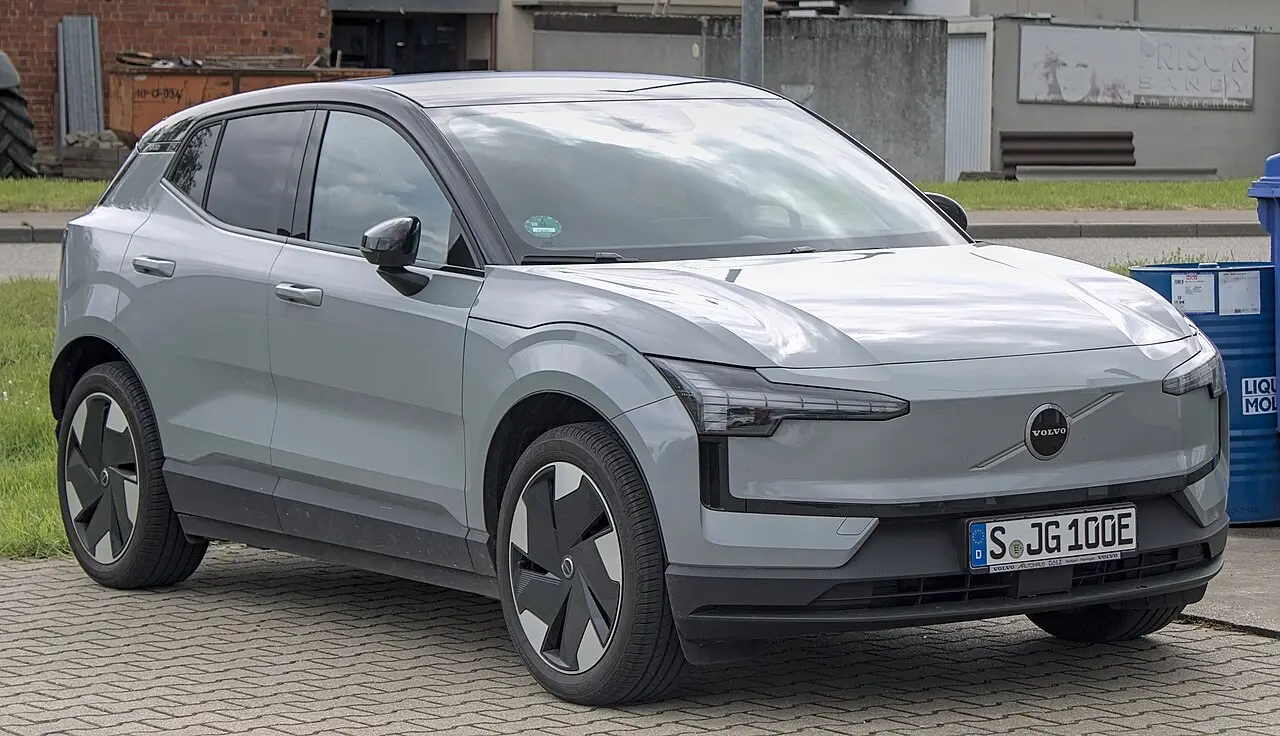
The official data lists 33 versions of the Volvo EX30 (2023–2026), in the European Union, the United Kingdom, the United States, and Canada. Each market publishes its own figures, measured on its own test procedure.
At a glance
Years in the data
2023–2026
Markets
European Union, United Kingdom, United States, Canada
Power
75 kW (102 PS) to 428 kW (582 PS)
Fuels
Electric
New registrations in the EU
102,046
What is the Volvo EX30?
The EX30 is Volvo’s small all-electric SUV, bringing the brand’s SUV format into a more compact size. Its interior uses a central display and a clean, organised layout. Interior material options include recycled and renewable materials such as recycled textiles and flax.
The first generation began in 2024 and is listed as continuing today. The model was sold in the European Union from 2023, the UK from 2024, and the United States and Canada from 2025. It brings Volvo’s electric SUV range into a smaller body style.
Electric power
Every EX30 version listed in these markets is electric. European Union versions range from 75 kW (102 PS) to 315 kW (428 PS). The UK listing spans 200 kW (272 PS) to 428 kW (582 PS), while the Canadian range runs from 200 kW (272 PS) to 315 kW (428 PS).
In the EU registration figures, the 200 kW (272 PS) version was the leading listed configuration in both 2024 and 2025. A 315 kW (428 PS) version also appears among the leading configurations.
Where is the Volvo EX30 sold?
The EX30 is sold in the European Union, the UK, the United States and Canada. EU registration figures span 2023–2025 and total 102,046. All listed versions in these regions are electric, with power ranges varying by market.
Recycled and renewable materials are among the EX30’s interior options, including textiles and flax décor. Its compact size and all-electric power give it a distinct place in Volvo’s SUV range.
Questions and answers
Is the Volvo EX30 electric?
Yes. All versions listed for the European Union, UK, United States and Canada are electric.
How powerful is the Volvo EX30?
EU versions range from 75 kW (102 PS) to 315 kW (428 PS); the UK listing reaches 428 kW (582 PS).
How many generations of EX30 are there?
One first generation, beginning in 2024 and listed as continuing today.
What kind of car is the Volvo EX30?
It is a small, fully electric SUV with recycled and renewable material options in its interior.
New cars registered in the EU (plus Norway and Iceland), from the European Environment Agency. Figures on the NEDC procedure until 2020 and on WLTP from 2021; versions are grouped by engine and power, with their number of registrations.
Years and version
Engine
Power
Fuel
Consumption (combined)
CO₂
Electric range
EU registrations
2025
Electric motor
200 kW (272 PS)
Electric
18.0 kWh/100 km WLTP
0 g/km
430 km
30,064
2025
Electric motor
315 kW (428 PS)
Electric
18.4 kWh/100 km WLTP
0 g/km
437 km
4,307
2025
Electric motor
75 kW (102 PS)
Electric
17.0 kWh/100 km WLTP
0 g/km
452 km
498
2025
Electric motor
116 kW (158 PS)
Electric
17.7 kWh/100 km WLTP
0 g/km
447 km
191
2025
Electric motor
180 kW (245 PS)
Electric
15.7 kWh/100 km WLTP
0 g/km
337 km
75
2024
Electric motor
200 kW (272 PS)
Electric
17.0 kWh/100 km WLTP
0 g/km
443 km
52,250
United Kingdom 13 versions
New cars on sale in the UK, from the Vehicle Certification Agency. NEDC figures until 2018 and WLTP figures after; years are the editions a version appeared in.
Years and version
Engine
Power
Fuel
Consumption (combined)
CO₂
Electric range
2025–2026Single Motor Plus · Single Motor Core
Electric motor
200 kW (272 PS)
Electric
17.1 kWh/100 km WLTP
0 g/km
337 km
2025–2026Single Motor Extended Range Plus
Electric motor
200 kW (272 PS)
Electric
17.0 kWh/100 km WLTP
0 g/km
476 km
2025–2026Single Motor Extended Range Ultra
Electric motor
200 kW (272 PS)
Electric
17.0 kWh/100 km WLTP
0 g/km
474 km
2025–2026Single Motor Extended Range Core
Electric motor
200 kW (272 PS)
Electric
17.0 kWh/100 km WLTP
0 g/km
475 km
2025–2026Twin Motor Performance Plus
Electric motor
315 kW (428 PS)
Electric
17.5 kWh/100 km WLTP
0 g/km
450 km
2025–2026Twin Motor Performance Ultra
Electric motor
315 kW (428 PS)
Electric
17.5 kWh/100 km WLTP
0 g/km
449 km
2025–2026Twin Motor Performance Cross Country Ultra
Electric motor
315 kW (428 PS)
Electric
18.7 kWh/100 km WLTP
0 g/km
427 km
2024Single Motor Plus · Single Motor Core
Electric motor
272 kW (370 PS)
Electric
17.1 kWh/100 km WLTP
0 g/km
337 km
2024Single Motor Extended Range Plus
Electric motor
272 kW (370 PS)
Electric
17.0 kWh/100 km WLTP
0 g/km
476 km
2024Single Motor Extended Range Ultra
Electric motor
272 kW (370 PS)
Electric
17.0 kWh/100 km WLTP
0 g/km
474 km
2024Single Motor Extended Range Core
Electric motor
272 kW (370 PS)
Electric
17.0 kWh/100 km WLTP
0 g/km
475 km
2024Twin Motor Performance Plus
Electric motor
428 kW (582 PS)
Electric
17.5 kWh/100 km WLTP
0 g/km
450 km
2024Twin Motor Performance Ultra
Electric motor
428 kW (582 PS)
Electric
17.5 kWh/100 km WLTP
0 g/km
449 km
United States 6 versions
Model years sold in the USA, from the EPA and the Department of Energy (fueleconomy.gov). MPG on the EPA test; litres per 100 km = 235.215 ÷ MPG.
Years and version
Engine
Fuel
Gearbox
Drive
Consumption (combined)
CO₂
Electric range
2025–2026
Electric motor
Electric
Automatic
Rear-wheel drive
116 MPGe EPA
0 g/km
420 km
2025–2026
Electric motor
Electric
Automatic
All-wheel drive
109 MPGe EPA
0 g/km
407 km
2026
Electric motor
Electric
Automatic
All-wheel drive
89 MPGe EPA
0 g/km
327 km
2026
Electric motor
Electric
Automatic
All-wheel drive
99 MPGe EPA
0 g/km
365 km
2025
Electric motor
Electric
Automatic
Rear-wheel drive
114 MPGe EPA
0 g/km
414 km
2025
Electric motor
Electric
Automatic
All-wheel drive
109 MPGe EPA
0 g/km
402 km
Canada 6 versions
Model years sold in Canada, from Natural Resources Canada fuel consumption ratings (5-cycle test).
Years and version
Engine
Power
Fuel
Gearbox
Consumption (combined)
CO₂
Electric range
2025–2026Sport utility vehicle: Small
Electric motor
200 kW (272 PS)
Electric
Automatic
18.1 kWh/100 km 5-cycle
0 g/km
420 km
2026Sport utility vehicle: Small
Electric motor
315 kW (428 PS)
Electric
Automatic
19.3 kWh/100 km 5-cycle
0 g/km
407 km
2026Sport utility vehicle: Small
Electric motor
315 kW (428 PS)
Electric
Automatic
23.5 kWh/100 km 5-cycle
0 g/km
327 km
2026Sport utility vehicle: Small
Electric motor
315 kW (428 PS)
Electric
Automatic
21.2 kWh/100 km 5-cycle
0 g/km
365 km
2025Sport utility vehicle: Small
Electric motor
200 kW (272 PS)
Electric
Automatic
18.4 kWh/100 km 5-cycle
0 g/km
414 km
2025Sport utility vehicle: Small
Electric motor
315 kW (428 PS)
Electric
Automatic
19.3 kWh/100 km 5-cycle
0 g/km
402 km
Versions outside these generations
European Union 2 versions
New cars registered in the EU (plus Norway and Iceland), from the European Environment Agency. Figures on the NEDC procedure until 2020 and on WLTP from 2021; versions are grouped by engine and power, with their number of registrations.
Years and version
Engine
Power
Fuel
Consumption (combined)
CO₂
Electric range
EU registrations
2023–2024
Electric motor
315 kW (428 PS)
Electric
17.5 kWh/100 km WLTP
0 g/km
449 km
13,984
2023
Electric motor
200 kW (272 PS)
Electric
17.0 kWh/100 km WLTP
0 g/km
475 km
677
Official figures are measured on standard test procedures and differ between markets. Your consumption depends on how, where and in what conditions you drive.