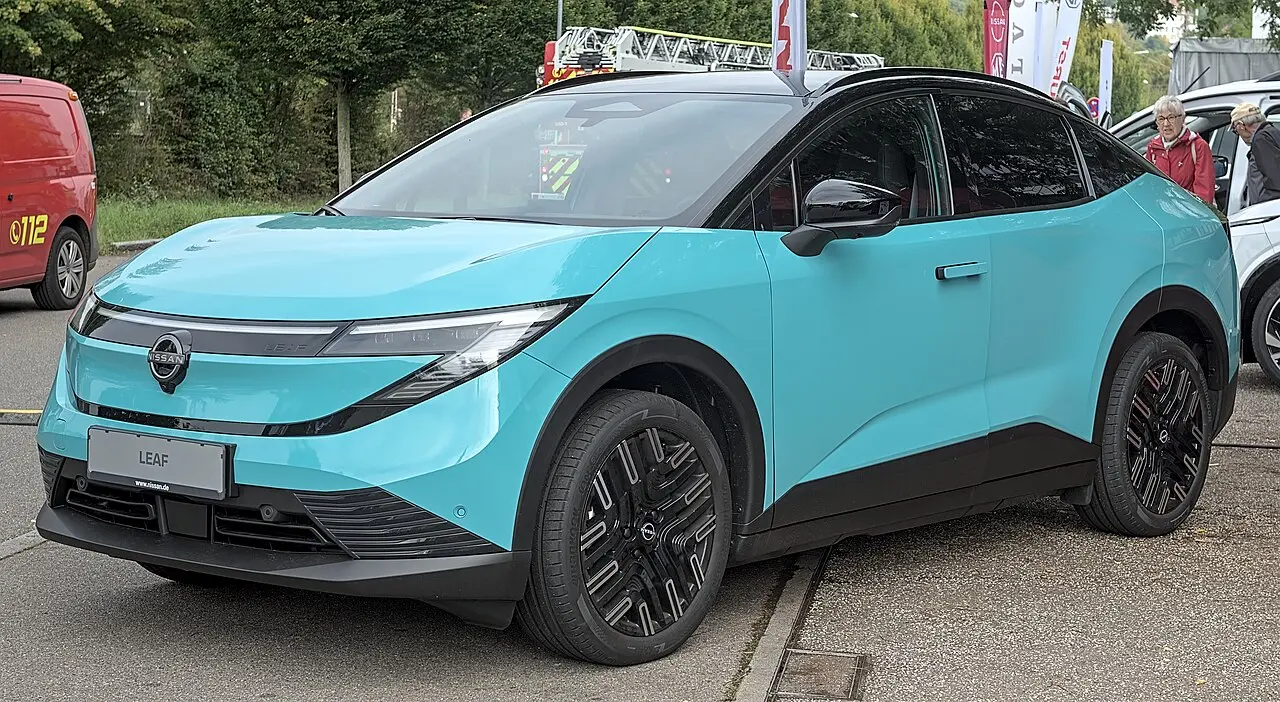
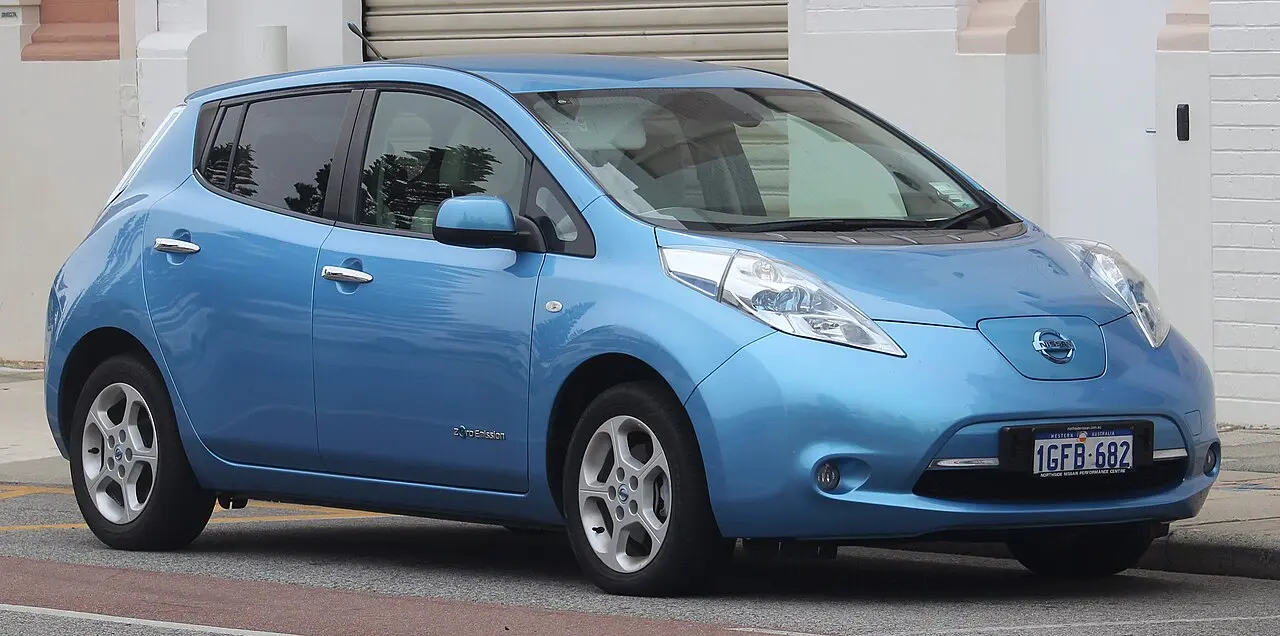
The official data lists 42 versions of the Nissan Leaf (2010 - 2026), in the European Union, the United Kingdom, France, the United States, and Canada. Each market publishes its own figures, measured on its own test procedure.
At a glance
Years in the data
2010 - 2026
Markets
European Union, United Kingdom, France, United States, Canada
Power
40 kW (54 PS) to 160 kW (218 PS)
Fuels
Electric
New registrations in the EU
389,223
What is the Nissan Leaf?
The Nissan Leaf is a fully electric family hatchback designed for everyday passenger use. Nissan introduced it in 2010 as the world’s first mass-produced electric vehicle, giving battery power a familiar five-door form.
Leaf generations
The first generation, ZE0 and AZE0, ran from 2011 to 2017. The second generation, ZE1, began in 2018. The later Leaf brought a new design and more technology while continuing the model’s role as an electric family car.
Electric power and emissions
EU registration figures cover 2010-2025, with electric power from 80 kW (109 PS) to 160 kW (218 PS), and total 389,223 registrations. The leading entries are 110 kW (150 PS) versions, with the highest annual totals in 2018, 2019 and 2020.
UK figures cover 2013-2026 and show electric versions from 40 kW (54 PS) to 160 kW (218 PS). French figures cover 2012-2026, with power from 80 kW (109 PS) to 90 kW (122 PS). Canadian figures span 2012-2026 and list power from 80 kW (109 PS) to 160 kW (218 PS). US EPA figures cover 2011-2026. Test procedures differ: Europe uses WLTP or NEDC, the US uses EPA testing, and Canada uses its 5-cycle procedure. Results from these tests are not directly comparable.
Where was the Leaf sold?
The Leaf appears in figures for the EU, UK, France, the United States and Canada. Its two generations show how Nissan developed the design and technology of its electric family hatchback over time.
Questions and answers
Is the Nissan Leaf fully electric?
Yes. The Leaf is electric in the EU, UK, France, the United States and Canada.
What are the Leaf generations?
The first generation, ZE0/AZE0, ran from 2011 to 2017. The second, ZE1, began in 2018.
What power range is listed for EU Leaf versions?
EU figures show electric power from 80 kW (109 PS) to 160 kW (218 PS).
Does the Leaf have a fuel-consumption figure?
The Leaf is electric, so it has no fuel-consumption figure. Test procedures differ by market: Europe uses WLTP or NEDC, the US uses EPA testing, and Canada uses the 5-cycle procedure.
At a glance: Length 4,450 mm · Kerb weight 1,405 - 1,500 kg · Top speed 144 - 145 km/h · MOT first-time pass at 6 - 8 years: 83.7% (UK average 86.4%) Specifications, reliability and all versions
At a glance: Length 4,490 mm · Kerb weight 1,480 - 1,656 kg · Top speed 144 - 157 km/h · MOT first-time pass at 4 - 5 years: 93.3% (UK average 91.0%) Specifications, reliability and all versions
Show all 34 versions
European Union 12 versions
New cars registered in the EU (plus Norway and Iceland), from the European Environment Agency. Figures on the NEDC procedure until 2020 and on WLTP from 2021; versions are grouped by engine and power, with their number of registrations.
Years and version
Engine
Power
Fuel
Consumption (combined)
CO₂
Electric range
EU registrations
2021 - 2025
Electric motor
110 kW (150 PS)
Electric
16.7 - 17.5 kWh/100 km WLTP
0 g/km
270 - 280 km
37,826
2022 - 2025
Electric motor
160 kW (218 PS)
Electric
17.8 - 17.9 kWh/100 km WLTP
0 g/km
392 - 411 km
11,797
2025
Electric motor
Not listed
Electric
-
0 g/km
-
26
2021 - 2022
Electric motor
90 kW (122 PS)
Electric
17.4 - 17.6 kWh/100 km WLTP
0 g/km
302 km
23,104
2021 - 2022
Electric motor
85 kW (116 PS)
Electric
16.0 - 17.5 kWh/100 km WLTP
0 g/km
293 - 295 km
2,124
2022
Electric motor
-
Electric
-
0 g/km
-
36
2021
Electric motor
160 kW (218 PS)
Electric
5.4 L/100 km WLTP18.5 kWh/100 km WLTP
0 g/km
385 km
14,676
2018 - 2020
Electric motor
110 kW (150 PS)
Electric
19.7 - 20.4 kWh/100 km NEDC
0 g/km
270 km
108,365
2018 - 2020
Electric motor
90 kW (122 PS)
Electric
19.3 - 20.5 kWh/100 km NEDC
0 g/km
304 km
46,119
2019 - 2020
Electric motor
160 kW (218 PS)
Electric
17.9 - 18.5 kWh/100 km NEDC
0 g/km
385 km
19,015
2018 - 2020
Electric motor
85 kW (116 PS)
Electric
18.7 - 20.6 kWh/100 km NEDC
0 g/km
306 km
6,084
2018 - 2019
Electric motor
80 kW (109 PS)
Electric
14.9 - 15.0 kWh/100 km NEDC
0 g/km
-
886
United Kingdom 16 versions
New cars on sale in the UK, from the Vehicle Certification Agency. NEDC figures until 2018 and WLTP figures after; years are the editions a version appeared in.
New cars on sale in France, from ADEME Car Labelling. NEDC figures until 2015, WLTP figures in the current catalogue.
Years and version
Engine
Power
Fuel
Gearbox
Consumption (combined)
Electric range
2026LEAF 62kWh
Electric motor
90 kW (122 PS)
Electric
Continuously variable (CVT)
14.7 kWh/100 km WLTP
449 km
2026LEAF 40kWh
Electric motor
90 kW (122 PS)
Electric
Continuously variable (CVT)
14.6 kWh/100 km WLTP
300 km
United States 1 version
Model years sold in the USA, from the EPA and the Department of Energy (fueleconomy.gov). MPG on the EPA test; litres per 100 km = 235.215 ÷ MPG.
Years and version
Engine
Fuel
Gearbox
Drive
Consumption (combined)
CO₂
Electric range
2018 - 2026
Electric motor
Electric
Automatic
Front-wheel drive
103 - 121 MPGe EPA
0 g/km
240 - 488 km
Canada 3 versions
Model years sold in Canada, from Natural Resources Canada fuel consumption ratings (5-cycle test).
Years and version
Engine
Power
Fuel
Gearbox
Consumption (combined)
CO₂
Electric range
2026Station wagon: Small
Electric motor
160 kW (218 PS)
Electric
Automatic
17.3 - 20.3 kWh/100 km 5-cycle
0 g/km
417 - 488 km
2018 - 2025Mid-size
Electric motor
110 kW (150 PS)
Electric
Automatic
18.7 - 18.9 kWh/100 km 5-cycle
0 g/km
240 - 243 km
2019 - 2025Mid-size
Electric motor
160 kW (218 PS)
Electric
Automatic
19.1 - 20.0 kWh/100 km 5-cycle
0 g/km
341 - 363 km
Nissan Leaf recalls
26 official safety recalls for the Nissan Leaf from NHTSA (United States), DVSA (United Kingdom) and the EU Safety Gate, newest first. Recall repairs are normally free at the maker’s dealers.
Rear seat belts may not secure a child restraint2026
High-voltage battery may short circuit2026
Battery may overheat during quick charging2021 - 2022
Battery may overheat during quick charging2019 - 2020
Stored vehicle identification number may be incorrect2019 - 2023
Official figures are measured on standard test procedures and differ between markets. Your consumption depends on how, where and in what conditions you drive.