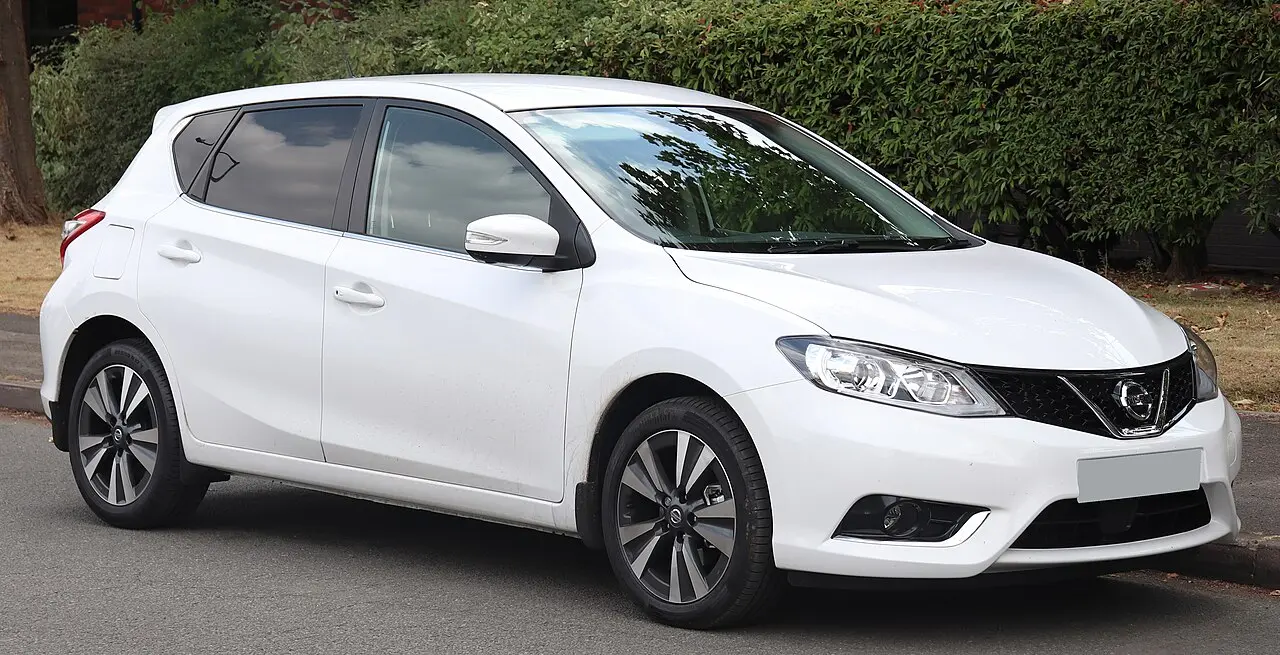
The official data lists 40 versions of the Nissan Pulsar (2014–2019), in the European Union, the United Kingdom, and France. Each market publishes its own figures, measured on its own test procedure.
At a glance
Years in the data
2014–2019
Markets
European Union, United Kingdom, France
Engines
1.2 L to 1.6 L
Power
81 kW (110 PS) to 140 kW (190 PS)
Fuels
Diesel, Petrol
Lowest consumption (France)
3.6 L/100 km (NEDC)
Lowest consumption (United Kingdom)
3.6 L/100 km (NEDC)
New registrations in the EU
247,305
What is the Nissan Pulsar?
The Pulsar is a family hatchback that gave Nissan a traditional compact-car option in Europe alongside its crossovers. Its roomy cabin and rear seating made it suited to everyday journeys with passengers.
Nissan returned to the European C-segment hatchback market with the Pulsar. The C13 generation brought a conventional hatchback layout and technology such as Around View Monitor.
Generation and engines
The European Pulsar is the first generation, known by the code C13 and listed for 2014–2018. It marked Nissan’s return to the European C-segment hatchback market.
EU registration figures span 1.2 L to 1.6 L engines, with power from 81 kW (110 PS) to 140 kW (190 PS). The recorded fuels include petrol, diesel and other. UK figures list 1.2 L to 1.6 L engines and petrol and diesel versions. Among the most registered EU configurations were a 1.5 L diesel and a 1.2 L petrol.
Fuel consumption and markets
The lowest listed consumption is 3.6 L/100 km in both the UK VCA and France ADEME figures, measured on the NEDC test. NEDC results can differ from those measured under other procedures. EU registrations cover 2014–2019 and total 247,305. UK figures cover 2015–2018, while the French ADEME figures are for 2015.
The Pulsar served as Nissan’s European family hatchback, with a conventional layout and petrol and diesel engine options.
Questions and answers
What generation is the European Nissan Pulsar?
The European model is the first generation, C13, listed for 2014–2018.
What engines were available?
The EU figures span 1.2 L to 1.6 L engines and 81 kW (110 PS) to 140 kW (190 PS).
What is the lowest listed fuel consumption?
The lowest UK and French figures are both 3.6 L/100 km on the NEDC test.
New cars registered in the EU (plus Norway and Iceland), from the European Environment Agency. Figures on the NEDC procedure until 2020 and on WLTP from 2021; versions are grouped by engine and power, with their number of registrations.
Years and version
Engine
Power
Fuel
CO₂
EU registrations
2018
1.2 L
85 kW (116 PS)
Petrol
118 g/km
22,717
2018
1.5 L
81 kW (110 PS)
Diesel
95 g/km
6,450
2018
1.2 L
–
Petrol
119 g/km
3,644
2018
1.6 L
140 kW (190 PS)
Petrol
136 g/km
572
2017
1.2 L
85 kW (116 PS)
Other fuel
118 g/km
17,224
2017
1.5 L
81 kW (110 PS)
Diesel
94 g/km
9,208
2017
1.2 L
85 kW (116 PS)
Petrol
118 g/km
8,624
2017
1.2 L
–
Petrol
119 g/km
6,610
2017
1.5 L
81 kW (110 PS)
Other fuel
94 g/km
6,048
2017
1.6 L
140 kW (190 PS)
Petrol
137 g/km
1,392
2017
1.2 L
128 kW (174 PS)
Petrol
117 g/km
524
2017
1.5 L
122 kW (166 PS)
Diesel
94 g/km
30
2016
1.2 L
85 kW (116 PS)
Petrol
118 g/km
28,380
2016
1.5 L
81 kW (110 PS)
Diesel
95 g/km
24,086
2016
1.2 L
–
Petrol
119 g/km
7,460
2016
1.6 L
140 kW (190 PS)
Petrol
136 g/km
2,446
2015
1.5 L
81 kW (110 PS)
Diesel
94 g/km
38,742
2015
1.2 L
85 kW (116 PS)
Petrol
118 g/km
34,036
2015
1.2 L
–
Petrol
118 g/km
10,298
2015
1.6 L
140 kW (190 PS)
Petrol
137 g/km
2,016
2014–2015
1.5 L
81 kW (110 PS)
Diesel
94 g/km
40
2014
1.5 L
81 kW (110 PS)
Diesel
94 g/km
8,450
2014
1.2 L
85 kW (116 PS)
Petrol
117 g/km
5,496
2014
1.2 L
–
Petrol
117 g/km
1,598
United Kingdom 9 versions
New cars on sale in the UK, from the Vehicle Certification Agency. NEDC figures until 2018 and WLTP figures after; years are the editions a version appeared in.
New cars on sale in France, from ADEME Car Labelling. NEDC figures until 2015, WLTP figures in the current catalogue.
Years and version
Engine
Power
Fuel
Gearbox
Consumption (combined)
CO₂
2015PULSAR dCi (110ch)
–
81 kW (110 PS)
Diesel
6-speed manual
3.6 L/100 km NEDC
94 g/km
2015PULSAR DIG-T (115ch)
–
85 kW (116 PS)
Petrol
6-speed manual
5.0 L/100 km NEDC
117 g/km
2015PULSAR DIG-T (115ch) Xtronic 7
–
85 kW (116 PS)
Petrol
Continuously variable (CVT)
5.1 L/100 km NEDC
119 g/km
2015PULSAR 1.6 DIG-T (140ch)
–
140 kW (190 PS)
Petrol
6-speed manual
5.7 L/100 km NEDC
134 g/km
2015PULSAR 1.6 DIG-T (140ch)
–
140 kW (190 PS)
Petrol
6-speed manual
5.9 L/100 km NEDC
138 g/km
Versions outside these generations
European Union 2 versions
New cars registered in the EU (plus Norway and Iceland), from the European Environment Agency. Figures on the NEDC procedure until 2020 and on WLTP from 2021; versions are grouped by engine and power, with their number of registrations.
Official figures are measured on standard test procedures and differ between markets. Your consumption depends on how, where and in what conditions you drive.