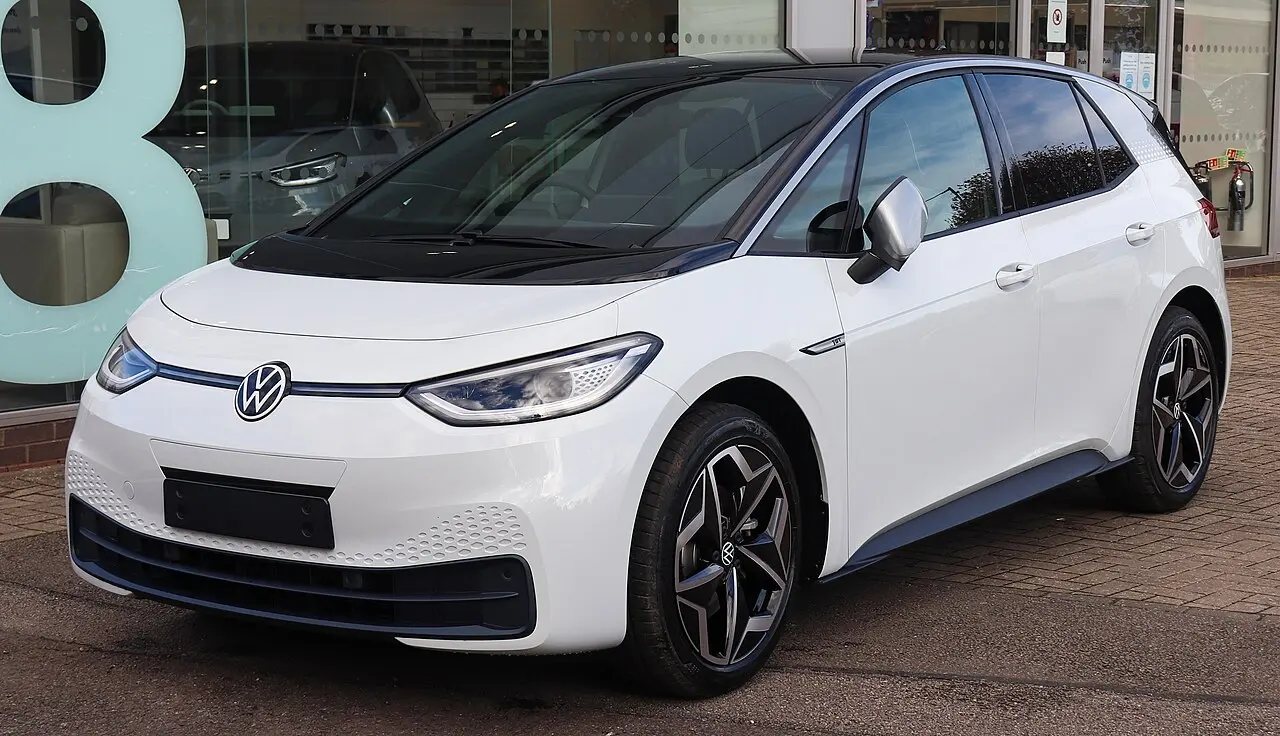
Volkswagen

Volkswagen ID.3

Volkswagen ID.3
Photo: Vauxford / Wikimedia Commons · CC BY-SA 4.0

The official data lists 60 versions of the Volkswagen ID.3 (2019–2026), in the European Union and the United Kingdom. Each market publishes its own figures, measured on its own test procedure.

At a glance

Years in the data
2019–2026
Markets
European Union, United Kingdom
Power
67 kW (91 PS) to 240 kW (326 PS)
Fuels
Electric
New registrations in the EU
429,581

What is the Volkswagen ID.3?

The ID.3 is a compact electric hatchback in Volkswagen’s ID family. Its dedicated electric platform gives the cabin a flat floor, helping make the most of the space in a car shaped for everyday use. It suits drivers who want a familiar hatchback layout with electric power.

Series production began in 2019. The ID.3 was the first Volkswagen model based on the company’s MEB electric platform, marking a new direction for the brand’s electric cars. Its listed generation, Generation I, spans 2020 to today.

Engines and power

Every ID.3 uses electric power. In European Union registration figures from 2019 to 2025, power ranges from 67 kW (91 PS) to 240 kW (326 PS). UK figures for 2025–2026 range from 125 kW (170 PS) to 240 kW (326 PS).

The most frequently registered EU entries include 70 kW (95 PS) versions in 2020 and 2021, and a 150 kW (204 PS) version in 2023.

Fuel consumption and CO₂

The ID.3 runs on electricity, so its energy use is measured in kilowatt-hours rather than litres per 100 kilometres. No consumption or CO₂ figures are included here.

Where was the ID.3 sold?

The ID.3 appears in European Union and UK figures. EU registrations cover 2019–2025, with 429,581 cars registered over that period; UK figures cover 2025–2026. As a compact hatchback, it brings electric power to a familiar everyday car format.

Questions and answers

Is the Volkswagen ID.3 electric?

Yes. The ID.3 versions listed for the EU and UK use electric power.

How much power does the ID.3 have?

The EU range is 67 kW (91 PS) to 240 kW (326 PS). The UK range is 125 kW (170 PS) to 240 kW (326 PS).

When did the ID.3 generation begin?

Generation I is listed from 2020 to today.

Where was the ID.3 sold?

The ID.3 appears in European Union and UK figures.

ID.3 I (since 2020)

Volkswagen ID.3 I
Photo: Vauxford / Wikimedia Commons · CC BY-SA 4.0

Model codes: E11 · References: volkswagen-newsroom.com, volkswagen-newsroom.com

European Union 48 versions

New cars registered in the EU (plus Norway and Iceland), from the European Environment Agency. Figures on the NEDC procedure until 2020 and on WLTP from 2021; versions are grouped by engine and power, with their number of registrations.

Years and versionEnginePowerFuelConsumption (combined)CO₂Electric rangeEU registrations
2025Electric motor170 kW (231 PS)Electric16.2 kWh/100 km WLTP0 g/km462 km42,173
2025Electric motor125 kW (170 PS)Electric17.3 kWh/100 km WLTP0 g/km364 km17,008
2025Electric motor240 kW (326 PS)Electric15.4 kWh/100 km WLTP0 g/km576 km3,274
2025Electric motor210 kW (286 PS)Electric14.8 kWh/100 km WLTP0 g/km596 km2,902
2025Electric motor70 kW (95 PS)Electric15.5 kWh/100 km WLTP0 g/km438 km2,270
2025Electric motor150 kW (204 PS)Electric15.3 kWh/100 km WLTP0 g/km439 km438
2025Electric motor89 kW (121 PS)Electric15.0 kWh/100 km WLTP0 g/km588 km78
2024Electric motor150 kW (204 PS)Electric15.3 kWh/100 km WLTP0 g/km439 km28,763
2024Electric motor170 kW (231 PS)Electric15.6 kWh/100 km WLTP0 g/km468 km10,128
2024Electric motor70 kW (95 PS)Electric15.8 kWh/100 km WLTP0 g/km462 km6,832
2024Electric motor89 kW (121 PS)Electric15.0 kWh/100 km WLTP0 g/km589 km582
2024Electric motor125 kW (170 PS)Electric15.3 kWh/100 km WLTP0 g/km387 km259
2024Electric motor210 kW (286 PS)Electric14.8 kWh/100 km WLTP0 g/km597 km125
2024Electric motor240 kW (326 PS)Electric15.2 kWh/100 km WLTP0 g/km583 km99
2024Electric motor107 kW (145 PS)Electric15.4 kWh/100 km WLTP0 g/km423 km28
2024Electric motor110 kW (150 PS)Electric16.4 kWh/100 km WLTP0 g/km358 km10
2023Electric motor150 kW (204 PS)Electric15.5 kWh/100 km WLTP0 g/km452 km45,181
2023Electric motor70 kW (95 PS)Electric15.5 kWh/100 km WLTP0 g/km459 km2,859
2023Electric motor107 kW (145 PS)Electric15.3 kWh/100 km WLTP0 g/km424 km2,157
2023Electric motor110 kW (150 PS)Electric15.1 kWh/100 km WLTP0 g/km371 km204
2023Electric motor67 kW (91 PS)Electric15.4 kWh/100 km WLTP0 g/km439 km99
2023Electric motor80 kW (109 PS)Electric15.4 kWh/100 km WLTP0 g/km424 km30
2023Electric motor81 kW (110 PS)Electric15.4 kWh/100 km WLTP0 g/km439 km27
2023Electric motor89 kW (121 PS)Electric–0 g/km–21
2023Electric motor84 kW (114 PS)Electric15.4 kWh/100 km WLTP0 g/km432 km17
2023Electric motor95 kW (129 PS)Electric15.4 kWh/100 km WLTP0 g/km442 km14
2023Electric motor91 kW (124 PS)Electric15.4 kWh/100 km WLTP0 g/km423 km10
2023Electric motor116 kW (158 PS)Electric15.4 kWh/100 km WLTP0 g/km450 km10
2022Electric motor150 kW (204 PS)Electric14.3 kWh/100 km WLTP0 g/km449 km19,422
2022Electric motor107 kW (145 PS)Electric14.0 kWh/100 km WLTP0 g/km365 km11,787
2022Electric motor70 kW (95 PS)Electric15.3 kWh/100 km WLTP0 g/km440 km6,235
2022Electric motor110 kW (150 PS)Electric13.4 kWh/100 km WLTP0 g/km344 km3,490
2022Electric motor206 kW (280 PS)Electric–0 g/km–30
2021Electric motor70 kW (95 PS)Electric14.5 kWh/100 km WLTP0 g/km422 km81,778
2021Electric motor150 kW (204 PS)Electric15.6 kWh/100 km WLTP0 g/km441 km22,638
2021Electric motor110 kW (150 PS)Electric15.1 kWh/100 km WLTP0 g/km346 km3,728
2021Electric motor107 kW (145 PS)Electric15.3 kWh/100 km WLTP0 g/km421 km3,340
2021Electric motor77 kW (105 PS)Electric–0 g/km–44
2021Electric motor58 kW (79 PS)Electric–0 g/km–14
2021Electric motor45 kW (61 PS)Electric–0 g/km–10
2021Electric motor125 kW (170 PS)Electric–0 g/km–10
2020Electric motor70 kW (95 PS)Electric15.2 kWh/100 km NEDC0 g/km417 km74,393
2020Electric motor150 kW (204 PS)Electric15.6 kWh/100 km NEDC0 g/km417 km34,582
2020Electric motor85 kW (116 PS)Electric–0 g/km–2,026
2020Electric motor110 kW (150 PS)Electric–0 g/km–36
2020Electric motor93 kW (126 PS)Electric–0 g/km–34
2020Electric motor107 kW (145 PS)Electric–0 g/km–22
2020Electric motor125 kW (170 PS)Electric–0 g/km–22

United Kingdom 8 versions

New cars on sale in the UK, from the Vehicle Certification Agency. NEDC figures until 2018 and WLTP figures after; years are the editions a version appeared in.

Years and versionEnginePowerFuelConsumption (combined)CO₂Electric range
2025–2026Pure Essential 52kWh 170 PS 1-Speed Automatic 5 DoorElectric motor125 kW (170 PS)Electric15.2 kWh/100 km WLTP0 g/km388 km
2025–2026Pure Match 52kWh 170 PS 1-Speed Automatic 5 DoorElectric motor125 kW (170 PS)Electric15.2 kWh/100 km WLTP0 g/km387 km
2025–2026Pro 59kWh 204 PS 1-Speed Automatic 5 DoorElectric motor150 kW (204 PS)Electric15.4 kWh/100 km WLTP0 g/km432 km
2025–2026Pro Essential 59kWh 204 PS 1-Speed Automatic 5 DoorElectric motor150 kW (204 PS)Electric15.3 kWh/100 km WLTP0 g/km433 km
2025–2026Pro Match 59kWh 204 PS 1-Speed Automatic 5 DoorElectric motor150 kW (204 PS)Electric15.4 kWh/100 km WLTP0 g/km431 km
2025–2026Pro S 79kWh 204 PS 1-Speed Automatic 5 Door · Pro S Essential 79kWh 204 PS 1-Speed Automatic 5 DoorElectric motor150 kW (204 PS)Electric15.6 kWh/100 km WLTP0 g/km566 km
2025–2026Pro S Match 79kWh 204 PS 1-Speed Automatic 5 DoorElectric motor150 kW (204 PS)Electric15.7 kWh/100 km WLTP0 g/km564 km
2025–2026GTX Performance 79kWh 326 PS 1-Speed Automatic 5 DoorElectric motor240 kW (326 PS)Electric14.8 kWh/100 km WLTP0 g/km595 km

Versions outside these generations

European Union 4 versions

New cars registered in the EU (plus Norway and Iceland), from the European Environment Agency. Figures on the NEDC procedure until 2020 and on WLTP from 2021; versions are grouped by engine and power, with their number of registrations.

Years and versionEnginePowerFuelCO₂EU registrations
2019Electric motor150 kW (204 PS)Electric0 g/km278
2019Electric motor110 kW (150 PS)Electric0 g/km32
2019Electric motor107 kW (145 PS)Electric0 g/km20
2019Electric motor93 kW (126 PS)Electric0 g/km12

Official figures are measured on standard test procedures and differ between markets. Your consumption depends on how, where and in what conditions you drive.