

Hyundai Elantra VI
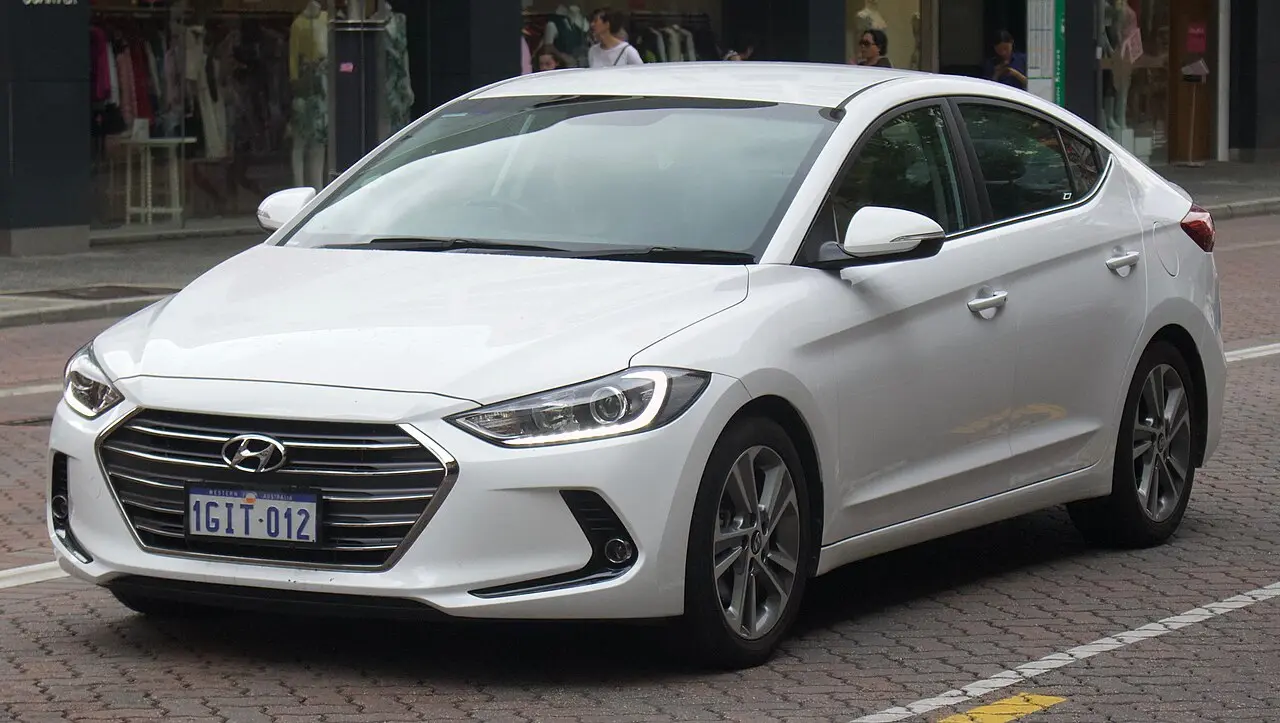
The Hyundai Elantra VI (2017–2020): dimensions, weights, reliability and the official figures of its 23 versions in the European Union, the United States, and Canada.
Model codes: AD
Dimensions, weights and capacity
| Specification | Europe | North America | Wikipedia |
|---|---|---|---|
| Dimensions | |||
| Length | 4,570 mm RDW | 4,290–4,620 mm TC | – |
| Width | 1,800 mm RDW | 1,780–1,800 mm TC | 1,800 mm |
| Height | 1,450 mm RDW | 1,400–1,450 mm TC | 1,435 mm |
| Wheelbase | 2,700 mm RDW | 2,640–2,700 mm TC | 2,700 mm |
| Front track | – | 1,550–1,560 mm TC | – |
| Rear track | – | 1,550–1,570 mm TC | – |
| Weights and towing | |||
| Kerb weight | 1,195 kg RDW | 1,275–1,391 kg TC | 1,185–1,433 kg |
| Mass in running order | 1,295 kg RDW | – | – |
| Gross vehicle weight | 1,770 kg RDW | – | – |
| Towing, braked trailer | 300 kg RDW | – | – |
| Towing, unbraked trailer | 300 kg RDW | – | – |
| Seats and space | |||
| Seats | 5 RDW | – | – |
| Doors | 4 RDW | – | – |
| Luggage space (EPA) | – | 396–708 L EPA | – |
| Passenger space (EPA) | – | 2,718–2,747 L EPA | – |
| Performance | |||
| Top speed | 200 km/h RDW | – | 190–200 km/h |
| 0–100 km/h | – | – | 10.6–11.3 s |
| Torque | – | – | 144–154 Nm |
NHTSA overall safety rating (US): 2017: ★★★★★ · 2018–2020: ★★★★☆
Ranges cover the generation’s versions and body styles; European and North American versions can differ. Sources: RDW type approvals (Netherlands), Transport Canada vehicle specifications, Wikipedia (en, de), US EPA fuel economy data, NHTSA 5-Star Safety Ratings. Wikipedia figures are used under CC BY-SA 4.0.
Reliability and owner reports
Owner complaints to NHTSA (US)
1,651 complaints for model years 2017–2020. 82 crashes · 23 fires · 51 injuries · 4 deaths
- Engine 738
- Electrical system 216
- Transmission and drivetrain 152
- Body and structure 143
- Steering 117
- Lights 107
Complaints are reported by owners and not checked by NHTSA; they are not adjusted for how many cars were sold, so popular models have more. NHTSA owner complaints
All 23 versions of the Hyundai Elantra VI
Show all 23 versions
European Union 6 versions
New cars registered in the EU (plus Norway and Iceland), from the European Environment Agency. Figures on the NEDC procedure until 2020 and on WLTP from 2021; versions are grouped by engine and power, with their number of registrations.
| Years and version | Engine | Power | Fuel | CO₂ | EU registrations |
|---|---|---|---|---|---|
| 2017–2020 | 1.6 L | 93 kW (126 PS) | Petrol | 152–154 g/km | 6,758 |
| 2017–2020 | 1.6 L | 94 kW (128 PS) | Petrol | 152–158 g/km | 3,662 |
| 2017–2019 | 1.6 L | 100 kW (136 PS) | Diesel | 116–118 g/km | 1,596 |
| 2018 | 1.6 L | 100 kW (136 PS) | Petrol | 116 g/km | 32 |
| 2017 | 1.6 L | 141 kW (192 PS) | Petrol | 154 g/km | 2,720 |
| 2017 | 1.6 L | 150 kW (204 PS) | Diesel | 116 g/km | 100 |
United States 8 versions
Model years sold in the USA, from the EPA and the Department of Energy (fueleconomy.gov). MPG on the EPA test; litres per 100 km = 235.215 ÷ MPG.
| Years and version | Engine | Fuel | Gearbox | Drive | Consumption (combined) | CO₂ |
|---|---|---|---|---|---|---|
| 2017–2020SIDI | 1.4 L | Petrol | 7-speed automated manual | Front-wheel drive | 35–36 MPG (6.5–6.7 L/100 km) EPA | 155–159 g/km |
| 2017–2020SIDI | 1.6 L | Petrol | 7-speed automated manual | Front-wheel drive | 28–29 MPG (8.1–8.4 L/100 km) EPA | 190–200 g/km |
| 2017–2020SIDI | 1.6 L | Petrol | 6-speed manual | Front-wheel drive | 25–26 MPG (9.0–9.4 L/100 km) EPA | 219–226 g/km |
| 2018–2020SIDI | 2.0 L | Petrol | 6-speed automatic | Front-wheel drive | 27 MPG (8.7 L/100 km) EPA | 203 g/km |
| 2020 | 2.0 L | Petrol | Continuously variable (CVT) | Front-wheel drive | 34–35 MPG (6.7–6.9 L/100 km) EPA | 161–164 g/km |
| 2017–2020 | 2.0 L | Petrol | 6-speed manual | Front-wheel drive | 29–30 MPG (7.8–8.1 L/100 km) EPA | 187 g/km |
| 2017–2019 | 2.0 L | Petrol | 6-speed automatic | Front-wheel drive | 32–33 MPG (7.1–7.4 L/100 km) EPA | 169–175 g/km |
| 2018SIDI | 2.0 L | Petrol | 6-speed manual | Front-wheel drive | 26 MPG (9.0 L/100 km) EPA | 210 g/km |
Canada 9 versions
Model years sold in Canada, from Natural Resources Canada fuel consumption ratings (5-cycle test).
| Years and version | Engine | Fuel | Gearbox | Consumption (combined) | CO₂ |
|---|---|---|---|---|---|
| 2018–2020Full-size | 1.6 L | Petrol | 7-speed automated manual | 8.3–8.6 L/100 km 5-cycle | 194–205 g/km |
| 2018–2020Full-size | 1.6 L | Petrol | 6-speed manual | 9.2–9.6 L/100 km 5-cycle | 218–226 g/km |
| 2018–2020Mid-size | 1.6 L | Petrol | 7-speed automated manual | 8.1 L/100 km 5-cycle | 189–192 g/km |
| 2018–2020Mid-size | 1.6 L | Petrol | 6-speed manual | 9.0–9.4 L/100 km 5-cycle | 214–221 g/km |
| 2018–2020Full-size | 2.0 L | Petrol | 6-speed manual | 8.7 L/100 km 5-cycle | 205–207 g/km |
| 2020Mid-size | 2.0 L | Petrol | Continuously variable (CVT) | 6.8 L/100 km 5-cycle | 161 g/km |
| 2017–2020Mid-size | 2.0 L | Petrol | 6-speed manual | 7.9–8.7 L/100 km 5-cycle | 187–204 g/km |
| 2018–2020Full-size | 2.0 L | Petrol | 6-speed automatic | 8.4 L/100 km 5-cycle | 198–200 g/km |
| 2017–2019Mid-size | 2.0 L | Petrol | 6-speed automatic | 7.4–8.7 L/100 km 5-cycle | 174–206 g/km |
Similar models from other brands


Official figures are measured on standard test procedures and differ between markets. Your consumption depends on how, where and in what conditions you drive.