

Hyundai Accent I
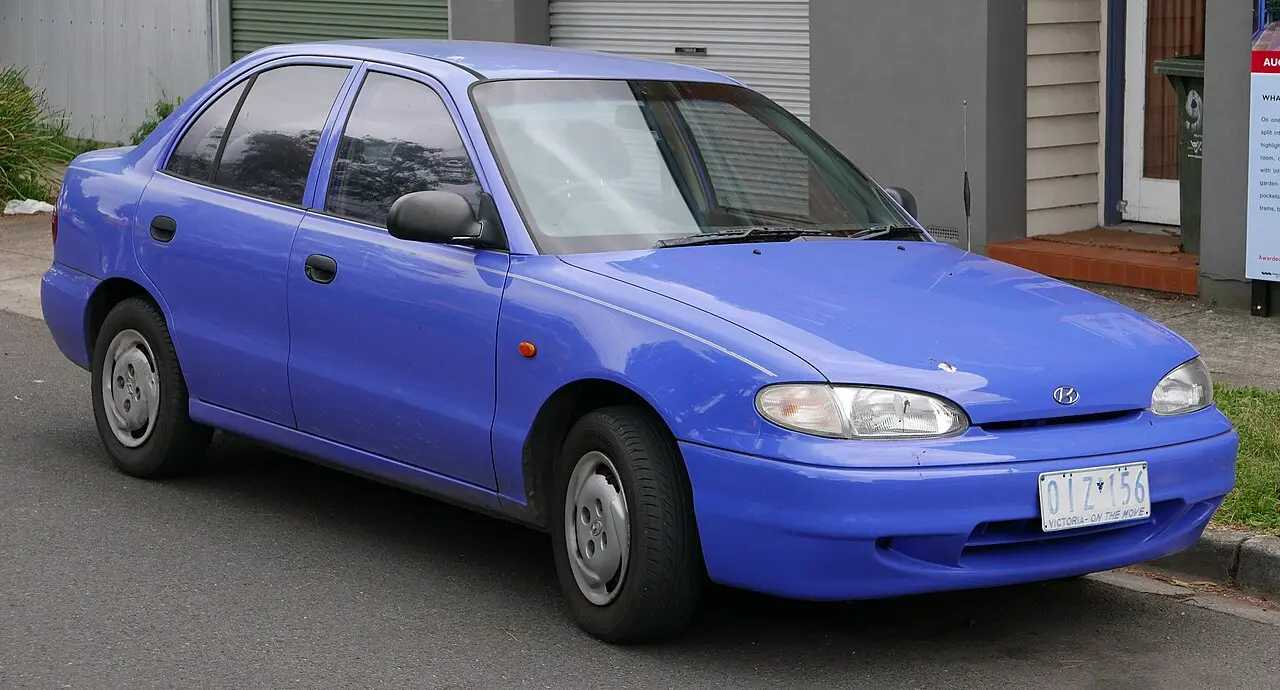
The Hyundai Accent I (1995–1999): dimensions, weights, reliability and the official figures of its 8 versions in the United States and Canada.
Model codes: X3
Dimensions, weights and capacity
| Specification | Europe | North America | Wikipedia |
|---|---|---|---|
| Dimensions | |||
| Length | 4,100–4,240 mm RDW | – | 4,100–4,117 mm |
| Width | 1,620 mm Traficom | – | 1,620 mm |
| Height | 1,390 mm Traficom | – | 1,395–1,410 mm |
| Wheelbase | 2,400–2,440 mm RDW | – | 2,400 mm |
| Front track | 1,416–1,435 mm ASTRA | – | – |
| Rear track | 1,406–1,425 mm ASTRA | – | – |
| Weights and towing | |||
| Kerb weight | 926–999 kg RDW | – | 953–975 kg |
| Mass in running order | 1,026–1,099 kg RDW | – | – |
| Gross vehicle weight | 1,480–1,555 kg RDW | – | – |
| Towing, braked trailer | 900–1,100 kg RDW | – | – |
| Towing, unbraked trailer | 453 kg RDW | – | – |
| Seats and space | |||
| Seats | 5 RDW | – | – |
| Doors | 2–4 RDW | – | – |
| Luggage space (EPA) | – | 255–453 L EPA | – |
| Passenger space (EPA) | – | 2,492 L EPA | – |
| Performance | |||
| Top speed | 158–188 km/h ASTRA | – | – |
| Torque | 114–134 Nm ASTRA | – | – |
Tyre sizes (most common first): 175/70R13, 155/80R13, 185/60R14
Ranges cover the generation’s versions and body styles; European and North American versions can differ. Sources: RDW type approvals (Netherlands), Wikipedia, Traficom type approvals (Finland), ASTRA type approvals (Switzerland), US EPA fuel economy data. Wikipedia figures are used under CC BY-SA 4.0.
Reliability and owner reports
UK MOT: first-time pass rate by age
| Age at test | Pass rate | UK average | Tests |
|---|---|---|---|
| 13 years and older | 58.8% (54.7–62.8) | 69.2% | 561 |
What the MOT finds
| Area | This model | UK average, same ages |
|---|---|---|
| Brakes | 54.0% | 36.4% |
| Suspension | 44.6% | 41.6% |
| Tyres | 31.4% | 31.2% |
| Body, chassis and structure | 31.2% | 18.6% |
| Lights and electrics | 27.6% | 28.8% |
| Noise, emissions and leaks | 27.1% | 17.1% |
First MOT test of each car per year in 2022–2024, from the DVSA’s anonymised test results; only ages with at least 500 tests are shown. The figure in brackets is the 95% confidence interval; green or red means clearly above or below the UK average. The second table shows how often an item was noted (defect or advisory) in each area, against the UK average for cars of the same ages. DVSA anonymised MOT tests (Open Government Licence)
Owner complaints to NHTSA (US)
407 complaints for model years 1995–1999. 78 crashes · 8 fires · 57 injuries · 1 death
- Airbags 80
- Suspension 69
- Transmission and drivetrain 48
- Engine 27
Complaints are reported by owners and not checked by NHTSA; they are not adjusted for how many cars were sold, so popular models have more. NHTSA owner complaints
All 8 versions of the Hyundai Accent I
United States 4 versions
Model years sold in the USA, from the EPA and the Department of Energy (fueleconomy.gov). MPG on the EPA test; litres per 100 km = 235.215 ÷ MPG.
| Years and version | Engine | Fuel | Gearbox | Drive | Consumption (combined) | CO₂ |
|---|---|---|---|---|---|---|
| 1998–19992MODE CLKUP | 1.5 L | Petrol | 4-speed automatic | Front-wheel drive | 26 MPG (9.0 L/100 km) EPA | 212 g/km |
| 1998–1999 | 1.5 L | Petrol | 5-speed manual | Front-wheel drive | 28 MPG (8.4 L/100 km) EPA | 197 g/km |
| 1995–1997(FFS) (MPFI), 2MODE CLKUP | 1.5 L | Petrol | 4-speed automatic | Front-wheel drive | 25–27 MPG (8.7–9.4 L/100 km) EPA | 205–221 g/km |
| 1995–1997(FFS) (MPFI) | 1.5 L | Petrol | 5-speed manual | Front-wheel drive | 27–28 MPG (8.4–8.7 L/100 km) EPA | 197–205 g/km |
Canada 4 versions
Model years sold in Canada, from Natural Resources Canada fuel consumption ratings (5-cycle test).
| Years and version | Engine | Fuel | Gearbox | Consumption (combined) | CO₂ |
|---|---|---|---|---|---|
| 1999Subcompact | 1.5 L | Petrol | 4-speed automatic | 9.0 L/100 km 5-cycle | 207 g/km |
| 1999Subcompact | 1.5 L | Petrol | 5-speed manual | 8.5 L/100 km 5-cycle | 196 g/km |
| 1995–1998Compact | 1.5 L | Petrol | 4-speed automatic | 8.5–9.3 L/100 km 5-cycle | 196–214 g/km |
| 1995–1998Compact | 1.5 L | Petrol | 5-speed manual | 8.2–8.9 L/100 km 5-cycle | 189–205 g/km |
Similar models from other brands





Official figures are measured on standard test procedures and differ between markets. Your consumption depends on how, where and in what conditions you drive.