

Ford Taurus Sixth generation
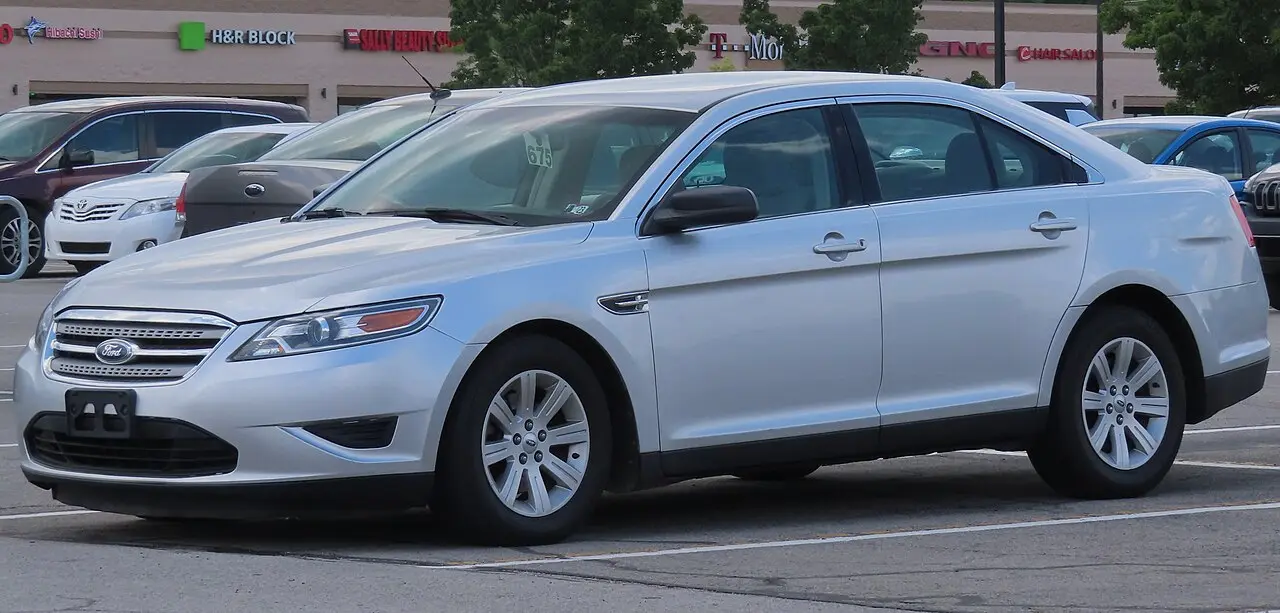
The Ford Taurus Sixth generation (2010–2019): dimensions, weights, reliability and the official figures of its 10 versions in the United States and Canada.
Model codes: D3 · Sold in: United States, Canada, and European Union
Dimensions, weights and capacity
| Specification | North America | Wikipedia |
|---|---|---|
| Dimensions | ||
| Length | 5,160 mm TC | 5,154 mm |
| Width | 1,940 mm TC | 1,935 mm |
| Height | 1,540 mm TC | 1,542 mm |
| Wheelbase | 2,870 mm TC | 2,868 mm |
| Front track | 1,680 mm TC | – |
| Rear track | 1,680 mm TC | – |
| Weights and towing | ||
| Kerb weight | 1,822–1,918 kg TC | 1,821 kg |
| Seats and space | ||
| Luggage space (EPA) | 566–595 L EPA | – |
| Passenger space (EPA) | 2,888–3,058 L EPA | – |
| Performance | ||
| Torque | – | 338–475 Nm |
NHTSA overall safety rating (US): 2011–2012: ★★★★☆ · 2013–2019: ★★★★★
Ranges cover the generation’s versions and body styles; European and North American versions can differ. Sources: Transport Canada vehicle specifications, Wikipedia (en, fr), US EPA fuel economy data, NHTSA 5-Star Safety Ratings. Wikipedia figures are used under CC BY-SA 4.0.
Reliability and owner reports
Owner complaints to NHTSA (US)
1,765 complaints for model years 2010–2019. 87 crashes · 20 fires · 82 injuries · 3 deaths
- Steering 499
- Engine 251
- Fuel system 243
- Electrical system 217
- Transmission and drivetrain 123
- Driver assistance 100
Complaints are reported by owners and not checked by NHTSA; they are not adjusted for how many cars were sold, so popular models have more. NHTSA owner complaints
All 10 versions of the Ford Taurus Sixth generation
United States 7 versions
Model years sold in the USA, from the EPA and the Department of Energy (fueleconomy.gov). MPG on the EPA test; litres per 100 km = 235.215 ÷ MPG.
| Years and version | Engine | Fuel | Gearbox | Drive | Consumption (combined) | CO₂ |
|---|---|---|---|---|---|---|
| 2010–2019SIDI | 3.5 L | Petrol | 6-speed automatic | All-wheel drive | 19–20 MPG (11.8–12.4 L/100 km) EPA | 276–294 g/km |
| 2013–2019 | 3.5 L | Petrol | 6-speed automatic | All-wheel drive | 19–21 MPG (11.2–12.4 L/100 km) EPA | 265–291 g/km |
| 2010–2019 | 3.5 L | Petrol | 6-speed automatic | Front-wheel drive | 21–23 MPG (10.2–11.2 L/100 km) EPA | 245–266 g/km |
| 2013–2019FFV | 3.5 L | Flex fuel (E85) | 6-speed automatic | All-wheel drive | 19–21 MPG (11.2–12.4 L/100 km) EPA | 265–291 g/km |
| 2013–2019FFV | 3.5 L | Flex fuel (E85) | 6-speed automatic | Front-wheel drive | 21–23 MPG (10.2–11.2 L/100 km) EPA | 245–266 g/km |
| 2013–2017SIDI | 2.0 L | Petrol | 6-speed automatic | Front-wheel drive | 23–26 MPG (9.0–10.2 L/100 km) EPA | 216–240 g/km |
| 2010 | 3.5 L | Petrol | 6-speed automatic | Four-wheel drive | 20 MPG (11.8 L/100 km) EPA | 276 g/km |
Canada 3 versions
Model years sold in Canada, from Natural Resources Canada fuel consumption ratings (5-cycle test).
| Years and version | Engine | Fuel | Gearbox | Consumption (combined) | CO₂ |
|---|---|---|---|---|---|
| 2010–2019Full-size | 3.5 L | Petrol | 6-speed automatic | 10.3–12.5 L/100 km 5-cycle | 237–294 g/km |
| 2013–2019Full-size | 3.5 L | Flex fuel (E85) | 6-speed automatic | 14.3–16.3 L/100 km 5-cycle | 229–271 g/km |
| 2013–2017Full-size | 2.0 L | Petrol | 6-speed automatic | 9.1–10.1 L/100 km 5-cycle | 209–238 g/km |
Similar models from other brands



Official figures are measured on standard test procedures and differ between markets. Your consumption depends on how, where and in what conditions you drive.