

VinFast VF 8 First generation
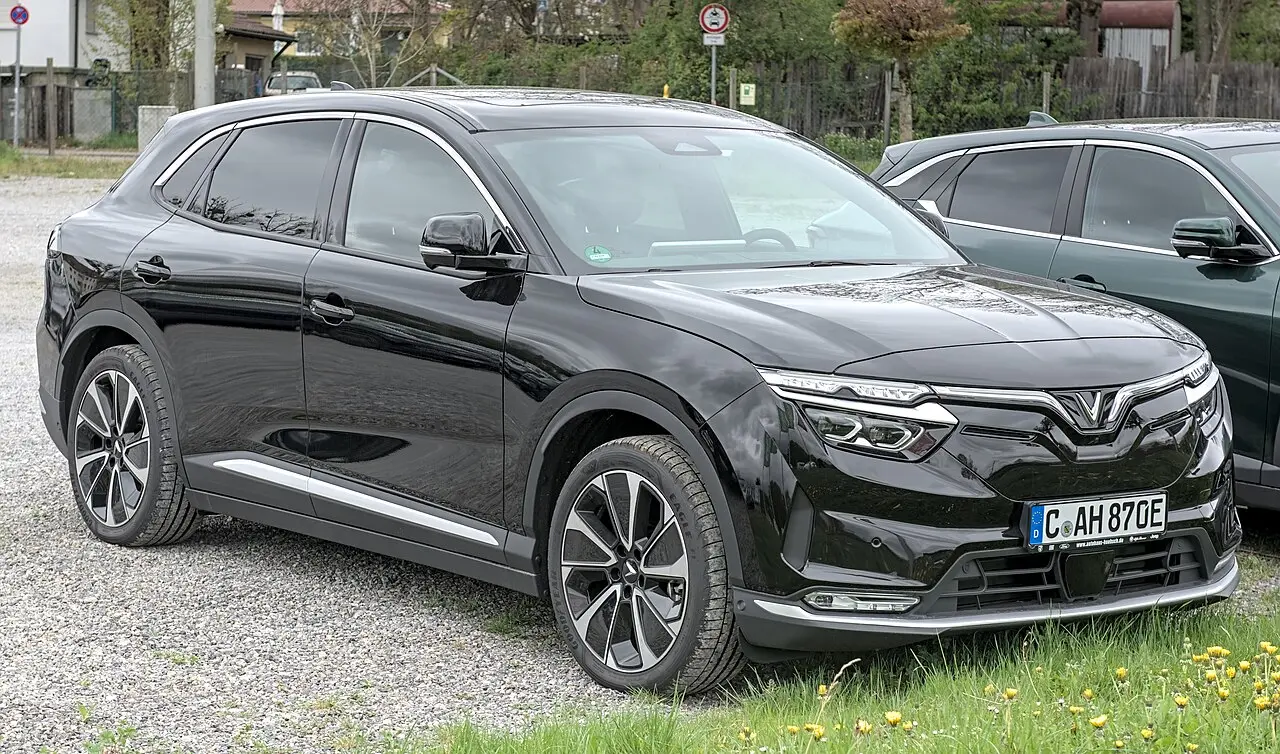
The VinFast VF 8 First generation (since 2022): dimensions, weights, reliability and the official figures of its 9 versions in the European Union, the United States, and Canada.
Dimensions, weights and capacity
| Specification | Europe | North America | Wikipedia |
|---|---|---|---|
| Dimensions | |||
| Length | 4,750 mm RDW | – | 4,750 mm |
| Width | 1,930 mm RDW | – | 1,900 mm |
| Height | 1,670 mm RDW | – | 1,660 mm |
| Wheelbase | 2,950 mm RDW | – | 2,950 mm |
| Weights and towing | |||
| Kerb weight | 2,430–2,495 kg RDW | – | 2,100–2,250 kg |
| Mass in running order | 2,530–2,595 kg RDW | – | – |
| Gross vehicle weight | 2,905–2,970 kg RDW | – | – |
| Towing, braked trailer | 1,800 kg RDW | – | – |
| Towing, unbraked trailer | 750 kg RDW | – | – |
| Seats and space | |||
| Seats | 5 RDW | – | – |
| Doors | 5 RDW | – | – |
| Boot space | 374–378 L EV DB | – | 342 L |
| Performance | |||
| Top speed | 200 km/h RDW | – | – |
| 0–100 km/h | 5.3–6.2 s EV DB | – | 5.9 s |
| Torque | 499–620 Nm EV DB | – | 500–620 Nm |
| Electric motor power | – | 260–300 kW NRCan | – |
| Electric | |||
| Battery capacity (usable) | 82.0–87.7 kWh EV DB | – | – |
| Battery capacity (gross) | 82.0–87.7 kWh EV DB | – | – |
| Range (WLTP) | 447–471 km EV DB | – | – |
| Range (EPA/NRCan) | – | 307–412 km EPA | – |
| Energy use | 186–196 Wh/km EV DB | – | – |
| AC charging power | 11 kW EV DB | – | – |
| DC fast charging power | 150 kW EV DB | – | – |
| Charging time at 240 V | – | 12.0 h EPA | – |
NHTSA overall safety rating (US): 2024: ★★★★☆
Ranges cover the generation’s versions and body styles; European and North American versions can differ. Sources: RDW type approvals (Netherlands), Wikipedia (en, fr, pl), open EV databases (EV Compare, Open EV Data, Gaia EVDB), Natural Resources Canada, US EPA fuel economy data, NHTSA 5-Star Safety Ratings. Wikipedia figures are used under CC BY-SA 4.0.
Reliability and owner reports
Owner complaints to NHTSA (US)
63 complaints for model years 2023–2025. 11 crashes · 1 fire · 6 injuries · 4 deaths
- Driver assistance 39
Complaints are reported by owners and not checked by NHTSA; they are not adjusted for how many cars were sold, so popular models have more. NHTSA owner complaints
All 9 versions of the VinFast VF 8 First generation
European Union 6 versions
New cars registered in the EU (plus Norway and Iceland), from the European Environment Agency. Figures on the NEDC procedure until 2020 and on WLTP from 2021; versions are grouped by engine and power, with their number of registrations.
| Years and version | Engine | Power | Fuel | Consumption (combined) | CO₂ | Electric range | EU registrations |
|---|---|---|---|---|---|---|---|
| 2024–2025 | Electric motor | 300 kW (408 PS) | Electric | 21.9–22.5 kWh/100 km WLTP | 0 g/km | 457 km | 173 |
| 2024–2025 | Electric motor | 260 kW (354 PS) | Electric | 22.9 kWh/100 km WLTP | 0 g/km | 471 km | 54 |
| 2024 | Electric motor | 150 kW (204 PS) | Electric | 21.9 kWh/100 km WLTP | 0 g/km | 457 km | 92 |
| 2024 | Electric motor | 130 kW (177 PS) | Electric | 22.9 kWh/100 km WLTP | 0 g/km | 471 km | 66 |
| 2023 | Electric motor | 140 kW (190 PS) | Electric | – | 0 g/km | – | 28 |
| 2022 | Electric motor | 140 kW (190 PS) | Electric | 21.2 kWh/100 km WLTP | 0 g/km | – | 12 |
United States 1 version
Model years sold in the USA, from the EPA and the Department of Energy (fueleconomy.gov). MPG on the EPA test; litres per 100 km = 235.215 ÷ MPG.
| Years and version | Engine | Fuel | Gearbox | Drive | Consumption (combined) | CO₂ | Electric range |
|---|---|---|---|---|---|---|---|
| 2023–2027 | Electric motor | Electric | Automatic | All-wheel drive | 73–87 MPGe EPA | 0 g/km | 307–412 km |
Canada 2 versions
Model years sold in Canada, from Natural Resources Canada fuel consumption ratings (5-cycle test).
| Years and version | Engine | Power | Fuel | Gearbox | Consumption (combined) | CO₂ | Electric range |
|---|---|---|---|---|---|---|---|
| 2023–2026Sport utility vehicle: Standard | Electric motor | 260 kW (354 PS) | Electric | Automatic | 27.8–33.2 kWh/100 km 5-cycle | 0 g/km | 354–425 km |
| 2023–2026Sport utility vehicle: Standard | Electric motor | 300 kW (408 PS) | Electric | Automatic | 45.9–47.3 kWh/100 km 5-cycle | 0 g/km | 378–391 km |
Similar models from other brands
Official figures are measured on standard test procedures and differ between markets. Your consumption depends on how, where and in what conditions you drive.