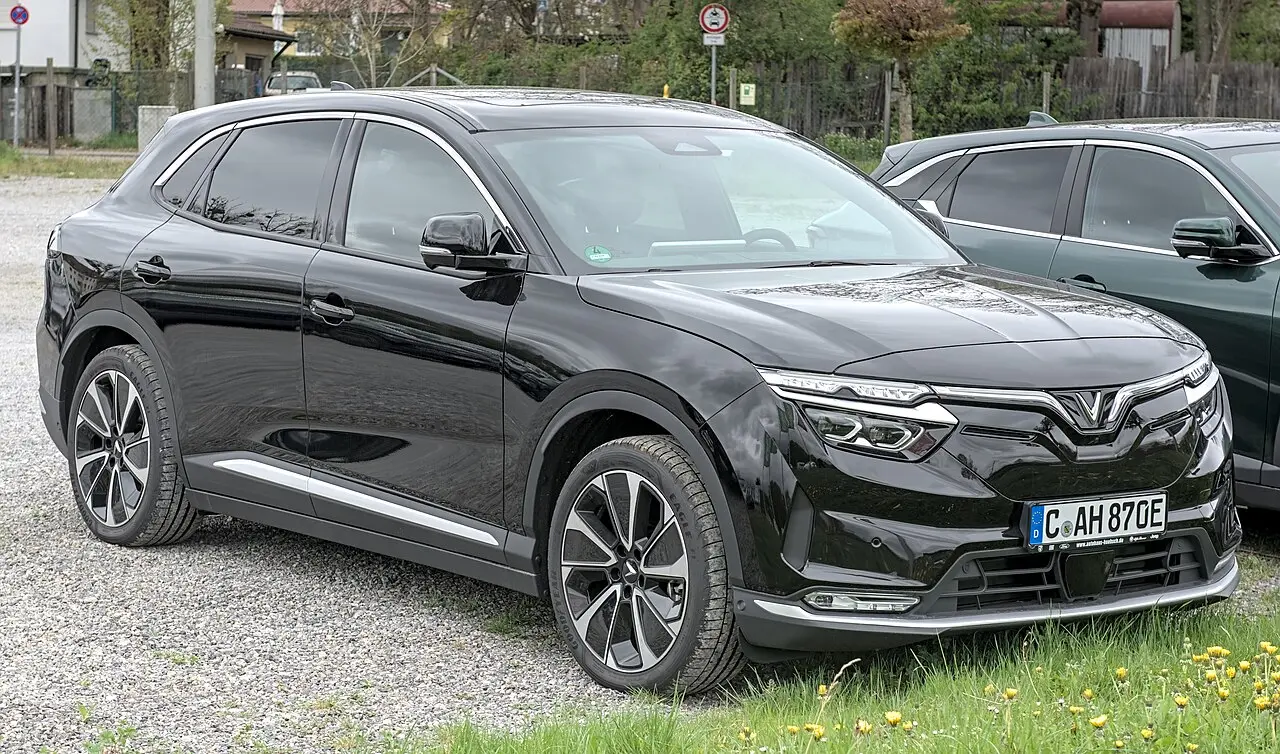
The official data lists 20 versions of the VinFast VF 8 (2022–2027), in the European Union, the United States, and Canada. Each market publishes its own figures, measured on its own test procedure.
At a glance
Years in the data
2022–2027
Markets
European Union, United States, Canada
Power
130 kW (177 PS) to 300 kW (408 PS)
Fuels
Electric
New registrations in the EU
425
What is the VinFast VF 8?
The VF 8 is a fully electric SUV in the middle of VinFast’s range, between the smaller VF 6 and larger VF 9. It was introduced as a D-segment model, with the higher seating position and versatile cabin associated with an SUV.
VinFast is a Vietnamese carmaker and part of Vingroup. The VF 8 was designed with Italian studio Pininfarina, and its first generation began in 2022.
Generations and engines
The VF 8’s first generation began in 2022 and continues today. The model is part of VinFast’s move towards an electric vehicle range.
All listed versions are electric. In the EU, power ranges from 130 kW (177 PS) to 300 kW (408 PS). Canadian NRCan listings specify 260 kW (354 PS) to 300 kW (408 PS).
Where was the VF 8 sold?
The VF 8 appears in official EU registration figures from 2022 to 2025, and in US EPA listings from 2023 to 2027. Canadian NRCan listings run from 2023 to 2026. EU registrations total 425. The most registered individual entry was the 150 kW (204 PS) electric version in 2024, with 92 registrations; the 300 kW (408 PS) version had 91 registrations in 2025 and 82 in 2024.
European, US and Canadian efficiency and emissions results use different test procedures: WLTP or NEDC in Europe, EPA in the US, and the 5-cycle test in Canada.
Questions and answers
Is the VinFast VF 8 electric?
Yes. The listed versions in the EU, US and Canada are all electric.
How much power does the VF 8 have?
EU listings range from 130 kW (177 PS) to 300 kW (408 PS). Canadian listings range from 260 kW (354 PS) to 300 kW (408 PS).
When did the VF 8 first generation begin?
The first generation began in 2022 and continues today.
Where is the VF 8 listed?
It appears in EU registration figures, US EPA listings and Canadian NRCan listings.
New cars registered in the EU (plus Norway and Iceland), from the European Environment Agency. Figures on the NEDC procedure until 2020 and on WLTP from 2021; versions are grouped by engine and power, with their number of registrations.
Years and version
Engine
Power
Fuel
Consumption (combined)
CO₂
Electric range
EU registrations
2025
Electric motor
300 kW (408 PS)
Electric
21.9 kWh/100 km WLTP
0 g/km
457 km
91
2024–2025
Electric motor
260 kW (354 PS)
Electric
22.9 kWh/100 km WLTP
0 g/km
471 km
54
2024
Electric motor
150 kW (204 PS)
Electric
21.9 kWh/100 km WLTP
0 g/km
457 km
92
2024
Electric motor
300 kW (408 PS)
Electric
22.5 kWh/100 km WLTP
0 g/km
457 km
82
2024
Electric motor
130 kW (177 PS)
Electric
22.9 kWh/100 km WLTP
0 g/km
471 km
66
2023
Electric motor
140 kW (190 PS)
Electric
–
0 g/km
–
28
2022
Electric motor
140 kW (190 PS)
Electric
21.2 kWh/100 km WLTP
0 g/km
–
12
United States 6 versions
Model years sold in the USA, from the EPA and the Department of Energy (fueleconomy.gov). MPG on the EPA test; litres per 100 km = 235.215 ÷ MPG.
Years and version
Engine
Fuel
Gearbox
Drive
Consumption (combined)
CO₂
Electric range
2027
Electric motor
Electric
Automatic
All-wheel drive
73 MPGe EPA
0 g/km
412 km
2027
Electric motor
Electric
Automatic
All-wheel drive
73 MPGe EPA
0 g/km
360 km
2025
Electric motor
Electric
Automatic
All-wheel drive
73 MPGe EPA
0 g/km
412 km
2025
Electric motor
Electric
Automatic
All-wheel drive
76 MPGe EPA
0 g/km
378 km
2023
Electric motor
Electric
Automatic
All-wheel drive
87 MPGe EPA
0 g/km
333 km
2023
Electric motor
Electric
Automatic
All-wheel drive
80 MPGe EPA
0 g/km
307 km
Canada 7 versions
Model years sold in Canada, from Natural Resources Canada fuel consumption ratings (5-cycle test).
Official figures are measured on standard test procedures and differ between markets. Your consumption depends on how, where and in what conditions you drive.