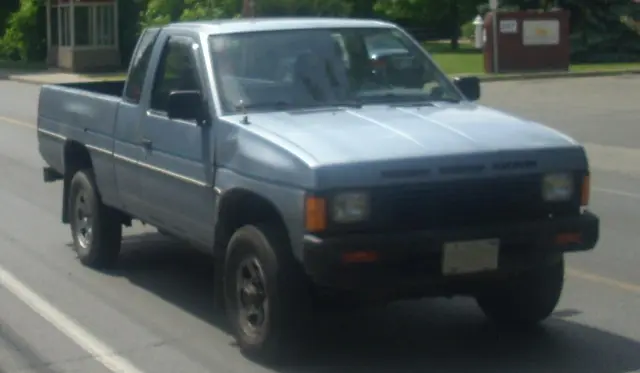
The official data lists 39 versions of the Dodge Ram 50 (1984 - 1993), in the United States. Each market publishes its own figures, measured on its own test procedure.
At a glance
Years in the data
1984 - 1993
Markets
United States
Engines
2.0 L to 3.0 L
Fuels
Petrol, Diesel
Lowest consumption (United States)
8.4 L/100 km (EPA)
What is the Dodge Ram 50?
The Dodge Ram 50 was a compact pickup sold in the United States and built by Mitsubishi for Chrysler. Its open bed gave it a smaller-truck role in Dodge’s range, alongside the larger pickups.
Generations and engines
The second generation ran from 1987 to 1993, continuing the Ram 50 as a compact pickup with a new design.
US EPA listings cover 2.0 L to 3.0 L engines, with petrol and diesel options.
How economical is the Dodge Ram 50?
The best combined US EPA rating listed for the Ram 50 is 28 MPG, and its lowest listed consumption is 8.4 L/100 km. The results vary by engine and fuel type.
The Ram 50 appears in US EPA listings from 1984 to 1993.
Questions and answers
What kind of vehicle is the Dodge Ram 50?
It is a compact pickup built by Mitsubishi and sold under Dodge’s name.
When was the second-generation Ram 50 sold?
The second generation ran from 1987 to 1993.
What engines did the Ram 50 use?
US listings cover 2.0 L to 3.0 L engines, with petrol and diesel options.
What is its best official fuel economy?
The best combined US EPA figure listed is 28 MPG, and its lowest listed consumption is 8.4 L/100 km.
Ram 50 first generation (1981 - 1986)
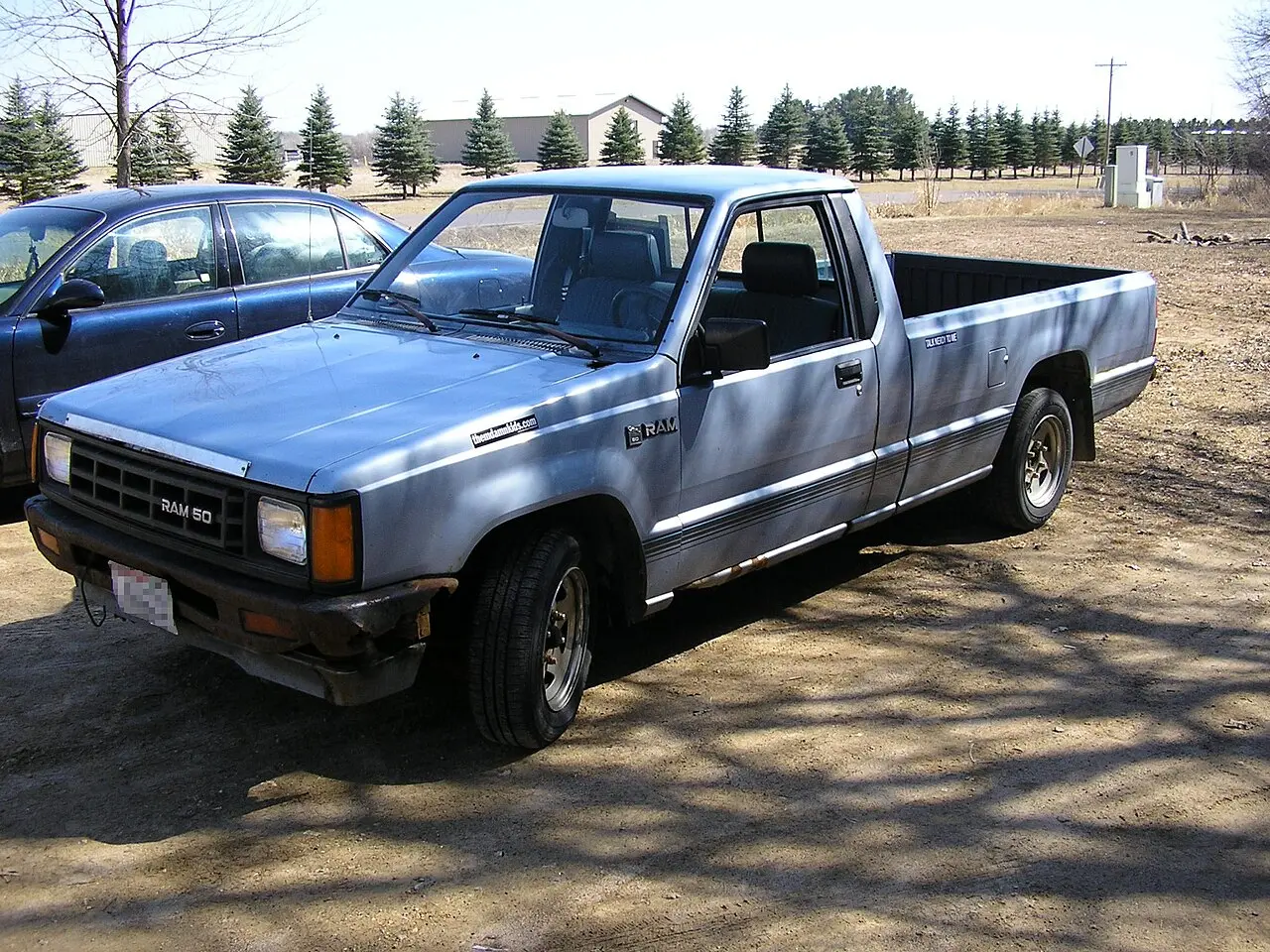
No photo of this generation yet; the photo shows the second generation.Photo: Lyle Putnam / Wikimedia Commons · Public domain
Model years sold in the USA, from the EPA and the Department of Energy (fueleconomy.gov). MPG on the EPA test; litres per 100 km = 235.215 ÷ MPG.
Years and version
Engine
Fuel
Gearbox
Drive
Consumption (combined)
CO₂
1991 - 1993(FFS) · SOHC (FFS)
2.4 L
Petrol
4-speed automatic
Rear-wheel drive
19 MPG (12.4 L/100 km) EPA
291 g/km
1990 - 1993(FFS) · SOHC (FFS)
2.4 L
Petrol
5-speed manual
Rear-wheel drive
19 MPG (12.4 L/100 km) EPA
291 g/km
1990 - 1993(FFS)
2.4 L
Petrol
4-speed automatic
Four- or all-wheel drive
17 MPG (13.8 L/100 km) EPA
325 g/km
1990 - 1993(FFS)
2.4 L
Petrol
5-speed manual
Four- or all-wheel drive
18 MPG (13.1 L/100 km) EPA
307 g/km
1990 - 1992(FFS)
3.0 L
Petrol
4-speed automatic
Four- or all-wheel drive
16 MPG (14.7 L/100 km) EPA
345 g/km
1990 - 1992(FFS)
3.0 L
Petrol
5-speed manual
Four- or all-wheel drive
17 MPG (13.8 L/100 km) EPA
325 g/km
1990(FFS)
2.4 L
Petrol
4-speed automatic
Rear-wheel drive
18 MPG (13.1 L/100 km) EPA
307 g/km
1987 - 1989(FFS)
2.0 L
Petrol
4-speed automatic
Rear-wheel drive
22 MPG (10.7 L/100 km) EPA
251 g/km
1987 - 1989(FFS)
2.0 L
Petrol
5-speed manual
Rear-wheel drive
23 MPG (10.2 L/100 km) EPA
240 g/km
1987 - 1989(FFS)
2.6 L
Petrol
5-speed manual
Rear-wheel drive
20 MPG (11.8 L/100 km) EPA
276 g/km
1987 - 1989(FFS)
2.6 L
Petrol
4-speed automatic
Rear-wheel drive
19 - 20 MPG (11.8 - 12.4 L/100 km) EPA
276 - 291 g/km
1987 - 1989(FFS)
2.6 L
Petrol
4-speed automatic
Four- or all-wheel drive
16 - 18 MPG (13.1 - 14.7 L/100 km) EPA
307 - 345 g/km
1988 - 1989(FFS)
2.6 L
Petrol
5-speed manual
Four- or all-wheel drive
17 - 18 MPG (13.1 - 13.8 L/100 km) EPA
307 - 325 g/km
Dodge Ram 50 recalls
2 official safety recalls for the Dodge Ram 50 from NHTSA (United States), DVSA (United Kingdom) and the EU Safety Gate, newest first. Recall repairs are normally free at the maker’s dealers.
Front seat belt buckle buttons may break1986 - 1991
Official figures are measured on standard test procedures and differ between markets. Your consumption depends on how, where and in what conditions you drive.