Dodge

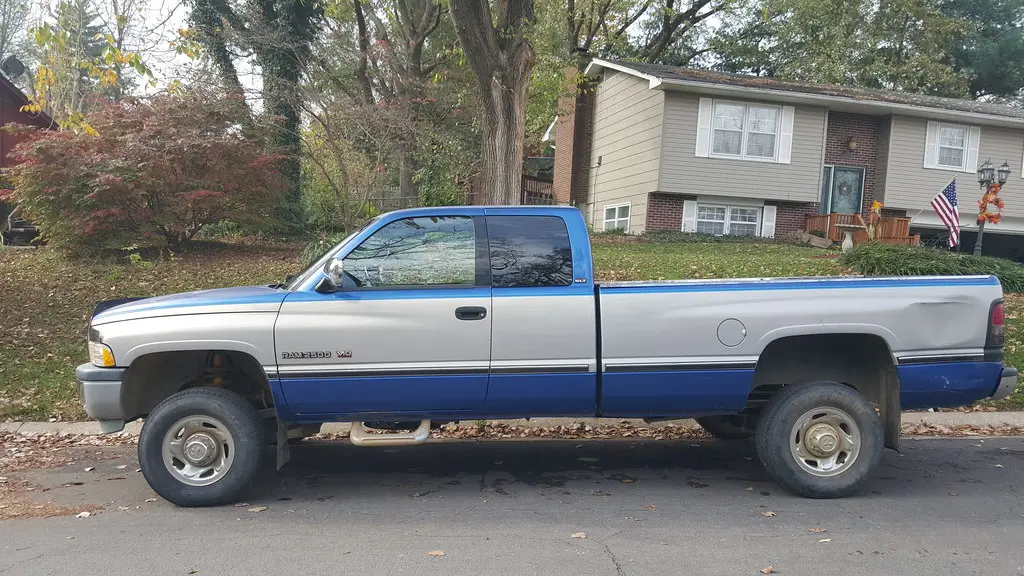
Dodge Ram 2500

Dodge Ram 2500
Photo: Robert Stinnett / Wikimedia Commons · CC BY 2.0

The official data lists 31 versions of the Dodge Ram 2500 (1994–1996), in the United States and Canada. Each market publishes its own figures, measured on its own test procedure.

At a glance

Years in the data
1994–1996
Markets
United States, Canada
Engines
5.2 L to 5.9 L
Fuels
Petrol
Lowest consumption (United States)
16.8 L/100 km (EPA)
Lowest consumption (Canada)
17.6 L/100 km (5-cycle)

What is the Dodge Ram 2500?

The Ram 2500 is a heavy-duty, full-size pickup in Dodge’s Ram line, suited to work that calls for a substantial truck. The second generation, introduced in 1994, brought a tall front end and large grille inspired by big rigs, giving Dodge trucks a distinctive new look.

Generations and engines

The Ram 2500 belongs to the second generation, identified by the BR and BE codes. In the United States and Canada, the listed model years are 1994–1996. Petrol engine sizes range from 5.2 L to 5.9 L.

How economical is the Ram 2500?

For US models from 1994–1996, the best combined EPA rating is 14 MPG. The lowest listed consumption is 16.8 L/100 km under the EPA procedure. In Canada, the lowest listed consumption for 1995–1996 is 17.6 L/100 km under the NRCan 5-cycle test. These procedures differ, so the results are best read within their own markets.

Where was it sold?

The Ram 2500 appears in US figures for 1994–1996, with 15 versions, and Canadian figures for 1995–1996, with 16 versions. Petrol is listed in both markets.

Questions and answers

Which generation of Ram 2500 is covered?

The second generation, identified by the BR and BE codes, for 1994–1996.

What engine sizes are listed?

Petrol engines from 5.2 L to 5.9 L.

What is its best official fuel economy figure?

The best US result is 14 MPG combined under the EPA procedure.

Why do the US and Canadian consumption figures differ?

The US uses the EPA test, while Canada uses NRCan’s 5-cycle test. Different procedures can produce different results.

Ram 2500 second generation (1994–1996)

Dodge Ram 2500 second generation
Photo: Robert Stinnett / Wikimedia Commons · CC BY 2.0

Model codes: BR, BE · References: en.wikipedia.org, iseecars.com

United States 15 versions

Model years sold in the USA, from the EPA and the Department of Energy (fueleconomy.gov). MPG on the EPA test; litres per 100 km = 235.215 ÷ MPG.

Years and versionEngineFuelGearboxDriveConsumption (combined)CO₂
1994–1996(FFS), Creeper5.2 LPetrol5-speed manualRear-wheel drive13 MPG (18.1 L/100 km) EPA425 g/km
1994–1996(FFS) · (FFS), CLKUP5.2 LPetrol4-speed automaticFour- or all-wheel drive12 MPG (19.6 L/100 km) EPA460 g/km
1996(FFS), Creeper5.2 LPetrol5-speed manualFour- or all-wheel drive12 MPG (19.6 L/100 km) EPA460 g/km
1996(FFS), CLKUP5.2 LPetrol4-speed automaticRear-wheel drive14 MPG (16.8 L/100 km) EPA394 g/km
1994–1996(FFS) · (FFS), CLKUP5.9 LPetrol4-speed automaticFour- or all-wheel drive12 MPG (19.6 L/100 km) EPA460 g/km
1995–1996(FFS), Creeper5.9 LPetrol5-speed manualFour- or all-wheel drive12 MPG (19.6 L/100 km) EPA460 g/km
1996(FFS), CLKUP5.9 LPetrol4-speed automaticRear-wheel drive13 MPG (18.1 L/100 km) EPA425 g/km
1996(FFS), Creeper5.9 LPetrol5-speed manualRear-wheel drive12 MPG (19.6 L/100 km) EPA460 g/km
1995(FFS)5.2 LPetrol4-speed automaticRear-wheel drive13 MPG (18.1 L/100 km) EPA425 g/km
1995(FFS), Creeper5.2 LPetrol5-speed manualFour- or all-wheel drive13 MPG (18.1 L/100 km) EPA425 g/km
1994–1995(FFS)5.9 LPetrol4-speed automaticRear-wheel drive12 MPG (19.6 L/100 km) EPA460 g/km
1994–1995(FFS), Creeper5.9 LPetrol5-speed manualRear-wheel drive13 MPG (18.1 L/100 km) EPA425 g/km
1994(FFS)5.2 LPetrol4-speed automaticRear-wheel drive13 MPG (18.1 L/100 km) EPA425 g/km
1994(FFS), Creeper5.2 LPetrol5-speed manualFour- or all-wheel drive12 MPG (19.6 L/100 km) EPA460 g/km
1994(FFS), Creeper5.9 LPetrol5-speed manualFour- or all-wheel drive13 MPG (18.1 L/100 km) EPA425 g/km

Canada 16 versions

Model years sold in Canada, from Natural Resources Canada fuel consumption ratings (5-cycle test).

Years and versionEngineFuelGearboxConsumption (combined)CO₂
1996Pickup truck: Standard5.2 LPetrol4-speed automatic17.6 L/100 km 5-cycle405 g/km
1996Pickup truck: Standard5.2 LPetrol5-speed manual18.4 L/100 km 5-cycle423 g/km
1996Pickup truck: Standard5.2 LPetrol4-speed automatic18.8 L/100 km 5-cycle432 g/km
1996Pickup truck: Standard5.2 LPetrol5-speed manual20.0 L/100 km 5-cycle460 g/km
1996Pickup truck: Standard5.9 LPetrol4-speed automatic18.6 L/100 km 5-cycle428 g/km
1996Pickup truck: Standard5.9 LPetrol5-speed manual19.9 L/100 km 5-cycle458 g/km
1996Pickup truck: Standard5.9 LPetrol4-speed automatic20.3 L/100 km 5-cycle467 g/km
1996Pickup truck: Standard5.9 LPetrol5-speed manual20.1 L/100 km 5-cycle462 g/km
1995Pickup truck: Standard5.2 LPetrol4-speed automatic18.5 L/100 km 5-cycle426 g/km
1995Pickup truck: Standard5.2 LPetrol5-speed manual18.7 L/100 km 5-cycle430 g/km
1995Pickup truck: Standard5.2 LPetrol4-speed automatic19.1 L/100 km 5-cycle439 g/km
1995Pickup truck: Standard5.2 LPetrol5-speed manual18.9 L/100 km 5-cycle435 g/km
1995Pickup truck: Standard5.9 LPetrol4-speed automatic19.5 L/100 km 5-cycle449 g/km
1995Pickup truck: Standard5.9 LPetrol5-speed manual19.1 L/100 km 5-cycle439 g/km
1995Pickup truck: Standard5.9 LPetrol4-speed automatic20.7 L/100 km 5-cycle476 g/km
1995Pickup truck: Standard5.9 LPetrol5-speed manual19.9 L/100 km 5-cycle458 g/km

Official figures are measured on standard test procedures and differ between markets. Your consumption depends on how, where and in what conditions you drive.