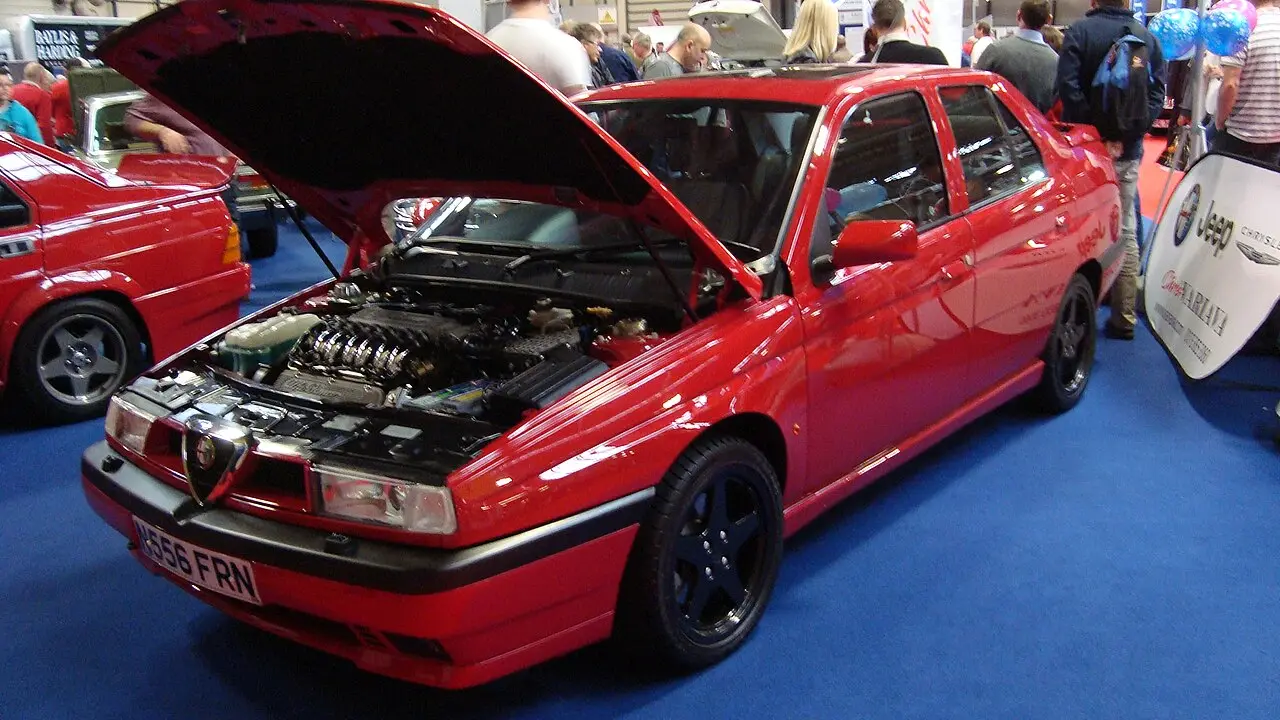
What is the Alfa Romeo 155?
The Alfa Romeo 155 is a four-door family saloon from the Milanese marque. It brought Alfa Romeo’s sporting identity into a practical shape: a conventional boot, room for everyday passengers and a range of engines aimed at drivers who wanted more character than a purely utilitarian car offered. It sat in the middle of the company’s range, below larger executive models.
The 155 also had a visible life in touring-car competition, which helped make the name familiar beyond Italy. Its squared-off body and purposeful stance give it a different look from the softer, rounded Alfa saloons that followed.
Engines and generations
The 155 was offered with petrol engines, including Alfa Romeo’s Twin Spark four-cylinders, as well as larger petrol options. Some versions used turbocharging and four-wheel drive. Its engines ranged from Twin Spark four-cylinders to larger petrol options, with turbocharging and four-wheel drive on selected versions.
The model is generally treated as a single generation, with a mid-life facelift bringing revised exterior details. It was followed in Alfa Romeo’s family-saloon line by the 156. Alfa Romeo’s history is closely tied to Milan, Italian design and motor racing, and the 155’s touring-car career reflects that sporting strand of the marque’s identity.
Fuel consumption, CO₂ and markets
The 155 was sold in European markets, with availability and engine choice varying by country. Its competition profile was especially prominent in touring-car racing, while road-car specifications reflected local lineups.
Questions and answers
Was the Alfa Romeo 155 a hatchback?
No. It was a four-door saloon with a separate boot.
Did the 155 have a four-wheel-drive version?
Yes. Some versions paired four-wheel drive with a turbocharged petrol engine.
What does Twin Spark mean on the 155?
Twin Spark refers to Alfa Romeo petrol engines with two spark plugs per cylinder.
Can I compare its official fuel figures with a modern Alfa Romeo?
Only with care. Test procedures and vehicle technology have changed, and the figures stated here are not version-specific.