Alfa Romeo

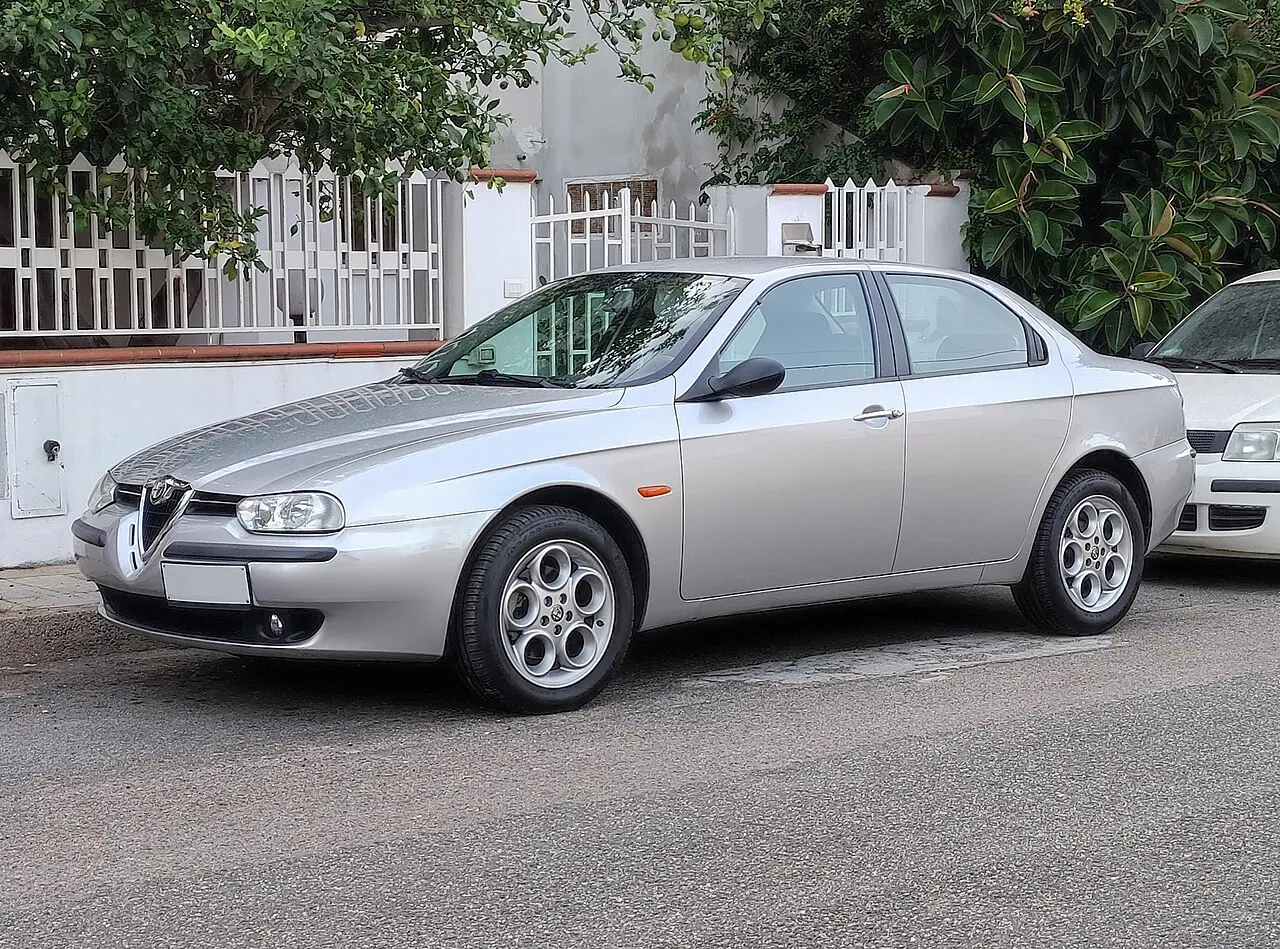
Alfa Romeo 156

Alfa Romeo 156
Photo: Salexx156 / Wikimedia Commons · CC BY-SA 4.0

The official data lists 40 versions of the Alfa Romeo 156 (2000–2010), in the European Union and the United Kingdom. Each market publishes its own figures, measured on its own test procedure.

At a glance

Years in the data
2000–2010
Markets
European Union, United Kingdom
Engines
1.6 L to 3.2 L
Fuels
Diesel, Petrol
Lowest consumption (United Kingdom)
5.8 L/100 km (NEDC)
New registrations in the EU
10

What is the Alfa Romeo 156?

The Alfa Romeo 156 is a family saloon with a distinctly sporting character. A Sportwagon estate joined the range for drivers who wanted more room for luggage. Both body styles brought Alfa Romeo’s focus on design to a practical everyday car.

Designed by Walter de Silva, the 156 has a clean, purposeful shape. Concealed rear door handles give the saloon a coupe-like profile, while the Sportwagon adds a longer roof and a more versatile rear end.

Generations and engines

The 156 generation ran from 1997 to 2007. It was offered as a saloon and Sportwagon, with petrol and diesel engines. UK VCA figures span engines from 1.6 to 3.2 litres.

How economical is the Alfa Romeo 156?

The lowest listed UK consumption is 5.8 L/100 km on the NEDC test. This is a standardised result; everyday consumption varies with the car’s condition, route and driving style.

Official EU registration figures include 10 diesel 156s in 2010, including a 1.9-litre diesel. The EU registration years shown differ from the 156 generation dates.

Where was the 156 sold?

UK VCA figures cover 2000 to 2004, while official EU registration figures include 2010. These figures give a glimpse of the 156 in two European markets; the model was offered as both a saloon and an estate.

Questions and answers

When was the Alfa Romeo 156 generation sold?

The 156 generation ran from 1997 to 2007.

What body styles did the 156 have?

It was sold as a saloon and as the Sportwagon estate.

What is the lowest listed UK consumption?

The lowest listed UK figure is 5.8 L/100 km on the NEDC test.

What engine sizes appear in the UK figures?

The UK range spans 1.6 to 3.2 litres, with petrol and diesel versions.

156 156 (1997–2007)

Alfa Romeo 156 156
Photo: Salexx156 / Wikimedia Commons · CC BY-SA 4.0

Model codes: 932 · Sold in: European Union and United Kingdom · References: en.wikipedia.org, media.stellantis.com

United Kingdom 39 versions

New cars on sale in the UK, from the Vehicle Certification Agency. NEDC figures until 2018 and WLTP figures after; years are the editions a version appeared in.

Years and versionEngineFuelGearboxConsumption (combined)CO₂
2000–20041.6 Twin Spark 16v · 1.61.6 LPetrol5-speed manual8.2 L/100 km NEDC195 g/km
2001–20041.81.7 LPetrol5-speed manual8.5 L/100 km NEDC202 g/km
2001–20041.81.7 LPetrol5-speed manual8.6 L/100 km NEDC205 g/km
2003–20041.9 JTD1.9 LDiesel5-speed manual5.8 L/100 km NEDC155 g/km
2003–20041.9 JTD1.9 LDiesel5-speed manual6.0 L/100 km NEDC160 g/km
20041.9 JTD 16v M-Jet1.9 LDiesel6-speed manual5.9 L/100 km NEDC157 g/km
20041.9 JTD 16v M-Jet1.9 LDiesel6-speed manual6.1 L/100 km NEDC161 g/km
2002–20042.0 JTS2.0 LPetrol5-speed manual8.6 L/100 km NEDC205 g/km
2002–20042.0 JTS Selespeed2.0 LPetrol5-speed automatic8.6 L/100 km NEDC205 g/km
2002–20042.0 JTS2.0 LPetrol5-speed manual8.9 L/100 km NEDC212 g/km
2002–20042.0 JTS Selespeed2.0 LPetrol5-speed automatic8.9 L/100 km NEDC212 g/km
20042.4 JTD 20v M-Jet2.4 LDiesel6-speed manual6.6 L/100 km NEDC175 g/km
20042.4 JTD 20v M-Jet2.4 LDiesel6-speed manual6.7 L/100 km NEDC178 g/km
2002–2004GTA3.2 LPetrol6-speed manual12.1 L/100 km NEDC287 g/km
2002–2004GTA Selespeed3.2 LPetrol6-speed automatic12.1 L/100 km NEDC287 g/km
2002–2004GTA3.2 LPetrol6-speed manual12.3 L/100 km NEDC293 g/km
2002–2004GTA Selespeed3.2 LPetrol6-speed automatic12.3 L/100 km NEDC293 g/km
2000–20031.6 Twin Spark 16v · 1.61.6 LPetrol5-speed manual8.3 L/100 km NEDC198 g/km
2002–20032.4 JTD2.4 LDiesel5-speed manual6.6 L/100 km NEDC175 g/km
2002–20032.4 JTD2.4 LDiesel5-speed manual6.7 L/100 km NEDC178 g/km
2001–20032.5 V62.5 LPetrol6-speed manual11.8 L/100 km NEDC282 g/km
2000–20032.5 V6 Q-System2.5 LPetrol4-speed automatic11.9 L/100 km NEDC283 g/km
2001–20032.5 V62.5 LPetrol6-speed manual12.0 L/100 km NEDC286 g/km
2001–20032.5 V6 Q-System2.5 LPetrol4-speed automatic12.2 L/100 km NEDC291 g/km
2001–20022.02.0 LPetrol5-speed manual8.7 L/100 km NEDC207 g/km
2001–20022.0 Selespeed2.0 LPetrol5-speed automatic8.7 L/100 km NEDC207 g/km
2001–20022.02.0 LPetrol5-speed manual9.0 L/100 km NEDC214 g/km
2001–20022.0 Selespeed2.0 LPetrol5-speed automatic9.0 L/100 km NEDC214 g/km
2000–20022.4 JTD2.4 LDiesel5-speed manual6.7 L/100 km NEDC178 g/km
2000–20022.4 JTD2.4 LDiesel5-speed manual6.8 L/100 km NEDC180 g/km
2000–20011.8 Twin Spark 16v1.7 LPetrol5-speed manual8.2 L/100 km NEDC195 g/km
2000–20011.8 Twin Spark 16v1.7 LPetrol5-speed manual8.4 L/100 km NEDC199 g/km
2000–20012.0 Twin Spark 16v2.0 LPetrol5-speed manual8.5 L/100 km NEDC202 g/km
2000–20012.0 Selespeed2.0 LPetrol5-speed automatic8.5 L/100 km NEDC202 g/km
2000–20012.0 Twin Spark 16v2.0 LPetrol5-speed manual8.8 L/100 km NEDC209 g/km
2000–20012.0 Selespeed2.0 LPetrol5-speed automatic8.8 L/100 km NEDC209 g/km
2000–20012.5 V62.5 LPetrol6-speed manual11.4 L/100 km NEDC271 g/km
2000–20012.5 V62.5 LPetrol6-speed manual11.7 L/100 km NEDC280 g/km
2000–20012.5 V6 Q-System2.5 LPetrol4-speed automatic12.0 L/100 km NEDC287 g/km

Versions outside these generations

European Union 1 version

New cars registered in the EU (plus Norway and Iceland), from the European Environment Agency. Figures on the NEDC procedure until 2020 and on WLTP from 2021; versions are grouped by engine and power, with their number of registrations.

Years and versionEngineFuelCO₂EU registrations
20101.9 LDiesel153 g/km10

Official figures are measured on standard test procedures and differ between markets. Your consumption depends on how, where and in what conditions you drive.