

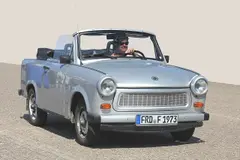


Who made the Trabant?
Trabant was an East German car marque built by VEB Sachsenring Automobilwerke in Zwickau. Its name is closely associated with the small, practical cars of the German Democratic Republic. The familiar 601 became a fixture of everyday motoring there, valued for straightforward transport and a design shaped by the materials and manufacturing available to its maker.
The 601’s body panels were made from Duroplast, a pressed material used over a steel structure. That unusual construction became one of the car’s defining features. Its compact shape and simple layout reflect a car intended to serve ordinary journeys, rather than to impress with luxury or speed.
Which Trabant models are covered?
The Trabant range here centres on one model line: the 601. It ran from 1964 to 1990, giving the marque a remarkably consistent presence across the years represented. The name is best known in saloon form, while estate versions also formed part of the 601 family.
For drivers, the 601’s appeal was its role as an uncomplicated small car for daily use. Its modest footprint suited town streets and routine travel, while its practical cabin and load space made it useful for family errands. That character helps explain why the model became so closely identified with everyday life in East Germany.
How did the 601 develop?
The 601 arrived as an evolution of earlier Trabant small cars, with updated body styling while retaining the marque’s familiar basic approach. Its two-stroke petrol engine and Duroplast body panels set it apart from more conventional designs, but the car remained focused on simple, serviceable transport.
Across its long production span, the 601 kept the same central identity: a compact car built around familiar mechanical ideas. The model’s longevity is a defining part of its story. Rather than a succession of distinct lines, the range presented here is a single name that carried Trabant through several decades.
Where does electrification and market availability fit?
The 601 is a petrol-powered car, and its character belongs to an era before electric drive became part of Trabant’s regular passenger-car identity. Its story is therefore one of a conventional small car with distinctive materials and a long-running design.
Trabant’s strongest association is with East Germany, where the marque and the 601 became everyday sights. Official market figures use different test procedures in Europe, the USA and Canada: WLTP or NEDC in Europe, EPA in the USA and the five-cycle procedure in Canada. Those results are best understood within the test system used for each market.
Questions and answers
What is Trabant best known for?
The marque is best known for the 601, an East German small car with a distinctive Duroplast body and a long production life.
What kind of engine did the Trabant 601 use?
The 601 used a two-stroke petrol engine.
Was the Trabant 601 an electric car?
No. The 601 was petrol-powered.
Which Trabant model appears here?
The model line shown is the 601, produced from 1964 to 1990.