



Who was DKW?
DKW was a German vehicle maker whose name became closely associated with small, practical cars powered by two-stroke engines. It was one of the four marques brought together in Auto Union, whose four-ring emblem represented the companies’ union. DKW’s cars served everyday drivers, while the marque also built motorcycles and, in the post-war years, the Munga off-road vehicle.
Which DKW models are listed?
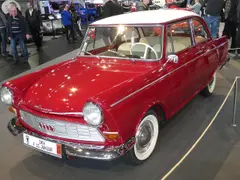
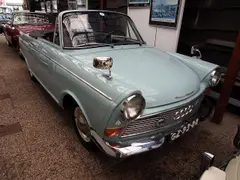
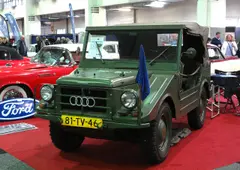
The model names here span a dozen years, from 1956 to 1968, and show two sides of DKW. The Munga was the rugged utility vehicle, while the F11 and F12 were compact passenger cars. They belonged to DKW’s post-war range, when the company was known for straightforward engineering and distinctive two-stroke power.
How did the DKW range develop?
The Munga arrived first and remained in production across the period represented here, from 1956 to 1968. Its name is commonly expanded as “Mehrzweck Universal Geländewagen mit Allradantrieb”: a versatile, all-wheel-drive vehicle for rough ground. It was designed for practical work and transport rather than family motoring alone.
The F11 and F12 followed in 1963 and ran through 1965. These compact cars carried DKW’s established two-stroke tradition into the 1960s passenger-car range. The F12 was the more developed of the pair, with features including a larger engine and front disc brakes. Together, the three models illustrate a range that combined a long-running utility vehicle with a short-lived pair of small cars.
Where can I find DKW fuel and emissions figures?
The markets listed for these models are not specified here, so there are no country-specific official fuel consumption, CO₂ or power figures to describe. Where such figures are available, test procedures matter: European results may use WLTP or the older NEDC cycle, the USA uses EPA testing, and Canada uses a five-cycle procedure. Those results should be read within their own test system.
Questions and answers
What does DKW stand for?
The initials come from the German “Dampf-Kraft-Wagen”, usually translated as “steam-powered car”. The name began with an early project and stayed with the marque even after its vehicles moved on from steam power.
What kind of vehicle was the DKW Munga?
The Munga was a compact, all-wheel-drive off-road utility vehicle intended for practical transport and work on rough terrain.
Were the DKW F11 and F12 the same car?
They were closely related compact passenger cars from the same period. The F12 was the more developed model, with updates that included a larger engine and front disc brakes.