

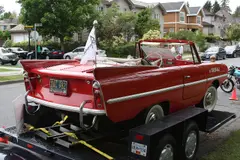
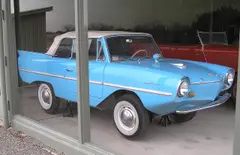




Who was Amphicar?
Amphicar was a German maker built around an unusual idea: a passenger car that could travel on roads and float on water. The project was designed by German engineer Hans Trippel and produced with backing from the Quandt industrial group. The marque’s identity was inseparable from its amphibious purpose; it did not build a broad range of ordinary family cars, sports cars or utility vehicles alongside it.
The Amphicar was aimed at drivers who wanted one vehicle for two very different settings. On land it looked like a small open-top car, while its sealed body and rear propellers let it enter the water and move under its own power. It suited curious owners drawn to the novelty and freedom of switching between road and water, as well as people with practical access to both.
What models did Amphicar make?
The 770 is the only Amphicar model line listed for 1960-1965, and it spans the entire period shown for the marque. There is no succession of named generations in this range: the 770 is the story. Its name and design reflect the central aim of combining everyday road-car form with water-going ability.
That dual role shaped the vehicle from the outset. Its body had to keep water out, and its rear propellers provided propulsion afloat. The driver could use it as a car on the road, then make the transition to water when conditions allowed. This was a distinctive engineering and design challenge, but the idea remained focused on one model rather than expanding into a family of different Amphicars.
How did the Amphicar range develop?
Across the years covered, Amphicar’s range stayed concentrated on the 770. That makes the marque unusual: its history here is not a sequence of new models, but a single, clearly defined concept carried through the period. The car combined a convertible passenger-car layout with the equipment and watertight construction needed for amphibious use.
The 770 was conceived by Trippel, whose work centered on amphibious vehicles. Production in Germany brought that idea to civilian motorists in the form of a road-going car. Amphicar’s place in motoring history rests on that blend of functions: it brought the water-going capability into a recognisable passenger-car shape rather than asking owners to choose between a car and a separate boat.
Was the Amphicar electric, and where was it sold?
The Amphicar 770 was powered by a petrol engine, with power routed to the rear wheels on land and to propellers in the water. It was not an electric model. Amphicar was a German make, though the available market information does not identify specific national markets for its cars.
Official fuel-consumption and CO₂ figures are not available here, so there is no basis for quoting a comparable efficiency result. Where official figures are published for cars sold in different regions, the test procedures differ: Europe has used NEDC and WLTP, the USA uses EPA testing, and Canada uses a five-cycle procedure. Those results should be read in the context of their respective tests.
Questions and answers
What was the Amphicar 770?
It was Amphicar’s amphibious passenger car, designed to drive on roads and propel itself through water.
Who designed the Amphicar?
German engineer Hans Trippel designed the Amphicar.
Was there more than one Amphicar model line?
The model line listed for Amphicar across 1960-1965 is the 770.
Was the Amphicar electric?
No. The 770 used a petrol engine and rear propellers for travel in water.