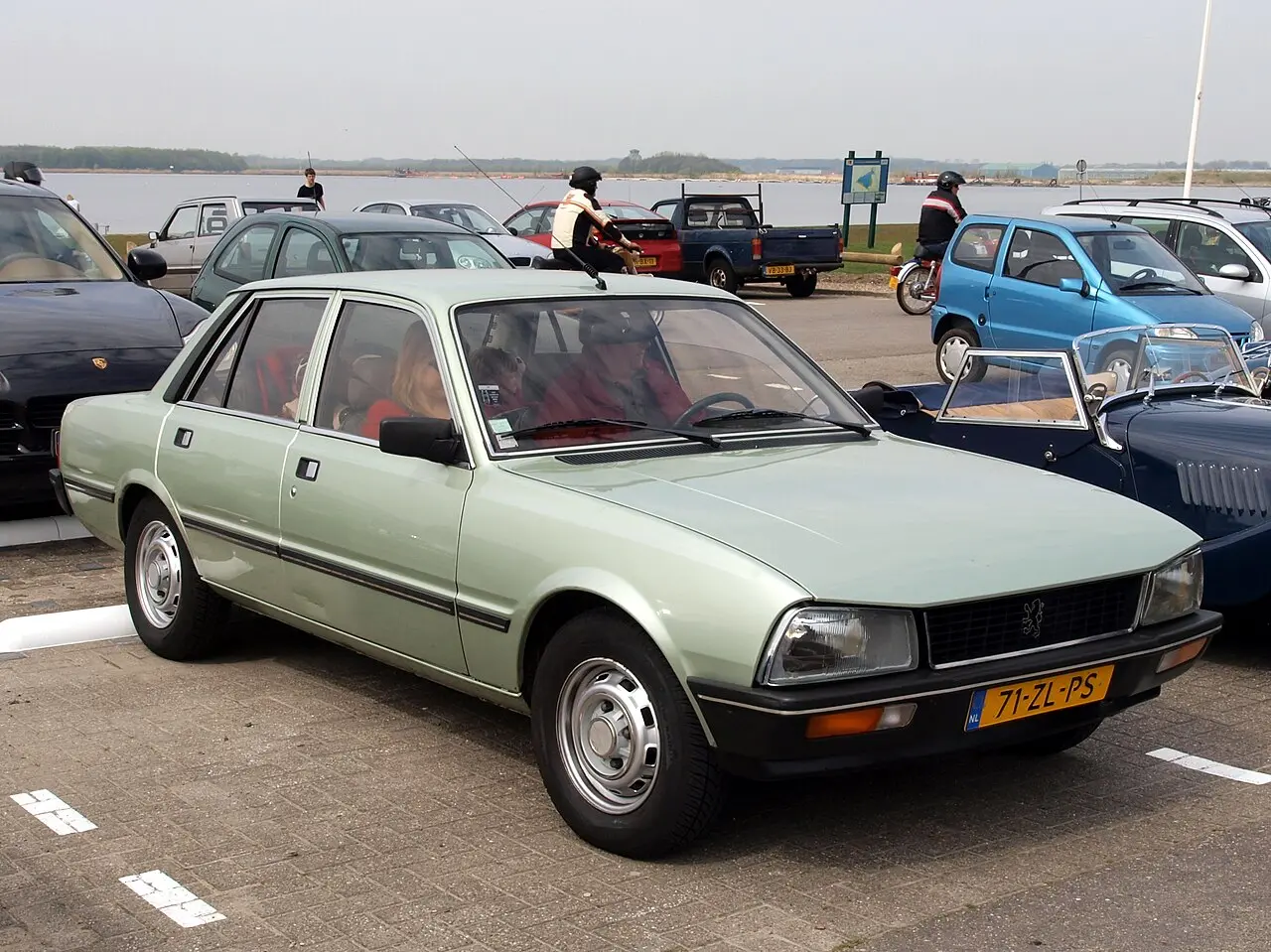
The official data lists 27 versions of the Peugeot 505 (1984 - 1992), in the United States. Each market publishes its own figures, measured on its own test procedure.
At a glance
Years in the data
1984 - 1992
Markets
United States
Engines
2.0 L to 2.9 L
Fuels
Petrol, Diesel
Lowest consumption (United States)
9.0 L/100 km (EPA)
What is the Peugeot 505?
The Peugeot 505 was a large family car, sold as a saloon and an estate. It sat among the roomier models in Peugeot’s range, with space for passengers and luggage and a conventional shape suited to everyday and long-distance travel.
Introduced in 1979, the 505 had a formal, practical design. The estate added a more versatile body style during the model’s run.
Generations and engines
The 505’s single generation ran from 1979 to 1992. The model received design updates during that time, but remained one generation.
Engine choices varied by market. In the United States, the range covered 2.0 L to 2.9 L petrol and diesel engines across 27 versions.
Fuel consumption and CO₂
US EPA figures give the 505 a best combined rating of 26 MPG. The lowest listed consumption is 9 L/100 km. These figures use the EPA test procedure.
Where was the 505 sold?
The 505 was sold in Europe and the United States. Its generation ran from 1979 to 1992, while US EPA figures cover model years 1984-1992. It was available as a saloon and an estate.
Questions and answers
When was the Peugeot 505 sold?
Its generation ran from 1979 to 1992. US EPA figures cover 1984-1992.
What engines did the US-market 505 have?
The US range covered 2.0 L to 2.9 L petrol and diesel engines.
What is the Peugeot 505’s best recorded US fuel economy?
Its best combined EPA rating is 26 MPG. The lowest listed consumption is 9 L/100 km.
4 official safety recalls for the Peugeot 505 from NHTSA (United States), DVSA (United Kingdom) and the EU Safety Gate, newest first. Recall repairs are normally free at the maker’s dealers.
Fuel tank mounting flange may corrode and break1988 - 1992
Rear axle may be overloaded if vehicle is fully occupied1989
Official figures are measured on standard test procedures and differ between markets. Your consumption depends on how, where and in what conditions you drive.