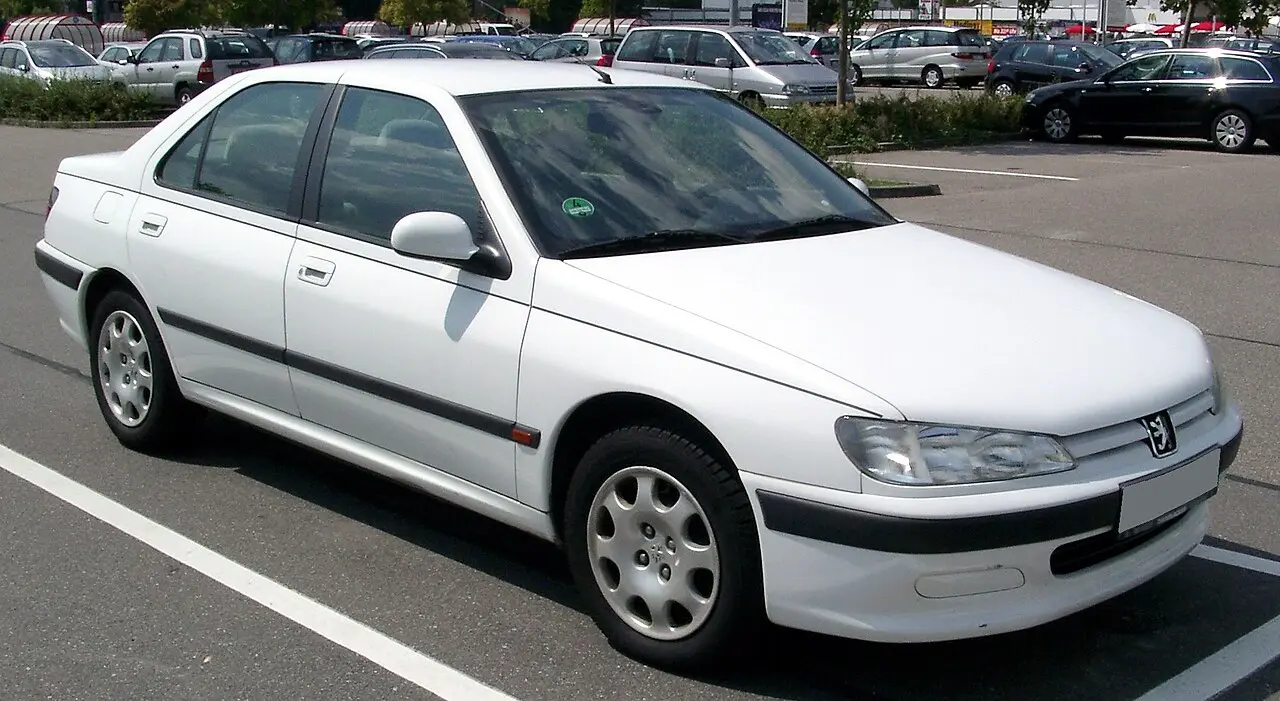
Peugeot

Peugeot 406

Peugeot 406
Photo: Rudolf Stricker / Wikimedia Commons · Attribution

The official data lists 46 versions of the Peugeot 406 (2000–2010), in the European Union and the United Kingdom. Each market publishes its own figures, measured on its own test procedure.

At a glance

Years in the data
2000–2010
Markets
European Union, United Kingdom
Engines
1.4 L to 2.9 L
Power
67 kW (91 PS) to 157 kW (213 PS)
Fuels
Petrol, Diesel
Lowest consumption (United Kingdom)
5.5 L/100 km (NEDC)
New registrations in the EU
200

What kind of car is the Peugeot 406?

The Peugeot 406 was a family car in the maker’s 400 series. Its range included a saloon and estate, as well as a coupé designed by Pininfarina, the Italian design house. The coupé gave the line a distinct two-door shape alongside its practical family-car forms.

The 406 generation ran from 1995 to 2004 and is identified by the development codes D8 and D9.

Engines and power

The UK range used petrol and diesel engines from 1.7 litres to 2.9 litres. Listed power ran from 67 kW (91 PS) to 157 kW (213 PS) across the range.

EU registration figures list petrol 1.4-litre and 1.6-litre versions in 2010. The 1.6-litre petrol accounted for 150 of the 200 registrations that year; the 1.4-litre petrol accounted for the other 50.

Fuel consumption and CO₂

The lowest listed UK fuel consumption for the 406 is 5.5 L/100 km on the NEDC test. This is the lowest result across the range; consumption varies by engine and body style.

NEDC is an earlier European test method. European figures may also use WLTP, while the USA’s EPA procedure and Canada’s 5-cycle test use different methods. Results from different markets are not directly comparable.

Where was the 406 sold?

The 406 generation ran from 1995 to 2004. UK figures cover 2000–2004, with 44 listed versions; EU registration figures show two petrol versions in 2010.

The saloon and estate gave the 406 a practical family-car role, while the Pininfarina-designed coupé brought a different shape to Peugeot’s 400 series.

Questions and answers

When was the Peugeot 406 generation sold?

The 406 generation ran from 1995 to 2004.

What body styles did the 406 range include?

It included a saloon, an estate and a coupé designed by Pininfarina.

What was the lowest listed fuel consumption?

The lowest listed UK figure is 5.5 L/100 km on the NEDC test.

What engine sizes and power were listed for UK versions?

The UK range covered 1.7-litre to 2.9-litre petrol and diesel engines, with power from 67 kW (91 PS) to 157 kW (213 PS).

406 406 (1995–2004)

Peugeot 406 406
Photo: Rudolf Stricker / Wikimedia Commons · Attribution

Model codes: D8, D9 · Sold in: European Union and United Kingdom · References: peugeot.nl, 406coupeclub.org

United Kingdom 44 versions

New cars on sale in the UK, from the Vehicle Certification Agency. NEDC figures until 2018 and WLTP figures after; years are the editions a version appeared in.

Years and versionEnginePowerFuelGearboxConsumption (combined)CO₂
2001–20041.8 (116 bhp)1.7 L87 kW (118 PS)Petrol5-speed manual7.7 L/100 km NEDC182 g/km
2001–20041.8 (116 bhp)1.7 L87 kW (118 PS)Petrol5-speed manual7.9 L/100 km NEDC187 g/km
2002–20042.0 HDi (90 bhp)2.0 L67 kW (91 PS)Diesel5-speed manual5.5 L/100 km NEDC148 g/km
2002–20042.0 HDi (90 bhp)2.0 L67 kW (91 PS)Diesel5-speed manual5.7 L/100 km NEDC151 g/km
2001–20042.0 Hdi turbo (110 bhp) · 2.0 HDi (110 bhp)2.0 L82 kW (111 PS)Diesel5-speed manual5.6 L/100 km NEDC147 g/km
2001–20042.0 Hdi turbo (110 bhp) · 2.0 HDi (110 bhp)2.0 L82 kW (111 PS)Diesel5-speed manual5.7 L/100 km NEDC149 g/km
2002–20042.0 HDi (110 bhp)2.0 L82 kW (111 PS)Diesel4-speed automatic6.5 L/100 km NEDC173 g/km
2003–20042.0 HDi (110 bhp)2.0 L82 kW (111 PS)Diesel4-speed automatic6.7 L/100 km NEDC178 g/km
2001–20042.0 (138 bhp)2.0 L103 kW (140 PS)Petrol5-speed manual8.3 L/100 km NEDC197 g/km
2001–20042.0 (138 bhp)2.0 L103 kW (140 PS)Petrol4-speed automatic8.6 L/100 km NEDC206 g/km
2001–20042.0 (138 bhp)2.0 L103 kW (140 PS)Petrol5-speed manual8.4 L/100 km NEDC200 g/km
2001–20042.0 (138 bhp)2.0 L103 kW (140 PS)Petrol4-speed automatic8.7 L/100 km NEDC208 g/km
2002–20042.0 HPi (143 bhp)2.0 L107 kW (145 PS)Petrol5-speed manual7.5 L/100 km NEDC177 g/km
2002–20042.0 HPi (143 bhp)2.0 L107 kW (145 PS)Petrol5-speed manual7.7 L/100 km NEDC185 g/km
2001–20042.2 Hdi turbo (136 bhp) · 2.2 HDi FAP (136 bhp)2.2 L101 kW (138 PS)Diesel5-speed manual6.4 L/100 km NEDC168 g/km
2001–20042.2 Hdi turbo (136 bhp) · 2.2 HDi FAP (136 bhp)2.2 L101 kW (138 PS)Diesel5-speed manual6.5 L/100 km NEDC170 g/km
2001–20042.2 (160 bhp)2.2 L119 kW (162 PS)Petrol5-speed manual8.8 L/100 km NEDC210 g/km
2000–20043.0 V6 210 bhp · 3.0 V6 (210 bhp)2.9 L157 kW (213 PS)Petrol5-speed manual9.8 L/100 km NEDC234 g/km
2001–20043.0 V6 (210 bhp)2.9 L157 kW (213 PS)Petrol4-speed automatic10.2 L/100 km NEDC243 g/km
2001–20043.0 V6 (210 bhp)2.9 L157 kW (213 PS)Petrol5-speed manual10.0 L/100 km NEDC238 g/km
2000–20043.0 V6 210 bhp · 3.0 V6 (210 bhp)2.9 L157 kW (213 PS)Petrol4-speed automatic10.4 L/100 km NEDC248 g/km
2000–20043.0 V6 210 bhp · 3.0 V6 (210 bhp)2.9 L157 kW (213 PS)Petrol5-speed manual9.6 L/100 km NEDC229 g/km
2000–20043.0 V6 210 bhp · 3.0 V6 (210 bhp)2.9 L157 kW (213 PS)Petrol4-speed automatic10.0 L/100 km NEDC238 g/km
2001–20022.2 (160 bhp)2.2 L119 kW (162 PS)Petrol5-speed manual8.9 L/100 km NEDC212 g/km
20011.8 (112 bhp)1.7 L84 kW (114 PS)Petrol5-speed manual7.7 L/100 km NEDC182 g/km
20011.8 (112 bhp)1.7 L84 kW (114 PS)Petrol5-speed manual7.9 L/100 km NEDC187 g/km
2000–20011.8 112 bhp · 1.8 (112 bhp)1.8 L84 kW (114 PS)Petrol5-speed manual8.7 L/100 km NEDC209 g/km
2000–20011.8 112 bhp · 1.8 (112 bhp)1.8 L84 kW (114 PS)Petrol5-speed manual9.0 L/100 km NEDC214 g/km
20012.0 Hdi turbo (90 bhp) · 2.0 HDi (90 bhp)2.0 L67 kW (91 PS)Diesel5-speed manual5.7 L/100 km NEDC150 g/km
20012.0 Hdi turbo (90 bhp) · 2.0 HDi (90 bhp)2.0 L67 kW (91 PS)Diesel5-speed manual5.9 L/100 km NEDC155 g/km
2000–2001Hdi Turbo 90 bhp · Hdi Turbo (90 bhp) · 2.0 HDi Turbo (90 bhp)2.0 L67 kW (91 PS)Diesel5-speed manual5.6 L/100 km NEDC154 g/km
2000–2001Hdi Turbo 90 bhp · Hdi Turbo (90 bhp) · 2.0 HDi Turbo (90 bhp)2.0 L67 kW (91 PS)Diesel5-speed manual5.8 L/100 km NEDC160 g/km
2000–2001Hdi Turbo 110 bhp · Hdi Turbo (110 bhp) · 2.0 HDi Turbo (110 bhp)2.0 L82 kW (111 PS)Diesel5-speed manual5.5 L/100 km NEDC150 g/km
2000–2001Hdi Turbo 110 bhp · Hdi Turbo (110 bhp) · 2.0 HDi Turbo (110 bhp)2.0 L82 kW (111 PS)Diesel5-speed manual5.7 L/100 km NEDC156 g/km
20012.0 (137 bhp)2.0 L102 kW (139 PS)PetrolAutomatic8.6 L/100 km NEDC206 g/km
2000–20012.0 137 bhp · 2.0 (137 bhp)2.0 L102 kW (139 PS)Petrol4-speed automatic8.6 L/100 km NEDC206 g/km
20012.0 (137 bhp)2.0 L102 kW (139 PS)Petrol5-speed manual8.3 L/100 km NEDC197 g/km
20012.0 (137 bhp)2.0 L102 kW (139 PS)Petrol5-speed manual8.4 L/100 km NEDC200 g/km
2000–20012.0 137 bhp · 2.0 (137 bhp)2.0 L102 kW (139 PS)Petrol5-speed manual8.3 L/100 km NEDC203 g/km
2000–20012.0 137 bhp · 2.0 (137 bhp)2.0 L102 kW (139 PS)Petrol5-speed manual8.4 L/100 km NEDC207 g/km
2000–20012.0 137 bhp · 2.0 (137 bhp)2.0 L102 kW (139 PS)Petrol4-speed automatic8.7 L/100 km NEDC208 g/km
2000–20012.0 137 bhp · 2.0 (137 bhp)2.0 L102 kW (139 PS)Petrol5-speed manual8.4 L/100 km NEDC206 g/km
2000–20013.0 V6 210 bhp · 3.0 V6 (210 bhp)2.9 L157 kW (213 PS)Petrol4-speed automatic10.2 L/100 km NEDC243 g/km
2000–20013.0 V6 210 bhp · 3.0 V6 (210 bhp)2.9 L157 kW (213 PS)Petrol5-speed manual10.0 L/100 km NEDC238 g/km

Versions outside these generations

European Union 2 versions

New cars registered in the EU (plus Norway and Iceland), from the European Environment Agency. Figures on the NEDC procedure until 2020 and on WLTP from 2021; versions are grouped by engine and power, with their number of registrations.

Years and versionEngineFuelCO₂EU registrations
20101.6 LPetrol141 g/km150
20101.4 LPetrol145 g/km50

Official figures are measured on standard test procedures and differ between markets. Your consumption depends on how, where and in what conditions you drive.