

Ford F-150 fourteenth generation
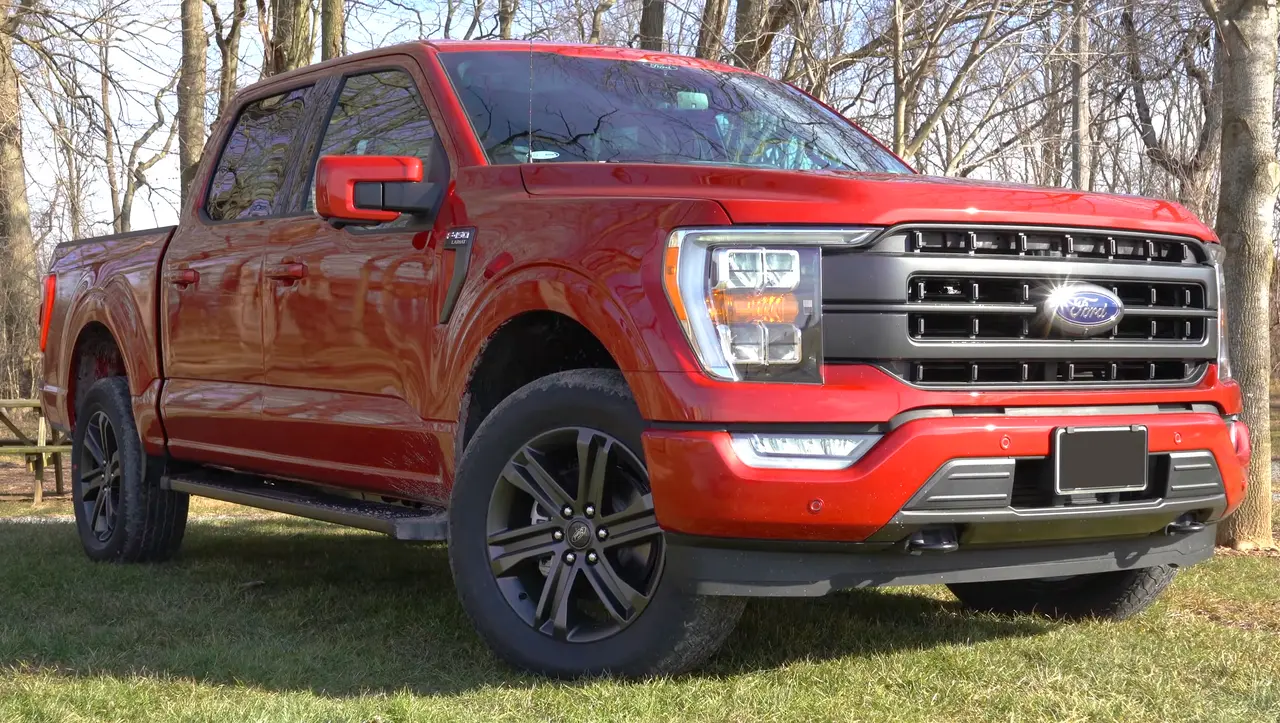
The Ford F-150 fourteenth generation (since 2021): dimensions, weights, reliability and the official figures of its 44 versions in the European Union, the United States, and Canada.
Model codes: P702
Dimensions, weights and capacity
| Specification | Europe | North America | Wikipedia |
|---|---|---|---|
| Dimensions | |||
| Length | – | 5,260–6,310 mm TC | 5,311–6,358 mm |
| Width | – | 2,030–2,200 mm TC | 2,029–2,200 mm |
| Height | – | 1,910–2,030 mm TC | 1,910–2,050 mm |
| Wheelbase | – | 3,120–4,170 mm TC | 3,119–4,168 mm |
| Front track | – | 1,720–1,880 mm TC | – |
| Rear track | – | 1,730–1,870 mm TC | – |
| Weights and towing | |||
| Kerb weight | – | 1,823–2,584 kg TC | 1,824 kg |
| Seats and space | |||
| Boot space | 592 L EV DB | – | – |
| Performance | |||
| Top speed | 177 km/h EV DB | – | – |
| 0–100 km/h | 4.0–4.5 s EV DB | – | – |
| Torque | 1,051 Nm EV DB | – | – |
| Electric motor power | – | 318–420 kW NRCan | – |
| Electric | |||
| Battery capacity (usable) | 91.0–123.0 kWh EV DB | – | – |
| Battery capacity (gross) | 98.0–131.0 kWh EV DB | – | – |
| Range (EPA/NRCan) | – | 370–515 km EPA | – |
| AC charging power | 11 kW EV DB | – | – |
| DC fast charging power | 150–155 kW EV DB | – | – |
| Charging time at 240 V | – | 9.3–14.6 h EPA | – |
NHTSA overall safety rating (US): 2021–2026: ★★★★★
Ranges cover the generation’s versions and body styles; European and North American versions can differ. Sources: Transport Canada vehicle specifications, Wikipedia (en, fr), open EV databases (EV Compare, Open EV Data, Gaia EVDB), Natural Resources Canada, US EPA fuel economy data, NHTSA 5-Star Safety Ratings. Wikipedia figures are used under CC BY-SA 4.0.
Reliability and owner reports
Owner complaints to NHTSA (US)
3,208 complaints for model years 2021–2026. 109 crashes · 32 fires · 86 injuries · 1 death
- Transmission and drivetrain 977
- Electrical system 642
- Lights 325
- Engine 233
- Brakes 209
- Fuel system 194
Complaints are reported by owners and not checked by NHTSA; they are not adjusted for how many cars were sold, so popular models have more. NHTSA owner complaints
All 44 versions of the Ford F-150 fourteenth generation
Show all 44 versions
European Union 2 versions
New cars registered in the EU (plus Norway and Iceland), from the European Environment Agency. Figures on the NEDC procedure until 2020 and on WLTP from 2021; versions are grouped by engine and power, with their number of registrations.
| Years and version | Engine | Power | Fuel | Consumption (combined) | CO₂ | Electric range | EU registrations |
|---|---|---|---|---|---|---|---|
| 2024–2025 | Electric motor | 337 kW (458 PS) | Electric | 26.6 kWh/100 km WLTP | 0 g/km | 429 km | 578 |
| 2024 | Electric motor | 92 kW (125 PS) | Electric | – | 0 g/km | – | 11 |
United States 32 versions
Model years sold in the USA, from the EPA and the Department of Energy (fueleconomy.gov). MPG on the EPA test; litres per 100 km = 235.215 ÷ MPG.
| Years and version | Engine | Fuel | Gearbox | Drive | Consumption (combined) | CO₂ | Electric range |
|---|---|---|---|---|---|---|---|
| 2021–2026SIDI & PFI | 2.7 L | Petrol | 10-speed automatic | Part-time four-wheel drive | 20–21 MPG (11.2–11.8 L/100 km) EPA | 268–281 g/km | – |
| 2021–2026SIDI & PFI | 2.7 L | Petrol | 10-speed automatic | Rear-wheel drive | 21–22 MPG (10.7–11.2 L/100 km) EPA | 251–264 g/km | – |
| 2021–2026SIDI & PFI | 3.5 L | Petrol | 10-speed automatic | Part-time four-wheel drive | 15–20 MPG (11.8–15.7 L/100 km) EPA | 277–370 g/km | – |
| 2021–2026SIDI & PFI | 3.5 L | Petrol | 10-speed automatic | Rear-wheel drive | 20 MPG (11.8 L/100 km) EPA | 272–283 g/km | – |
| 2026SIDI & PFI; Hybrid | 3.5 L | Hybrid | 10-speed automatic | Part-time four-wheel drive | 23 MPG (10.2 L/100 km) EPA | 241 g/km | – |
| 2026SIDI & PFI; Hybrid | 3.5 L | Hybrid | 10-speed automatic | Rear-wheel drive | 24 MPG (9.8 L/100 km) EPA | 231 g/km | – |
| 2024–2026SIDI & PFI | 5.0 L | Petrol | 10-speed automatic | Part-time four-wheel drive | 17–19 MPG (12.4–13.8 L/100 km) EPA | 293–325 g/km | – |
| 2024–2026SIDI & PFI | 5.0 L | Petrol | 10-speed automatic | Rear-wheel drive | 19 MPG (12.4 L/100 km) EPA | 291–294 g/km | – |
| 2023–2026 | 5.2 L | Petrol | 10-speed automatic | Part-time four-wheel drive | 12 MPG (19.6 L/100 km) EPA | 460 g/km | – |
| 2022–2025 | Electric motor | Electric | Automatic | All-wheel drive | 66–70 MPGe EPA | 0 g/km | 370–515 km |
| 2025 | Electric motor | Electric | Automatic | Four-wheel drive | 72 MPGe EPA | 0 g/km | 483 km |
| 2021–2025SIDI; Hybrid | 3.5 L | Hybrid | 10-speed automatic | Part-time four-wheel drive | 23–24 MPG (9.8–10.2 L/100 km) EPA | 229–240 g/km | – |
| 2023SIDI & PFI; with Stop-start | 2.7 L | Petrol | 10-speed automatic | Rear-wheel drive | 22 MPG (10.7 L/100 km) EPA | 252 g/km | – |
| 2023SIDI; with Stop-Start | 2.7 L | Petrol | 10-speed automatic | Rear-wheel drive | 21 MPG (11.2 L/100 km) EPA | 268 g/km | – |
| 2023SIDI & PFI; with Stop-start | 2.7 L | Petrol | 10-speed automatic | Part-time four-wheel drive | 20 MPG (11.8 L/100 km) EPA | 270 g/km | – |
| 2022–2023FFV · FFV; with Stop-start | 3.3 L | Flex fuel (E85) | 10-speed automatic | Rear-wheel drive | 21 MPG (11.2 L/100 km) EPA | 263 g/km | – |
| 2022–2023FFV · FFV; with Stop-start | 3.3 L | Flex fuel (E85) | 10-speed automatic | Part-time four-wheel drive | 20 MPG (11.8 L/100 km) EPA | 276 g/km | – |
| 2023FFV | 3.3 L | Flex fuel (E85) | 10-speed automatic | Rear-wheel drive | 20 MPG (11.8 L/100 km) EPA | 275 g/km | – |
| 2021–2023SIDI & PFI; Stop-Start · SIDI & PFI; with Stop-start | 3.5 L | Petrol | 10-speed automatic | Part-time four-wheel drive | 15–18 MPG (13.1–15.7 L/100 km) EPA | 309–359 g/km | – |
| 2022–2023SIDI; Hybrid · SIDI; Hybrid; with Stop-Start | 3.5 L | Hybrid | 10-speed automatic | Rear-wheel drive | 25 MPG (9.4 L/100 km) EPA | 219 g/km | – |
| 2023SIDI & PFI; with Stop-start | 3.5 L | Petrol | 10-speed automatic | Rear-wheel drive | 21 MPG (11.2 L/100 km) EPA | 268 g/km | – |
| 2023SIDI & PFI; with Stop-start | 3.5 L | Petrol | 10-speed automatic | Part-time four-wheel drive | 20 MPG (11.8 L/100 km) EPA | 280 g/km | – |
| 2021–2023SIDI & PFI; FFV | 5.0 L | Flex fuel (E85) | 10-speed automatic | Part-time four-wheel drive | 17–19 MPG (12.4–13.8 L/100 km) EPA | 291–322 g/km | – |
| 2021–2023SIDI & PFI; FFV | 5.0 L | Flex fuel (E85) | 10-speed automatic | Rear-wheel drive | 19–20 MPG (11.8–12.4 L/100 km) EPA | 277–289 g/km | – |
| 2022SIDI & PFI; Stop-Start | 3.5 L | Petrol | 10-speed automatic | Rear-wheel drive | 20 MPG (11.8 L/100 km) EPA | 271 g/km | – |
| 2022SIDI & PFI; Stop-Start | 3.5 L | Petrol | 10-speed automatic | Part-time four-wheel drive | 20 MPG (11.8 L/100 km) EPA | 276 g/km | – |
| 2022SIDI & PFI; FFV; Stop-Start | 5.0 L | Flex fuel (E85) | 10-speed automatic | Rear-wheel drive | 20 MPG (11.8 L/100 km) EPA | 276 g/km | – |
| 2022SIDI & PFI; FFV; Stop-Start | 5.0 L | Flex fuel (E85) | 10-speed automatic | Part-time four-wheel drive | 19 MPG (12.4 L/100 km) EPA | 291 g/km | – |
| 2021 | 3.0 L | Diesel | 10-speed automatic | Part-time four-wheel drive | 23 MPG (10.2 L/100 km) EPA | 277 g/km | – |
| 2021SIDI & PFI; FFV | 3.3 L | Flex fuel (E85) | 10-speed automatic | Rear-wheel drive | 21 MPG (11.2 L/100 km) EPA | 263 g/km | – |
| 2021SIDI & PFI; FFV | 3.3 L | Flex fuel (E85) | 10-speed automatic | Part-time four-wheel drive | 20 MPG (11.8 L/100 km) EPA | 277 g/km | – |
| 2021SIDI; Hybrid | 3.5 L | Hybrid | 10-speed automatic | Rear-wheel drive | 25 MPG (9.4 L/100 km) EPA | 217 g/km | – |
Canada 10 versions
Model years sold in Canada, from Natural Resources Canada fuel consumption ratings (5-cycle test).
| Years and version | Engine | Power | Fuel | Gearbox | Consumption (combined) | CO₂ | Electric range |
|---|---|---|---|---|---|---|---|
| 2021–2026Pickup truck: Standard | 2.7 L | – | Petrol | 10-speed automatic | 10.7–12.0 L/100 km 5-cycle | 252–282 g/km | – |
| 2021–2026Pickup truck: Standard | 3.5 L | – | Petrol | 10-speed automatic | 9.3–15.8 L/100 km 5-cycle | 217–370 g/km | – |
| 2021–2026Pickup truck: Standard | 5.0 L | – | Petrol | 10-speed automatic | 12.2–13.8 L/100 km 5-cycle | 287–322 g/km | – |
| 2023–2026Pickup truck: Standard | 5.2 L | – | Petrol | 10-speed automatic | 19.7 L/100 km 5-cycle | 460 g/km | – |
| 2022–2025Pickup truck: Standard | Electric motor | 318 kW (432 PS) | Electric | Automatic | 30.6 kWh/100 km 5-cycle | 0 g/km | 370–386 km |
| 2022–2025Pickup truck: Standard | Electric motor | 420 kW (571 PS) | Electric | Automatic | 29.2–31.5 kWh/100 km 5-cycle | 0 g/km | 483–515 km |
| 2021–2023Pickup truck: Standard | 3.3 L | – | Petrol | 10-speed automatic | 11.0–11.8 L/100 km 5-cycle | 259–277 g/km | – |
| 2021–2023Pickup truck: Standard | 3.3 L | – | Flex fuel (E85) | 10-speed automatic | 14.8–15.4 L/100 km 5-cycle | 242–256 g/km | – |
| 2021–2023Pickup truck: Standard | 5.0 L | – | Flex fuel (E85) | 10-speed automatic | 16.6–18.3 L/100 km 5-cycle | 270–303 g/km | – |
| 2021Pickup truck: Standard | 3.0 L | – | Diesel | 10-speed automatic | 10.7 L/100 km 5-cycle | 287 g/km | – |
Similar models from other brands



Official figures are measured on standard test procedures and differ between markets. Your consumption depends on how, where and in what conditions you drive.