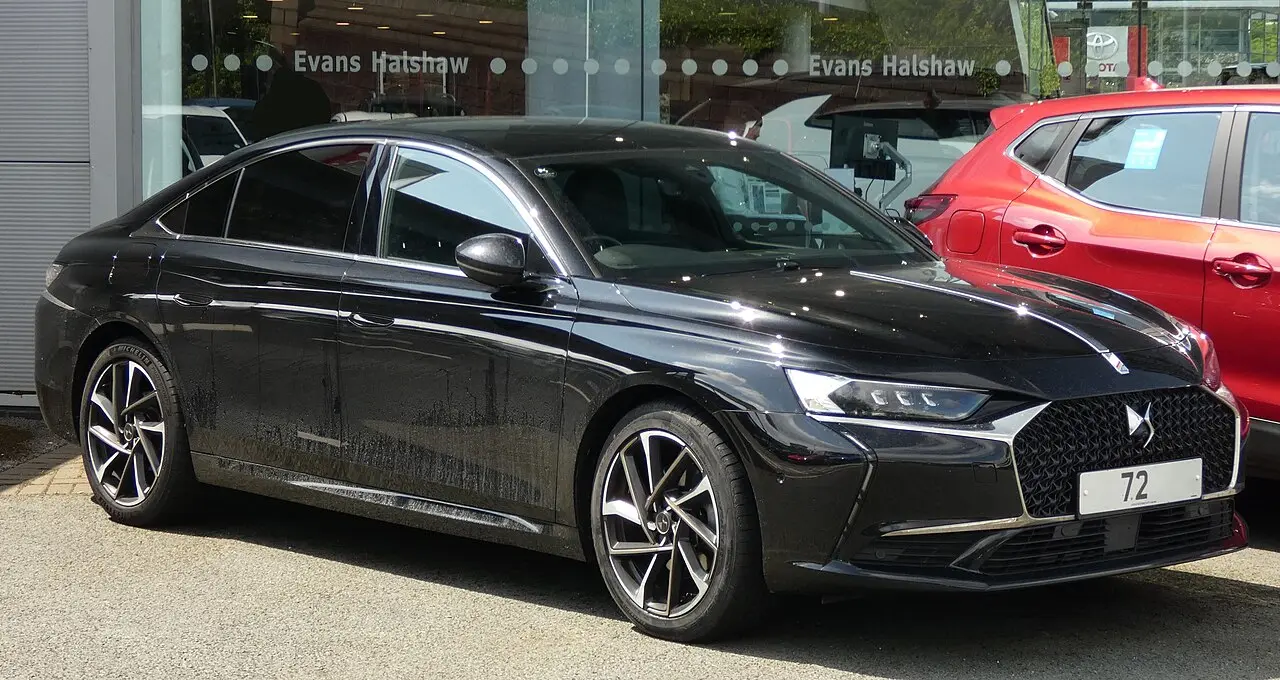
The official data lists 23 versions of the DS Automobiles DS 9 (2021–2026), in the European Union, the United Kingdom, and France. Each market publishes its own figures, measured on its own test procedure.
At a glance
Years in the data
2021–2026
Markets
European Union, United Kingdom, France
Engines
1.6 L
Power
133 kW (181 PS) to 200 kW (272 PS)
Fuels
Plug-in hybrid, Petrol, Hybrid
Lowest consumption (France)
6.5 L/100 km (WLTP)
Lowest consumption (European Union)
6.7 L/100 km (WLTP)
Plug-in hybrid, weighted (France)
0.9 L/100 km (WLTP)
Plug-in hybrid, weighted (European Union)
1.3 L/100 km (WLTP)
New registrations in the EU
3,914
What is the DS 9?
The DS 9 is a large saloon positioned at the top of the DS Automobiles range. Its formal, three-box shape and focus on rear passenger space mark it out as the brand’s executive saloon. Plug-in hybrid power was central to its launch, alongside petrol versions.
Generation and engines
The first generation has been built since 2021. European versions include petrol and hybrid choices alongside plug-in hybrids. A plug-in hybrid can be charged externally and use electric power for some driving, with the petrol engine available when needed.
EU figures cover 14 versions from 2021 to 2025, all with 1.6-litre engines and power from 133 kW (181 PS) to 165 kW (224 PS). UK figures list six plug-in hybrid versions from 2023 to 2024, with power from 147 kW (200 PS) to 200 kW (272 PS).
How economical is the DS 9?
The lowest EU consumption figure for petrol, diesel or hybrid versions is 6.7 L/100 km on WLTP. For plug-in hybrids, the EU weighted WLTP figure reaches 1.3 L/100 km. This result assumes some driving is electric, so it depends on charging and does not describe fuel use with a depleted battery. The UK plug-in hybrid figure is 6.1 L/100 km on WLTP. EU registrations total 3,914 from 2021 to 2025.
Where was it sold?
The DS 9 appears in official figures for the European Union, the United Kingdom and France. The French listing includes plug-in hybrid and petrol entries; its lowest stated plug-in hybrid figure is 0.9 L/100 km on WLTP, another weighted result that assumes some electric driving.
Questions and answers
When was the DS 9’s first generation?
The first generation has been built since 2021. EU registration figures extend to 2025.
What power does the DS 9 produce?
EU 1.6-litre versions range from 133 kW (181 PS) to 165 kW (224 PS); UK plug-in hybrids span 147 kW (200 PS) to 200 kW (272 PS).
What does the plug-in hybrid consumption figure mean?
The EU minimum is 1.3 L/100 km on WLTP, a weighted figure that assumes part of the driving is electric. Regular charging affects how closely it reflects everyday fuel use.
New cars registered in the EU (plus Norway and Iceland), from the European Environment Agency. Figures on the NEDC procedure until 2020 and on WLTP from 2021; versions are grouped by engine and power, with their number of registrations.
Years and version
Engine
Power
Fuel
Consumption (combined)
CO₂
Electric range
EU registrations
2025
1.6 L
147 kW (200 PS)
Plug-in hybrid
1.3 L/100 km WLTP17.6 kWh/100 km WLTP
32 g/km
62 km
136
2024
1.6 L
147 kW (200 PS)
Plug-in hybrid
1.3 L/100 km WLTP17.7 kWh/100 km WLTP
30 g/km
62 km
364
2024
1.6 L
165 kW (224 PS)
Petrol
6.8 L/100 km WLTP
154 g/km
–
24
2023
1.6 L
147 kW (200 PS)
Plug-in hybrid
1.3 L/100 km WLTP16.5 kWh/100 km WLTP
29 g/km
65 km
587
2023
1.6 L
165 kW (224 PS)
Petrol
6.8 L/100 km WLTP
155 g/km
–
88
2023
1.6 L
133 kW (181 PS)
Plug-in hybrid
1.5 L/100 km WLTP15.4 kWh/100 km WLTP
34 g/km
55 km
61
2022
1.6 L
133 kW (181 PS)
Plug-in hybrid
1.5 L/100 km WLTP15.5 kWh/100 km WLTP
34 g/km
55 km
580
2022
1.6 L
147 kW (200 PS)
Plug-in hybrid
1.7 L/100 km WLTP15.9 kWh/100 km WLTP
38 g/km
54 km
328
2022
1.6 L
165 kW (224 PS)
Petrol
6.7 L/100 km WLTP
155 g/km
–
166
2022
1.6 L
133 kW (181 PS)
Hybrid
1.4 L/100 km WLTP
135 g/km
–
12
2021
1.6 L
133 kW (181 PS)
Plug-in hybrid
1.5 L/100 km WLTP15.6 kWh/100 km WLTP
35 g/km
55 km
1,203
2021
1.6 L
165 kW (224 PS)
Petrol
6.9 L/100 km WLTP0.1 kWh/100 km WLTP
156 g/km
–
165
2021
1.6 L
147 kW (200 PS)
Plug-in hybrid
1.6 L/100 km WLTP16.0 kWh/100 km WLTP
37 g/km
55 km
136
2021
1.6 L
133 kW (181 PS)
Petrol
15.5 kWh/100 km WLTP
34 g/km
55 km
64
United Kingdom 6 versions
New cars on sale in the UK, from the Vehicle Certification Agency. NEDC figures until 2018 and WLTP figures after; years are the editions a version appeared in.
Years and version
Engine
Power
Fuel
Gearbox
Consumption (combined)
CO₂
Electric range
2024E-TENSE 4x4 360
1.6 L
200 kW (272 PS)
Plug-in hybrid
8-speed automatic
7.9 L/100 km WLTP23.4 kWh/100 km WLTP
179 g/km
56 km
2024E-TENSE 250 (VH)
1.6 L
200 kW (272 PS)
Plug-in hybrid
8-speed automatic
7.1 L/100 km WLTP21.5 kWh/100 km WLTP
161 g/km
53 km
2024E-TENSE 250 (VL)
1.6 L
200 kW (272 PS)
Plug-in hybrid
8-speed automatic
6.2 L/100 km WLTP18.7 kWh/100 km WLTP
141 g/km
65 km
2023E-TENSE 250 (VL)
1.6 L
147 kW (200 PS)
Plug-in hybrid
8-speed automatic
6.1 L/100 km WLTP18.7 kWh/100 km WLTP
138 g/km
83 km
2023E-TENSE 250 (VH)
1.6 L
147 kW (200 PS)
Plug-in hybrid
8-speed automatic
7.2 L/100 km WLTP21.5 kWh/100 km WLTP
162 g/km
69 km
2023E-TENSE 4x4 360
1.6 L
147 kW (200 PS)
Plug-in hybrid
8-speed automatic
8.2 L/100 km WLTP23.4 kWh/100 km WLTP
186 g/km
63 km
France 3 versions
New cars on sale in France, from ADEME Car Labelling. NEDC figures until 2015, WLTP figures in the current catalogue.
Official figures are measured on standard test procedures and differ between markets. Your consumption depends on how, where and in what conditions you drive.