



Who is Triumph?
Triumph was a British car maker whose name became closely associated with approachable sports cars. The company’s cars were shaped by a mix of home-grown engineering and Italian styling, with designer Giovanni Michelotti contributing to the look of several models. Triumph later became part of the British Leyland group, during a period when many British marques were brought under one corporate roof.
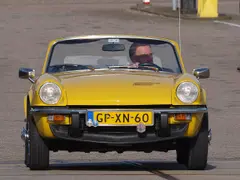
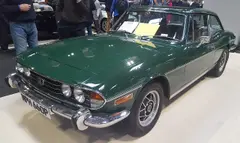
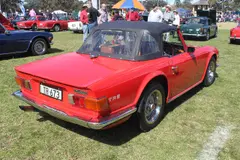
The models here belong to a distinct chapter in that story: the Spitfire, TR6 and Stag. Together they show Triumph working across different kinds of open-top motoring, from a compact two-seater to a more substantial touring car.
What are the main Triumph model lines?
The Spitfire was the small, light roadster in the range, suited to drivers drawn to simple, open-air sports-car motoring. Its neat proportions and Michelotti styling gave it a recognisable shape, while successive versions brought changes to the body and interior. It remained in production from 1962 to 1980, making it the longest-running model among these three.
The TR6 sat higher in the sports-car line-up, with a more muscular presence and a traditional two-seat roadster layout. It ran from 1968 to 1976. The Stag, produced from 1970 to 1977, took a different approach: a larger convertible intended for relaxed touring, with a distinctive roll bar and Triumph’s own V8 engine.
How did the range develop?
The Spitfire’s long run brought successive updates while keeping its compact roadster character. The TR6 arrived with a sharply restyled body, giving the TR line a more assertive look while retaining its open two-seat format. The Stag broadened the choice further, combining convertible styling with a more spacious, comfort-minded role.
The years in which these models overlapped mark a varied period for Triumph. Rather than one car being replaced by another across the whole range, the three served different purposes: the Spitfire as the smaller sports car, the TR6 as the more purposeful roadster, and the Stag as the grand touring convertible. Their designs and engines reflect the period’s emphasis on petrol-powered motoring; electrification was not part of these model lines.
Where do Triumph cars fit in market context?
Triumph was a British marque, and its sports cars also reached export buyers. The Spitfire and TR6, in particular, became familiar beyond their home market. Official fuel consumption and emissions figures can vary between countries because European tests such as WLTP and NEDC, the US EPA procedure and Canada’s 5-cycle test use different methods.
Questions and answers
Which Triumph model ran for the longest?
The Spitfire, produced from 1962 to 1980, had the longest run among these models.
What was the difference between the TR6 and the Stag?
The TR6 was a two-seat sports roadster. The Stag was a larger convertible designed for touring, with a distinctive roll bar and Triumph V8.
Did Triumph offer an electric version of these models?
No. The Spitfire, TR6 and Stag were petrol-powered cars; electrification was not part of these model lines.
Why can official fuel figures differ between countries?
Testing procedures differ: European figures may use WLTP or NEDC, the USA uses EPA testing, and Canada uses the 5-cycle procedure.