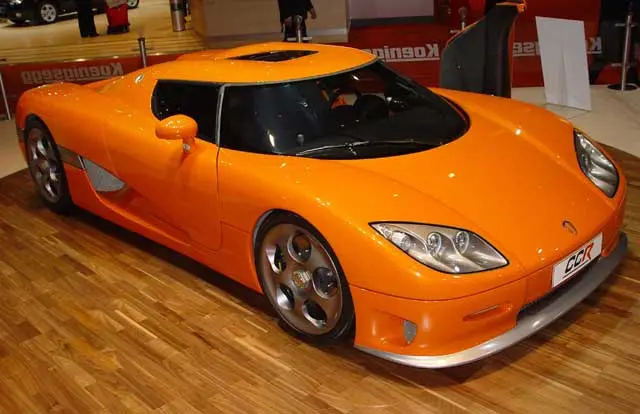
What is the Koenigsegg CCR?
The CCR is a two-seat Swedish sports car and an evolution of the CC8S, Koenigsegg’s first production model. It kept the original car’s basic idea while sharpening the body and upgrading key chassis components. A larger front splitter, rear wing, bigger brakes and wheels, and revised suspension gave this version a more developed performance focus.
Generation and engines
Koenigsegg produced the CCR from 2004 to 2006, with 14 examples made. It belongs to the early CC generation that began with the CC8S. Its twin-supercharged V8 was uprated to 806 hp, a substantial increase over the earlier model. The CCR also became part of the company’s early record-setting story when it set a production-car speed record at Italy’s Nardò circuit.
Fuel consumption and CO₂
No official fuel-consumption or CO₂ figures are listed for the CCR in the EU, UK, France, USA or Canada. There is no market-specific test-cycle rating to quote for this model.
Where was the CCR sold?
The CCR was built by Koenigsegg in Sweden in a limited run. Its international profile grew through public appearances and record attempts, but those do not establish official sales or registration figures for particular countries.
Questions and answers
When was the Koenigsegg CCR made?
Koenigsegg says the CCR was produced from 2004 to 2006.
How much power does the CCR produce?
Its twin-supercharged V8 is rated at 806 hp.
What is the CCR’s official fuel consumption?
No official fuel-consumption or CO₂ figure is listed for the markets covered here.