Mercedes-Benz

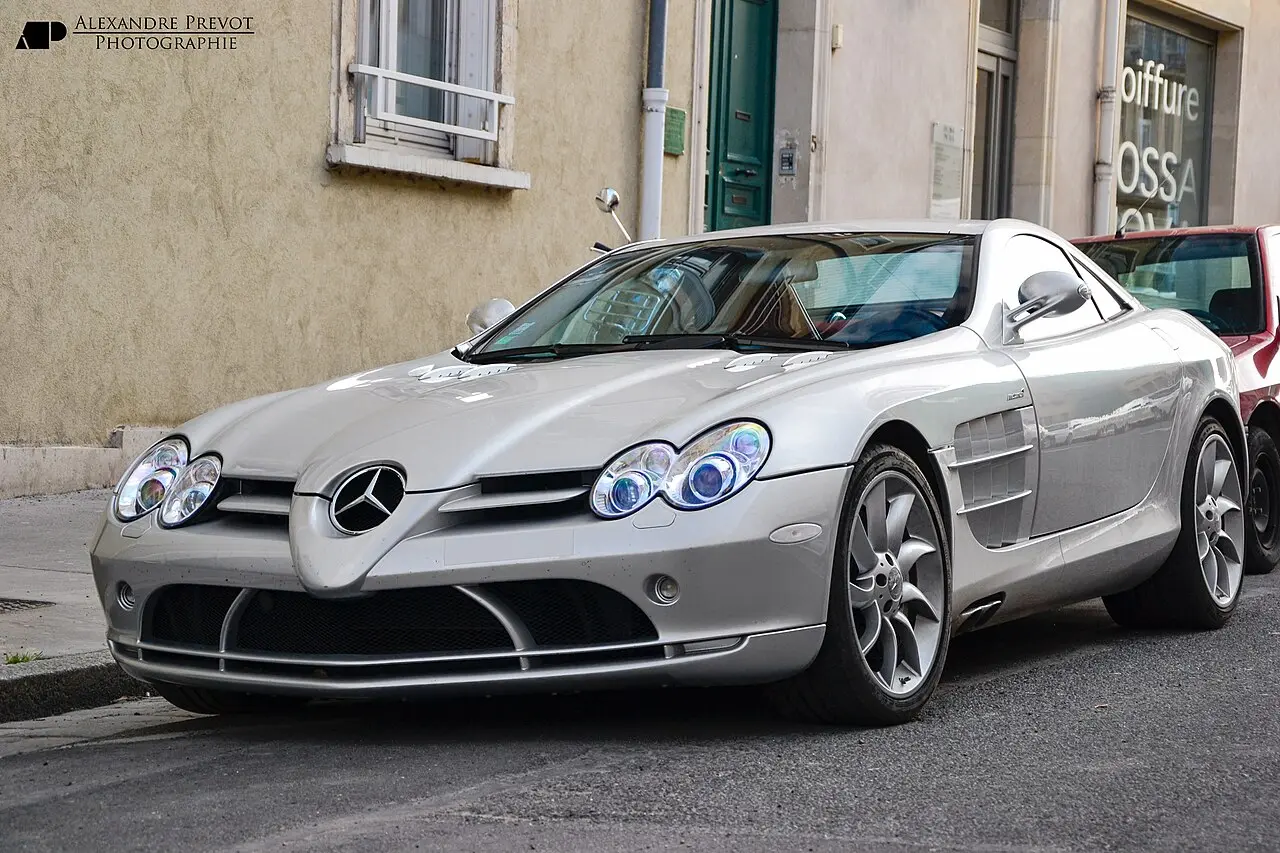
Mercedes-Benz SLR McLaren

Mercedes-Benz SLR McLaren
Photo: Alexandre Prévot from Nancy, France / Wikimedia Commons · CC BY-SA 2.0

The official data lists 17 versions of the Mercedes-Benz SLR McLaren (2004–2018), in the European Union, the United Kingdom, the United States, and Canada. Each market publishes its own figures, measured on its own test procedure.

At a glance

Years in the data
2004–2018
Markets
European Union, United Kingdom, United States, Canada
Engines
3.0 L to 6.0 L
Power
478 kW (650 PS)
Fuels
Petrol
Lowest consumption (United Kingdom)
7.7 L/100 km (NEDC)
Lowest consumption (Canada)
17.1 L/100 km (5-cycle)
Lowest consumption (United States)
18.1 L/100 km (EPA)
New registrations in the EU
172

What is the Mercedes-Benz SLR McLaren?

The SLR McLaren is a high-performance grand tourer developed through a partnership between Mercedes-Benz and McLaren. Its long bonnet and low cabin recall the marque’s racing cars, while carbon-fibre construction brought a material from racing-car design to a Mercedes-Benz road car. The SLR was a distinctive, specialist model in the Mercedes-Benz range, built for fast road driving.

Its single generation, I, carries the C199, R199 and Z199 codes and is dated 2004–2010. The car combined Mercedes-Benz design and engineering with McLaren’s sports-car expertise.

Engines and power

The SLR McLaren used a 5.4 L petrol engine in the EU registration figures, which include versions rated at 478 kW (650 PS) and 460 kW (625 PS). The EU figures cover three versions. UK listings cover seven versions and show an engine range of 3.0 L to 6.0 L; US and Canadian listings show 5.4 L engines.

How economical is the SLR McLaren?

Official consumption figures vary by market and test procedure. The lowest listed UK figure is 7.7 L/100 km on NEDC. In the United States, it is 18.1 L/100 km on the EPA test, or 13 MPG combined. Canada lists 17.1 L/100 km on the 5-cycle test. European NEDC, US EPA and Canadian 5-cycle procedures differ, so these results are not directly comparable.

Where was the SLR McLaren sold?

The SLR McLaren appears in figures for the European Union, the UK, the United States and Canada. EU registrations total 172 for 2010–2011: 100 for a 5.4 L petrol version in 2010, 56 for the 478 kW (650 PS) version in 2011, and 16 for the 460 kW (625 PS) version in 2011. UK listings span 2004–2018; US EPA and Canadian listings cover 2005–2009.

Questions and answers

When was the SLR McLaren generation made?

Its only generation, with C199, R199 and Z199 codes, is dated 2004–2010.

What engine did the SLR McLaren use?

The US and Canadian listings show a 5.4 L petrol engine. EU registration figures include 478 kW (650 PS) and 460 kW (625 PS) versions.

Which market has the lowest listed consumption?

The UK listing has the lowest figure: 7.7 L/100 km on NEDC.

How many SLR McLarens were registered in the EU figures?

The EU registration total is 172 for 2010–2011.

SLR McLaren I (2004–2010)

Mercedes-Benz SLR McLaren I
Photo: Alexandre Prévot from Nancy, France / Wikimedia Commons · CC BY-SA 2.0

Model codes: C199, R199, Z199 · References: en.wikipedia.org, sportlichleicht.com

European Union 1 version

New cars registered in the EU (plus Norway and Iceland), from the European Environment Agency. Figures on the NEDC procedure until 2020 and on WLTP from 2021; versions are grouped by engine and power, with their number of registrations.

Years and versionEngineFuelCO₂EU registrations
20105.4 LPetrol348 g/km100

United Kingdom 2 versions

New cars on sale in the UK, from the Vehicle Certification Agency. NEDC figures until 2018 and WLTP figures after; years are the editions a version appeared in.

Years and versionEngineFuelGearboxConsumption (combined)CO₂
2006–2007Coupé5.4 LPetrol5-speed automatic14.5 L/100 km NEDC348 g/km
2004Coupé5.4 LPetrol5-speed automatic14.5 L/100 km NEDC348 g/km

United States 3 versions

Model years sold in the USA, from the EPA and the Department of Energy (fueleconomy.gov). MPG on the EPA test; litres per 100 km = 235.215 ÷ MPG.

Years and versionEngineFuelGearboxDriveConsumption (combined)CO₂
2008–2009EMS 2MODE CLKUP5.4 LPetrol5-speed automaticRear-wheel drive13 MPG (18.1 L/100 km) EPA425 g/km
2006–2007EMS 2MODE CLKUP5.4 LPetrol5-speed automaticRear-wheel drive13 MPG (18.1 L/100 km) EPA425 g/km
2005EMS 2MODE CLKUP5.4 LPetrol5-speed automaticRear-wheel drive13 MPG (18.1 L/100 km) EPA425 g/km

Canada 4 versions

Model years sold in Canada, from Natural Resources Canada fuel consumption ratings (5-cycle test).

Years and versionEngineFuelGearboxConsumption (combined)CO₂
2008–2009Two-seater5.4 LPetrol5-speed automatic17.2 L/100 km 5-cycle396 g/km
2007Two-seater5.4 LPetrol5-speed automatic17.9 L/100 km 5-cycle412 g/km
2006Two-seater5.4 LPetrol5-speed automatic17.1 L/100 km 5-cycle393 g/km
2005Two-seater5.4 LPetrol5-speed automatic17.7 L/100 km 5-cycle407 g/km

Versions outside these generations

European Union 2 versions

New cars registered in the EU (plus Norway and Iceland), from the European Environment Agency. Figures on the NEDC procedure until 2020 and on WLTP from 2021; versions are grouped by engine and power, with their number of registrations.

Years and versionEnginePowerFuelCO₂EU registrations
20115.4 L478 kW (650 PS)Petrol348 g/km56
20115.4 L460 kW (625 PS)Petrol348 g/km16

United Kingdom 5 versions

New cars on sale in the UK, from the Vehicle Certification Agency. NEDC figures until 2018 and WLTP figures after; years are the editions a version appeared in.

Years and versionEngineFuelGearboxConsumption (combined)CO₂
2018SL 400 with 19'' rear wheels3.0 LPetrol9-speed automatic7.7 L/100 km NEDC175 g/km
2018SL 400 with 19'' rear wheels3.0 LPetrol9-speed automatic8.4 L/100 km NEDC191 g/km
2018SL 500 with 19'' rear wheels4.7 LPetrol9-speed automatic9.0 L/100 km NEDC205 g/km
2018AMG SL 63 with 19'' rear wheels · AMG SL 63 with 20'' rear wheels5.5 LPetrol7-speed automatic10.1 L/100 km NEDC234 g/km
2018AMG SL 65 with 19'' rear wheels · AMG SL 65 with 20'' rear wheels6.0 LPetrol7-speed automatic11.9 L/100 km NEDC279 g/km

Official figures are measured on standard test procedures and differ between markets. Your consumption depends on how, where and in what conditions you drive.