Honda

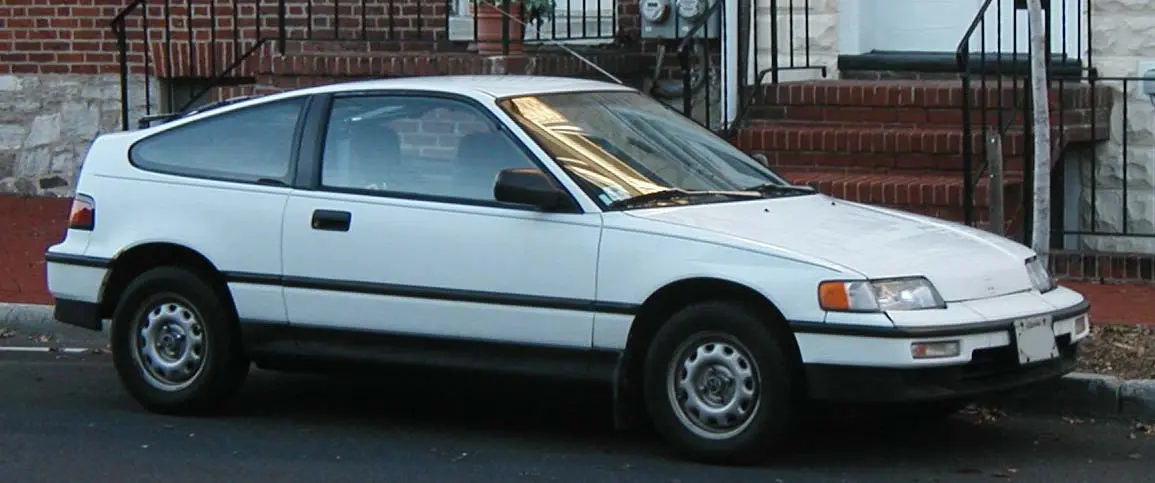
Honda CR-X

Honda CR-X
Photo: IFCAR / Wikimedia Commons · Public domain

The official data lists 32 versions of the Honda CR-X (1984–1991), in the United States. Each market publishes its own figures, measured on its own test procedure.

At a glance

Years in the data
1984–1991
Markets
United States
Engines
1.3 L to 1.6 L
Fuels
Petrol
Lowest consumption (United States)
5.1 L/100 km (EPA)

What is the Honda CR-X?

The Honda CR-X is a compact sports hatchback, with a low, compact shape and a focus on driving. Honda described the second generation as building on the original idea while pursuing stronger driving performance.

The CR-X was sold in the United States from 1984–1991. The generation identified for the US and European markets is the second generation, dated 1988–1991.

Generation and engines

The second-generation CR-X, identified by the ED and EE codes, ran from 1988–1991. US market figures list petrol engines from 1.3 L to 1.6 L.

Fuel consumption

The best combined US rating is 46 MPG under the EPA procedure, with a lowest listed consumption of 5.1 L/100 km. These EPA figures express fuel use in different formats. European figures use procedures such as WLTP or NEDC, while Canada uses the NRCan 5-cycle test; results from those tests are not directly interchangeable.

Where was the CR-X sold?

The CR-X appears in United States market figures. The second-generation entry also identifies the model with Europe, reflecting its presence beyond North America.

Questions and answers

When was the second-generation Honda CR-X sold?

It ran from 1988–1991.

What engine sizes are covered by the US figures?

Petrol engines from 1.3 L to 1.6 L.

What is the best combined US fuel-economy rating?

46 MPG combined under the EPA procedure.

CR-X II (1988–1991)

Honda CR-X II
Photo: IFCAR / Wikimedia Commons · Public domain

Model codes: ED, EE · Sold in: United States and European Union · References: en.wikipedia.org

United States 15 versions

Model years sold in the USA, from the EPA and the Department of Energy (fueleconomy.gov). MPG on the EPA test; litres per 100 km = 235.215 ÷ MPG.

Years and versionEngineFuelGearboxDriveConsumption (combined)CO₂
1991(FFS)1.5 LPetrol5-speed manualFront-wheel drive29 MPG (8.1 L/100 km) EPA190 g/km
1991(FFS), 2LKUP1.5 LPetrol4-speed automaticFront-wheel drive27 MPG (8.7 L/100 km) EPA205 g/km
1990–1991(FFS), SIL1.5 LPetrol5-speed manualFront-wheel drive43 MPG (5.5 L/100 km) EPA128 g/km
1990–1991(FFS)1.5 LPetrol5-speed manualFront-wheel drive39 MPG (6.0 L/100 km) EPA142 g/km
1990–1991(FFS)1.6 LPetrol5-speed manualFront-wheel drive27 MPG (8.7 L/100 km) EPA205 g/km
1990(FFS), 2LKUP1.5 LPetrol4-speed automaticFront-wheel drive28 MPG (8.4 L/100 km) EPA197 g/km
1990(FFS)1.5 LPetrol5-speed manualFront-wheel drive29 MPG (8.1 L/100 km) EPA190 g/km
1988–1989(FFS), SIL1.5 LPetrol5-speed manualFront-wheel drive44 MPG (5.3 L/100 km) EPA126 g/km
1988–1989(FFS)1.5 LPetrol5-speed manualFront-wheel drive41 MPG (5.7 L/100 km) EPA135 g/km
1989(FFS), 2LKUP1.5 LPetrol4-speed automaticFront-wheel drive28 MPG (8.4 L/100 km) EPA197 g/km
1989(FFS)1.5 LPetrol5-speed manualFront-wheel drive32 MPG (7.4 L/100 km) EPA173 g/km
1989(FFS)1.6 LPetrol5-speed manualFront-wheel drive26 MPG (9.0 L/100 km) EPA212 g/km
1988(FFS), 2LKUP1.5 LPetrol4-speed automaticFront-wheel drive29 MPG (8.1 L/100 km) EPA190 g/km
1988(FFS)1.5 LPetrol5-speed manualFront-wheel drive32 MPG (7.4 L/100 km) EPA173 g/km
1988(FFS)1.6 LPetrol5-speed manualFront-wheel drive28 MPG (8.4 L/100 km) EPA197 g/km

Versions outside these generations

United States 17 versions

Model years sold in the USA, from the EPA and the Department of Energy (fueleconomy.gov). MPG on the EPA test; litres per 100 km = 235.215 ÷ MPG.

Years and versionEngineFuelGearboxDriveConsumption (combined)CO₂
1986–1987(FFS) · (FFS) 3 barrel carb1.5 LPetrol5-speed manualFront-wheel drive29 MPG (8.1 L/100 km) EPA190 g/km
1986–1987(FFS) · (FFS) fuel injection1.5 LPetrol5-speed manualFront-wheel drive27 MPG (8.7 L/100 km) EPA205 g/km
1986–1987(FFS), SIL1.5 LPetrol5-speed manualFront-wheel drive46 MPG (5.1 L/100 km) EPA120 g/km
1986–1987SIL1.5 LPetrol5-speed manualFront-wheel drive40 MPG (5.9 L/100 km) EPA138 g/km
1987(FFS)1.5 LPetrol4-speed automaticFront-wheel drive27 MPG (8.7 L/100 km) EPA205 g/km
1986(FFS)1.5 LPetrol4-speed automaticFront-wheel drive28 MPG (8.4 L/100 km) EPA197 g/km
1985(FFS) CA model · (FFS)1.5 LPetrol3-speed automaticFront-wheel drive26 MPG (9.0 L/100 km) EPA212 g/km
1985(FFS) CA model1.5 LPetrol5-speed manualFront-wheel drive28 MPG (8.4 L/100 km) EPA197 g/km
1985CA model, SIL1.5 LPetrol5-speed manualFront-wheel drive41 MPG (5.7 L/100 km) EPA135 g/km
1985(FFS)1.5 LPetrol5-speed manualFront-wheel drive30 MPG (7.8 L/100 km) EPA184 g/km
1985(FFS)1.5 LPetrol5-speed manualFront-wheel drive29 MPG (8.1 L/100 km) EPA190 g/km
1985SIL1.5 LPetrol5-speed manualFront-wheel drive43 MPG (5.5 L/100 km) EPA128 g/km
19841.3 LPetrol5-speed manual–41 MPG (5.7 L/100 km) EPA135 g/km
1984CA model1.3 LPetrol5-speed manual–39 MPG (6.0 L/100 km) EPA142 g/km
1984(FFS)1.5 LPetrol3-speed automatic–27 MPG (8.7 L/100 km) EPA205 g/km
1984(FFS) · (FFS) CA model1.5 LPetrol5-speed manual–30 MPG (7.8 L/100 km) EPA184 g/km
1984(FFS) CA model1.5 LPetrol3-speed automatic–26 MPG (9.0 L/100 km) EPA212 g/km

Official figures are measured on standard test procedures and differ between markets. Your consumption depends on how, where and in what conditions you drive.