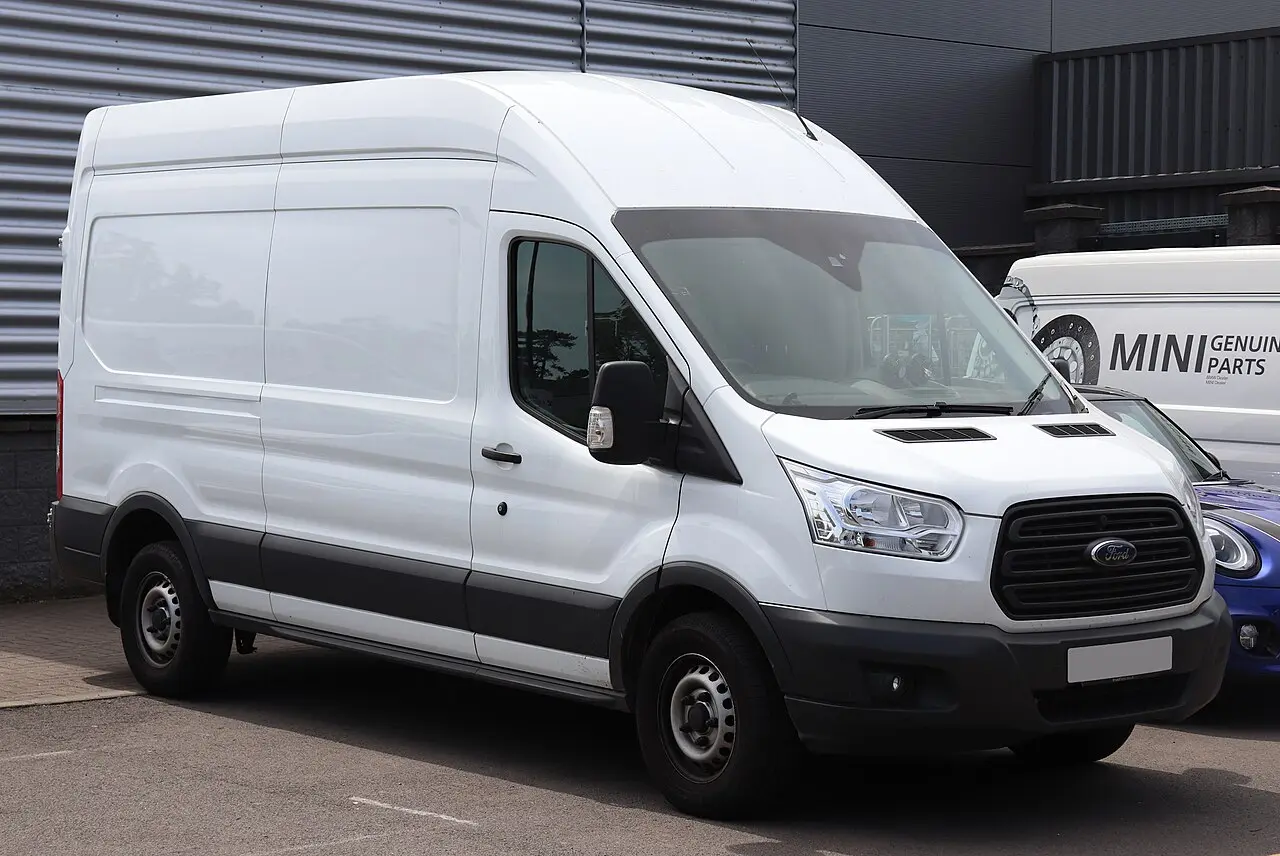
Ford

Ford Transit

Ford Transit
Photo: Vauxford / Wikimedia Commons · CC BY-SA 4.0

The official data lists 491 versions of the Ford Transit (2000–2025), in the European Union, the United Kingdom, France, the United States, and Canada. Each market publishes its own figures, measured on its own test procedure.

At a glance

Years in the data
2000–2025
Markets
European Union, United Kingdom, France, United States, Canada
Engines
1.0 L to 3.7 L
Power
55 kW (75 PS) to 125 kW (170 PS)
Fuels
Diesel, Electric, Hybrid, Petrol, Plug-in hybrid, Flex fuel (E85)
Lowest consumption (European Union)
5.1 L/100 km (WLTP)
Lowest consumption (France)
6.4 L/100 km (NEDC)
Lowest consumption (United Kingdom)
6.6 L/100 km (NEDC)
New registrations in the EU
181,005

What is the Ford Transit?

The Ford Transit is a nameplate for a broad range of commercial vans and work vehicles. It carries goods, equipment and passengers for businesses and other working uses. Over time, the name has grown to cover a family of vehicles, including the smaller Transit Custom.

Ford launched the Transit in Britain in 1965. It brought together the commercial-vehicle experience of Ford’s British and German operations in a van designed for varied working needs. The Transit has since become one of the best-known names in Ford’s commercial range.

Transit generations

The European generation labels listed here begin with Mk6, sold from 2000 to 2006, and Mk7, from 2006 to 2013. Mk8 followed from 2014 and continues in the generation history. In the USA and Canada, the listed fourth generation ran from 2015 to 2022. Generation names differ between markets.

The Transit has changed through successive generations while serving a wide range of commercial roles, from carrying goods and equipment to transporting passengers.

Engines, consumption and markets

EU registration figures span diesel, electric, hybrid, petrol, plug-in hybrid and other fuel types. Listed engines range from 1.0 to 2.4 litres, with power from 55 kW (75 PS) to 144 kW (196 PS). The lowest listed EU consumption is 5.1 L/100 km on WLTP for petrol, diesel and hybrid versions. French figures for 2012–2015 cover diesel models, with power from 74 kW (101 PS) to 114 kW (155 PS) and a lowest listed 6.4 L/100 km on NEDC.

UK figures cover 2000–2010, with 1.8- to 2.5-litre engines and power from 52 kW (70 PS) to 103 kW (140 PS). The lowest listed UK consumption is 6.6 L/100 km on NEDC. US figures cover 2015–2022 and petrol or E85 flex-fuel versions with 3.5- to 3.7-litre engines; the lowest listed consumption is 13.8 L/100 km on EPA. Canadian figures cover 2015–2021, with the same listed engine-size range and fuels, and a lowest figure of 14.5 L/100 km on NRCan’s 5-cycle procedure. European figures use WLTP or NEDC, US figures use EPA, and Canadian figures use a 5-cycle procedure, so the results are not directly comparable. EU registration figures total 181,005 for 2010–2025.

Questions and answers

What is the lowest listed Transit fuel consumption in the EU?

It is 5.1 L/100 km on WLTP for petrol, diesel and hybrid versions.

What power range is listed for EU Transit models?

EU figures span 55 kW (75 PS) to 144 kW (196 PS), with engines from 1.0 to 2.4 litres.

Why do the consumption figures differ by market?

The test procedures differ: European figures use WLTP or NEDC, US figures use EPA, and Canadian figures use a 5-cycle procedure.

Which Transit generations are listed?

European labels are Mk6 (2000–2006), Mk7 (2006–2013) and Mk8 (2014–today). The US and Canadian entry lists a fourth generation from 2015 to 2022.

Transit Mk6 (2000–2006)

Model codes: V184, V185 · Sold in: European Union, United Kingdom, and France · References: italiacamper.com, en.wikipedia.org

Show all 51 versions

Transit Mk7 (2006–2013)

Model codes: V347, V348 · Sold in: European Union, United Kingdom, and France · References: revues-technique.fr, en.wikipedia.org

Show all 155 versions

Transit Mk8 (since 2014)

Ford Transit Mk8
Photo: Vauxford / Wikimedia Commons · CC BY-SA 4.0

Model codes: V363 · Sold in: European Union, United Kingdom, and France · References: revues-technique.fr, media.ford.com

Show all 254 versions

Transit Fourth generation (2015–2022)

Model codes: V363 · Sold in: United States and Canada · References: en.wikipedia.org, haynes.com

United States 16 versions

Model years sold in the USA, from the EPA and the Department of Energy (fueleconomy.gov). MPG on the EPA test; litres per 100 km = 235.215 ÷ MPG.

Years and versionEngineFuelGearboxDriveConsumption (combined)CO₂
2022SIDI & PFI; FFV3.5 LFlex fuel (E85)10-speed automaticRear-wheel drive17 MPG (13.8 L/100 km) EPA334 g/km
2022SIDI & PFI; FFV3.5 LFlex fuel (E85)10-speed automaticAll-wheel drive16 MPG (14.7 L/100 km) EPA350 g/km
2021SIDI & PFI; FFV3.5 LFlex fuel (E85)10-speed automaticRear-wheel drive16 MPG (14.7 L/100 km) EPA336 g/km
2021SIDI & PFI; FFV3.5 LFlex fuel (E85)10-speed automaticAll-wheel drive16 MPG (14.7 L/100 km) EPA351 g/km
2020SIDI & PFI; FFV3.5 LFlex fuel (E85)10-speed automaticRear-wheel drive17 MPG (13.8 L/100 km) EPA334 g/km
2020SIDI & PFI; FFV3.5 LFlex fuel (E85)10-speed automaticAll-wheel drive16 MPG (14.7 L/100 km) EPA349 g/km
2019SIDI3.5 LPetrol6-speed automaticRear-wheel drive16 MPG (14.7 L/100 km) EPA343 g/km
2019FFV3.7 LFlex fuel (E85)6-speed automaticRear-wheel drive15 MPG (15.7 L/100 km) EPA355 g/km
20193.7 LPetrol6-speed automaticRear-wheel drive15 MPG (15.7 L/100 km) EPA355 g/km
2018SIDI3.5 LPetrol6-speed automaticRear-wheel drive16 MPG (14.7 L/100 km) EPA345 g/km
2016–2018FFV3.7 LFlex fuel (E85)6-speed automaticRear-wheel drive16 MPG (14.7 L/100 km) EPA354 g/km
20183.7 LPetrol6-speed automaticRear-wheel drive16 MPG (14.7 L/100 km) EPA354 g/km
2017SIDI3.5 LPetrol6-speed automaticRear-wheel drive16 MPG (14.7 L/100 km) EPA343 g/km
2016SIDI3.5 LPetrol6-speed automaticRear-wheel drive16 MPG (14.7 L/100 km) EPA341 g/km
20153.5 LPetrol6-speed automaticRear-wheel drive16 MPG (14.7 L/100 km) EPA344 g/km
2015FFV3.7 LFlex fuel (E85)6-speed automaticRear-wheel drive16 MPG (14.7 L/100 km) EPA345 g/km

Canada 21 versions

Model years sold in Canada, from Natural Resources Canada fuel consumption ratings (5-cycle test).

Years and versionEngineFuelGearboxConsumption (combined)CO₂
2021Van: Passenger3.5 LPetrol10-speed automatic14.5 L/100 km 5-cycle341 g/km
2021Van: Passenger3.5 LFlex fuel (E85)10-speed automatic19.3 L/100 km 5-cycle321 g/km
2021Van: Passenger3.5 LPetrol10-speed automatic15.1 L/100 km 5-cycle354 g/km
2021Van: Passenger3.5 LFlex fuel (E85)10-speed automatic19.9 L/100 km 5-cycle331 g/km
2020Van: Passenger3.5 LPetrol10-speed automatic14.5 L/100 km 5-cycle340 g/km
2020Van: Passenger3.5 LFlex fuel (E85)10-speed automatic19.1 L/100 km 5-cycle316 g/km
2020Van: Passenger3.5 LPetrol10-speed automatic15.0 L/100 km 5-cycle352 g/km
2020Van: Passenger3.5 LFlex fuel (E85)10-speed automatic19.8 L/100 km 5-cycle328 g/km
2019Van: Passenger3.5 LPetrol6-speed automatic14.7 L/100 km 5-cycle346 g/km
2019Van: Passenger3.7 LPetrol6-speed automatic15.2 L/100 km 5-cycle355 g/km
2018Van: Passenger3.5 LPetrol6-speed automatic14.7 L/100 km 5-cycle345 g/km
2018Van: Passenger3.7 LPetrol6-speed automatic15.1 L/100 km 5-cycle354 g/km
2017Van: Passenger3.5 LPetrol6-speed automatic14.6 L/100 km 5-cycle344 g/km
2017Van: Passenger3.7 LPetrol6-speed automatic15.1 L/100 km 5-cycle354 g/km
2017Van: Passenger3.7 LFlex fuel (E85)6-speed automatic20.9 L/100 km 5-cycle343 g/km
2016Van: Passenger3.5 LPetrol6-speed automatic14.6 L/100 km 5-cycle342 g/km
2016Van: Passenger3.7 LPetrol6-speed automatic15.2 L/100 km 5-cycle356 g/km
2016Van: Passenger3.7 LFlex fuel (E85)6-speed automatic21.0 L/100 km 5-cycle345 g/km
2015Van: Passenger3.5 LPetrol6-speed automatic14.7 L/100 km 5-cycle338 g/km
2015Van: Passenger3.7 LPetrol6-speed automatic14.8 L/100 km 5-cycle340 g/km
2015Van: Passenger3.7 LFlex fuel (E85)6-speed automatic19.7 L/100 km 5-cycle315 g/km

Official figures are measured on standard test procedures and differ between markets. Your consumption depends on how, where and in what conditions you drive.