Citroën

Citroën C5 X

Citroën C5 X
Photo: Alexander-93 / Wikimedia Commons · CC BY-SA 4.0

The official data lists 36 versions of the Citroën C5 X (2021–2026), in the European Union, the United Kingdom, and France. Each market publishes its own figures, measured on its own test procedure.

At a glance

Years in the data
2021–2026
Markets
European Union, United Kingdom, France
Engines
1.2 L to 1.6 L
Power
96 kW (131 PS) to 179 kW (243 PS)
Fuels
Petrol, Plug-in hybrid, Hybrid
Lowest consumption (European Union)
3.4 L/100 km (WLTP)
Lowest consumption (United Kingdom)
4.8 L/100 km (WLTP)
Lowest consumption (France)
6.4 L/100 km (WLTP)
Plug-in hybrid, weighted (European Union)
1.2 L/100 km (WLTP)
Plug-in hybrid, weighted (United Kingdom)
6.0 L/100 km (WLTP)
New registrations in the EU
24,813

What is the Citroën C5 X?

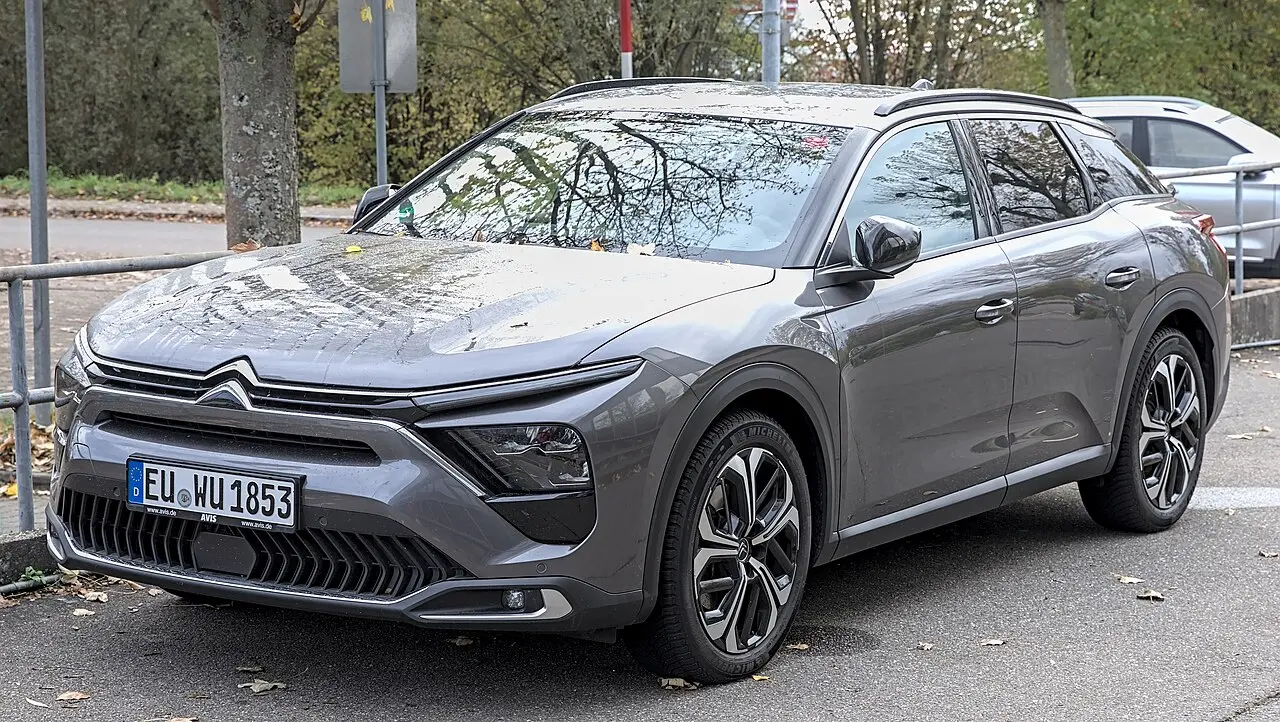
The C5 X is a large family car that blends the shape of a saloon, an estate and an SUV. It returns Citroën to the large tourer class with a long profile, estate-like practicality and a raised stance. That mix reflects the brand’s willingness to give familiar car shapes a distinctive interpretation.

Generations and engines

The C5 X has one generation, introduced in 2021 and listed as continuing today. EU figures cover 2021–2025; UK figures cover 2023–2026, and the French entry is for 2026.

The listed engines range from 1.2 L to 1.6 L. EU versions span 96 kW (131 PS) to 133 kW (181 PS), while UK versions span 96 kW (131 PS) to 179 kW (243 PS). Petrol, hybrid and plug-in hybrid versions appear in the EU and UK figures.

How economical is the Citroën C5 X?

For versions other than plug-in hybrids, the lowest listed consumption is 3.4 L/100 km in the EU on WLTP and 4.8 L/100 km in the UK on WLTP. The lowest EU plug-in hybrid figure is 1.2 L/100 km, a weighted official value that assumes some driving is electric. The UK plug-in hybrid figure is 6 L/100 km on the same weighted basis. Test procedures differ by region: Europe uses WLTP or NEDC, the USA uses EPA ratings, and Canada uses the 5-cycle test.

EU registration figures total 24,813 from 2021 to 2025. The 1.6 L plug-in hybrid rated at 132 kW (179 PS) recorded 5,500 registrations in 2023 and 5,444 in 2022. The 1.2 L petrol rated at 96 kW (131 PS) recorded 5,264 registrations across 2022–2023.

Where was the C5 X sold?

The C5 X appears in EU, UK and French figures. EU and UK entries include petrol, hybrid and plug-in hybrid versions; the French entry lists a 1.6 L petrol version rated at 133 kW (181 PS).

Questions and answers

How many generations of Citroën C5 X are there?

One: the first generation, introduced in 2021 and listed as continuing today.

What is the lowest plug-in hybrid consumption figure?

The lowest listed figure is 1.2 L/100 km in the EU on WLTP, using a weighted calculation that assumes some driving is electric.

What is the C5 X’s power range?

EU figures span 96 kW (131 PS) to 133 kW (181 PS); the UK range extends to 179 kW (243 PS).

C5 X first generation (since 2021)

Citroën C5 X first generation
Photo: Alexander-93 / Wikimedia Commons · CC BY-SA 4.0

Sold in: European Union and France · References: en.wikipedia.org, largus.fr

European Union 19 versions

New cars registered in the EU (plus Norway and Iceland), from the European Environment Agency. Figures on the NEDC procedure until 2020 and on WLTP from 2021; versions are grouped by engine and power, with their number of registrations.

Years and versionEnginePowerFuelConsumption (combined)CO₂Electric rangeEU registrations
20251.6 L132 kW (179 PS)Plug-in hybrid1.4 L/100 km WLTP15.6 kWh/100 km WLTP30 g/km59 km487
20251.2 L96 kW (131 PS)Petrol6.1 L/100 km WLTP138 g/km–394
20251.2 L100 kW (136 PS)Hybrid5.1 L/100 km WLTP116 g/km–368
20251.6 L110 kW (150 PS)Plug-in hybrid1.6 L/100 km WLTP16.0 kWh/100 km WLTP33 g/km57 km140
20241.2 L96 kW (131 PS)Petrol6.0 L/100 km WLTP137 g/km–1,796
2023–20241.6 L133 kW (181 PS)Petrol6.5 L/100 km WLTP147 g/km–1,355
20241.6 L132 kW (179 PS)Plug-in hybrid1.4 L/100 km WLTP15.5 kWh/100 km WLTP30 g/km59 km1,279
20241.6 L110 kW (150 PS)Plug-in hybrid1.3 L/100 km WLTP16.0 kWh/100 km WLTP31 g/km57 km369
20241.2 L100 kW (136 PS)Petrol5.1 L/100 km WLTP116 g/km–26
20231.6 L132 kW (179 PS)Plug-in hybrid1.2 L/100 km WLTP15.0 kWh/100 km WLTP28 g/km62 km5,500
2022–20231.2 L96 kW (131 PS)Petrol6.0 L/100 km WLTP136 g/km–5,264
20231.6 L110 kW (150 PS)Plug-in hybrid1.2 L/100 km WLTP14.8 kWh/100 km WLTP27 g/km63 km191
20231.6 L67 kW (91 PS)Petrol6.6 L/100 km WLTP149 g/km–11
20221.6 L132 kW (179 PS)Plug-in hybrid1.3 L/100 km WLTP16.0 kWh/100 km WLTP30 g/km59 km5,444
20221.6 L133 kW (181 PS)Petrol6.4 L/100 km WLTP147 g/km–1,941
20221.6 L132 kW (179 PS)Petrol3.4 L/100 km WLTP15.9 kWh/100 km WLTP148 g/km–119
20211.2 L96 kW (131 PS)Petrol6.0 L/100 km WLTP135 g/km–46
20211.6 L133 kW (181 PS)Petrol6.5 L/100 km WLTP148 g/km–42
20211.6 L132 kW (179 PS)Plug-in hybrid1.3 L/100 km WLTP15.9 kWh/100 km WLTP30 g/km59 km41

France 1 version

New cars on sale in France, from ADEME Car Labelling. NEDC figures until 2015, WLTP figures in the current catalogue.

Years and versionEnginePowerFuelGearboxConsumption (combined)CO₂
2026C5 X (181ch)1.6 L133 kW (181 PS)Petrol8-speed automatic6.4 L/100 km WLTP145 g/km

Versions outside these generations

United Kingdom 16 versions

New cars on sale in the UK, from the Vehicle Certification Agency. NEDC figures until 2018 and WLTP figures after; years are the editions a version appeared in.

Years and versionEnginePowerFuelGearboxConsumption (combined)CO₂Electric range
2025–2026PureTech 130 S&S1.2 L96 kW (131 PS)Petrol8-speed automatic6.0 L/100 km WLTP135 g/km–
2025–2026PureTech 130 S&S1.2 L96 kW (131 PS)Petrol8-speed automatic7.0 L/100 km WLTP158 g/km–
2025–2026Hybrid 136 e-DCS61.2 L100 kW (136 PS)Hybrid6-speed automatic4.8 L/100 km WLTP108 g/km–
2025–2026Hybrid 136 e-DCS61.2 L100 kW (136 PS)Hybrid6-speed automatic5.9 L/100 km WLTP133 g/km–
2025–2026Plug-in Hybrid 225 (180+80)1.6 L132 kW (179 PS)Plug-in hybrid8-speed automatic6.0 L/100 km WLTP16.0 kWh/100 km WLTP137 g/km56 km
2025–2026Plug-in Hybrid 225 (180+80)1.6 L132 kW (179 PS)Plug-in hybrid8-speed automatic6.8 L/100 km WLTP16.9 kWh/100 km WLTP154 g/km55 km
2024PureTech 130 S&S (VL)1.2 L131 kW (178 PS)Petrol8-speed automatic6.0 L/100 km WLTP135 g/km–
2024PureTech 130 S&S(VH)1.2 L131 kW (178 PS)Petrol8-speed automatic7.0 L/100 km WLTP158 g/km–
2024Hybrid 136 e-DCS6 (VL)1.2 L136 kW (185 PS)Hybrid6-speed automatic4.8 L/100 km WLTP108 g/km–
2024Hybrid 136 e-DCS6 (VH)1.2 L136 kW (185 PS)Hybrid6-speed automatic5.9 L/100 km WLTP133 g/km–
2024Plug-in Hybrid 225 (180+80) (VH)1.6 L179 kW (243 PS)Plug-in hybrid8-speed automatic6.8 L/100 km WLTP16.9 kWh/100 km WLTP154 g/km55 km
2024Plug-in Hybrid 225 (180+80) (VL)1.6 L179 kW (243 PS)Plug-in hybrid8-speed automatic6.0 L/100 km WLTP16.0 kWh/100 km WLTP137 g/km56 km
2023PureTech 130 S&S (VL)1.2 L96 kW (131 PS)Petrol8-speed automatic5.9 L/100 km WLTP133 g/km–
2023PureTech 130 S&S(VH)1.2 L96 kW (131 PS)Petrol8-speed automatic6.9 L/100 km WLTP156 g/km–
2023Plug-in Hybrid 225 (180+80) (VL)1.6 L132 kW (179 PS)Plug-in hybrid8-speed automatic6.0 L/100 km WLTP17.7 kWh/100 km WLTP137 g/km78 km
2023Plug-in Hybrid 225 (180+80) (VH)1.6 L132 kW (179 PS)Plug-in hybrid8-speed automatic6.8 L/100 km WLTP18.7 kWh/100 km WLTP154 g/km60 km

Official figures are measured on standard test procedures and differ between markets. Your consumption depends on how, where and in what conditions you drive.