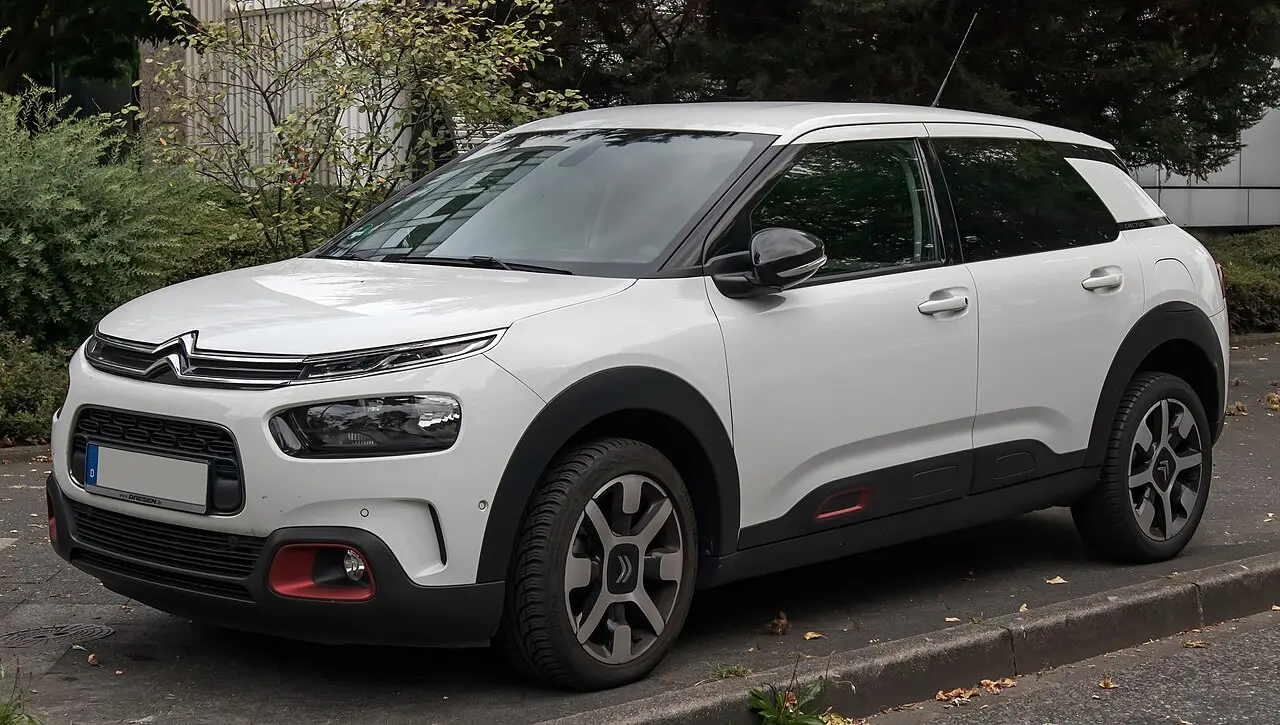
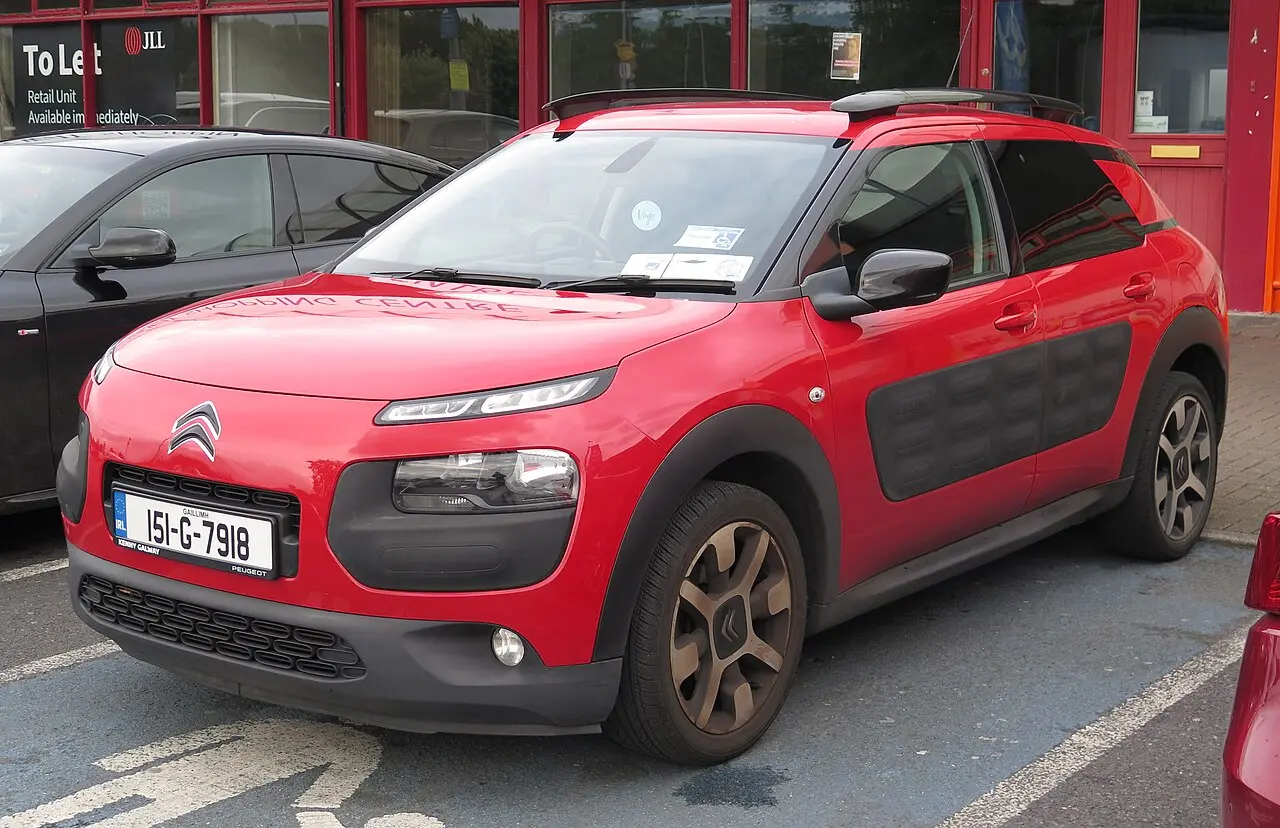
The official data lists 111 versions of the Citroën C4 Cactus (2014–2023), in the European Union, the United Kingdom, and France. Each market publishes its own figures, measured on its own test procedure.
At a glance
Years in the data
2014–2023
Markets
European Union, United Kingdom, France
Engines
1.2 L to 1.6 L
Power
55 kW (75 PS) to 96 kW (131 PS)
Fuels
Petrol, Diesel, Hybrid
Lowest consumption (United Kingdom)
3.1 L/100 km (NEDC)
Lowest consumption (France)
3.2 L/100 km (NEDC)
Lowest consumption (European Union)
4.5 L/100 km (WLTP)
New registrations in the EU
630,169
What is the Citroën C4 Cactus?
The C4 Cactus is a compact car with a raised stance and a distinctive design. Early versions were known for Airbump panels on the doors, which added a protective detail to the car’s unusual styling. The model reflected Citroën’s focus on comfort, especially after its redesign, which introduced Progressive Hydraulic Cushions suspension.
Launched as a crossover in 2014, the C4 Cactus took on a more hatchback-like role with its redesigned version in 2018. EU registrations cover 2014 to 2021, while UK figures cover 2014 to 2023.
Generations and engines
Generation I, code E3, ran from 2014 to 2017. Generation II, also code E3, followed from 2018 to 2020, with a substantial redesign and a shift toward a hatchback role.
EU engines ranged from 1.2 to 1.6 litres, with power from 55 kW (75 PS) to 122 kW (166 PS). The UK range covered the same engine-size span, with power from 75 kW (102 PS) to 96 kW (131 PS). Petrol and diesel versions were listed in the UK and France. EU registrations also include other and hybrid fuel classifications.
How economical is the Citroën C4 Cactus?
The lowest listed EU consumption is 4.5 L/100 km on WLTP. The UK low is 3.1 L/100 km on NEDC, and France’s is 3.2 L/100 km on NEDC. WLTP and NEDC are different European test procedures, so their results are not directly equivalent. Everyday consumption varies with how and where the car is driven.
EU registrations total 630,169 across 58 versions from 2014 to 2021. The most registered entries include a 1.6-litre diesel rated at 73 kW (99 PS), and a 1.2-litre petrol rated at 81 kW (110 PS).
Questions and answers
How many C4 Cactus generations were sold?
Two: Generation I (2014–2017) and Generation II (2018–2020).
What engines were available?
EU and UK versions ranged from 1.2 to 1.6 litres.
What is the lowest official consumption figure?
The UK listing gives 3.1 L/100 km on NEDC; the EU listing gives 4.5 L/100 km on WLTP.
New cars registered in the EU (plus Norway and Iceland), from the European Environment Agency. Figures on the NEDC procedure until 2020 and on WLTP from 2021; versions are grouped by engine and power, with their number of registrations.
Years and version
Engine
Power
Fuel
CO₂
EU registrations
2020
1.2 L
81 kW (110 PS)
Petrol
105 g/km
20,657
2020
1.5 L
75 kW (102 PS)
Diesel
90 g/km
11,658
2020
1.2 L
96 kW (131 PS)
Petrol
108 g/km
3,803
2020
1.2 L
–
Petrol
107 g/km
3,638
2020
1.5 L
88 kW (120 PS)
Diesel
101 g/km
3,469
2020
1.5 L
–
Diesel
91 g/km
498
2019
1.2 L
81 kW (110 PS)
Petrol
110 g/km
44,140
2019
1.5 L
75 kW (102 PS)
Diesel
97 g/km
20,866
2019
1.5 L
88 kW (120 PS)
Diesel
103 g/km
7,420
2019
1.2 L
–
Petrol
109 g/km
6,864
2019
1.2 L
96 kW (131 PS)
Petrol
111 g/km
5,554
2019
1.6 L
73 kW (99 PS)
Diesel
96 g/km
3,496
2019
1.5 L
–
Diesel
98 g/km
1,512
2019
1.2 L
60 kW (82 PS)
Petrol
109 g/km
104
2018
1.2 L
81 kW (110 PS)
Petrol
110 g/km
40,148
2018
1.6 L
73 kW (99 PS)
Diesel
95 g/km
25,953
2018
1.2 L
60 kW (82 PS)
Petrol
107 g/km
9,617
2018
1.2 L
–
Petrol
108 g/km
8,888
2018
1.5 L
75 kW (102 PS)
Diesel
97 g/km
7,450
2018
1.2 L
96 kW (131 PS)
Petrol
110 g/km
6,434
2018
1.5 L
88 kW (120 PS)
Diesel
102 g/km
978
2018
1.5 L
–
Diesel
98 g/km
710
2018
1.2 L
55 kW (75 PS)
Petrol
107 g/km
28
2018
1.2 L
90 kW (122 PS)
Petrol
110 g/km
10
United Kingdom 16 versions
New cars on sale in the UK, from the Vehicle Certification Agency. NEDC figures until 2018 and WLTP figures after; years are the editions a version appeared in.
Years and version
Engine
Power
Fuel
Gearbox
Consumption (combined)
CO₂
2020–2023PureTech 110 S&S 6-speed manual
1.2 L
81 kW (110 PS)
Petrol
6-speed manual
6.8 L/100 km WLTP
154 g/km
2020–2023PureTech 110 S&S 6-speed manual
1.2 L
81 kW (110 PS)
Petrol
6-speed manual
7.7 L/100 km WLTP
124 g/km
2020–2023PureTech 130 S&S EAT6 automatic
1.2 L
96 kW (131 PS)
Petrol
6-speed automatic
7.0 L/100 km WLTP
158 g/km
2020–2023PureTech 130 S&S EAT6 automatic
1.2 L
96 kW (131 PS)
Petrol
6-speed automatic
8.7 L/100 km WLTP
135 g/km
2020–2023Blue HDi 100 S&S 6-speed manual
1.5 L
75 kW (102 PS)
Diesel
6-speed manual
5.0 L/100 km WLTP
131 g/km
2020–2023Blue HDi 100 S&S 6-speed manual
1.5 L
75 kW (102 PS)
Diesel
6-speed manual
5.3 L/100 km WLTP
117 g/km
2020–2023Blue HDi 120 S&S EAT6 automatic
1.5 L
88 kW (120 PS)
Diesel
6-speed automatic
5.3 L/100 km WLTP
140 g/km
2020–2023Blue HDi 120 S&S EAT6 automatic
1.5 L
88 kW (120 PS)
Diesel
6-speed automatic
6.2 L/100 km WLTP
127 g/km
2019PureTech 110 S&S EAT6 auto
1.2 L
81 kW (110 PS)
Petrol
6-speed automatic
7.2 L/100 km WLTP
–
2019PureTech 110 S&S manual
1.2 L
81 kW (110 PS)
Petrol
6-speed manual
5.7 L/100 km WLTP
–
2019PureTech 110 S&S manual
1.2 L
81 kW (110 PS)
Petrol
6-speed manual
6.1 L/100 km WLTP
–
2019PureTech 130 S&S manual
1.2 L
96 kW (131 PS)
Petrol
6-speed manual
5.7 L/100 km WLTP
–
2019PureTech 130 S&S manual
1.2 L
96 kW (131 PS)
Petrol
6-speed manual
6.4 L/100 km WLTP
–
2019BlueHDi 100 S&S manual
1.5 L
75 kW (102 PS)
Diesel
6-speed manual
4.8 L/100 km WLTP
–
2019BlueHDi 100 S&S manual
1.5 L
75 kW (102 PS)
Diesel
6-speed manual
5.1 L/100 km WLTP
–
2019BlueHDi 120 S&S EAT6 auto
1.5 L
88 kW (120 PS)
Diesel
6-speed automatic
5.3 L/100 km WLTP
–
Versions outside these generations
European Union 4 versions
New cars registered in the EU (plus Norway and Iceland), from the European Environment Agency. Figures on the NEDC procedure until 2020 and on WLTP from 2021; versions are grouped by engine and power, with their number of registrations.
Official figures are measured on standard test procedures and differ between markets. Your consumption depends on how, where and in what conditions you drive.