

BMW iX3 first generation
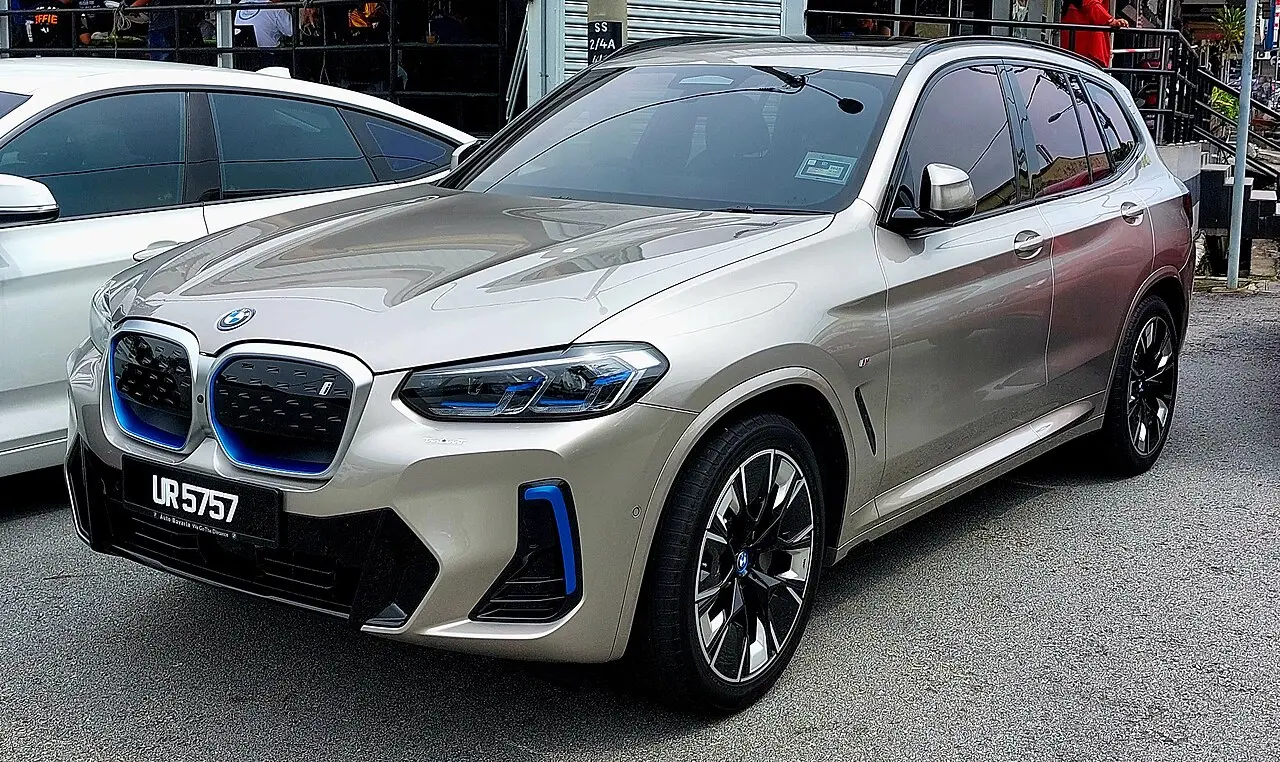
The BMW iX3 first generation (2020–2025): dimensions, weights, reliability and the official figures of its 11 versions in the European Union.
Model codes: G08 · Sold in: European Union
Dimensions, weights and capacity
| Specification | Europe |
|---|---|
| Dimensions | |
| Length | 4,730 mm RDW |
| Width | 1,890 mm RDW |
| Height | 1,670 mm RDW |
| Wheelbase | 2,860 mm RDW |
| Front track | 1,596–1,616 mm ASTRA |
| Rear track | 1,594–1,616 mm ASTRA |
| Weights and towing | |
| Kerb weight | 2,155–2,170 kg RDW |
| Mass in running order | 2,255–2,270 kg RDW |
| Gross vehicle weight | 2,725–2,740 kg RDW |
| Towing, braked trailer | 750 kg RDW |
| Towing, unbraked trailer | 750 kg RDW |
| Seats and space | |
| Seats | 5 RDW |
| Doors | 4 RDW |
| Boot space | 510 L EV DB |
| Performance | |
| Top speed | 180 km/h RDW |
| 0–100 km/h | 6.8 s EV DB |
| Torque | 400 Nm EV DB |
| Electric | |
| Battery capacity (usable) | 74.0–80.0 kWh EV DB |
| Battery capacity (gross) | 80.0–83.9 kWh EV DB |
| Range (WLTP) | 461 km EV DB |
| Energy use | 185 Wh/km EV DB |
| AC charging power | 11 kW EV DB |
| DC fast charging power | 150–155 kW EV DB |
Tyre sizes (most common first): 245/50R19, 245/45R20, 275/40R20
Ranges cover the generation’s versions and body styles; European and North American versions can differ. Sources: RDW type approvals (Netherlands), ASTRA type approvals (Switzerland), open EV databases (EV Compare, Open EV Data, Gaia EVDB), Traficom type approvals (Finland).
All 11 versions of the BMW iX3 first generation
European Union 11 versions
New cars registered in the EU (plus Norway and Iceland), from the European Environment Agency. Figures on the NEDC procedure until 2020 and on WLTP from 2021; versions are grouped by engine and power, with their number of registrations.
| Years and version | Engine | Power | Fuel | Consumption (combined) | CO₂ | Electric range | EU registrations |
|---|---|---|---|---|---|---|---|
| 2021–2025 | Electric motor | 210 kW (286 PS) | Electric | 18.2–18.8 kWh/100 km WLTP | 0 g/km | 456–463 km | 64,544 |
| 2025 | Electric motor | 345 kW (469 PS) | Electric | 16.5 kWh/100 km WLTP | 0 g/km | 743 km | 710 |
| 2021–2025 | Electric motor | 80 kW (109 PS) | Electric | 17.8–18.7 kWh/100 km WLTP | 0 g/km | 457–495 km | 8,989 |
| 2023–2025 | Electric motor | 190 kW (258 PS) | Electric | – | 0 g/km | – | 704 |
| 2024–2025 | Electric motor | 90 kW (122 PS) | Electric | – | 0 g/km | – | 59 |
| 2025 | Electric motor | 170 kW (231 PS) | Electric | 18.0 kWh/100 km WLTP | 0 g/km | 740 km | 40 |
| 2023 | Electric motor | 95 kW (129 PS) | Electric | – | 0 g/km | – | 15 |
| 2021–2022 | Electric motor | 73 kW (99 PS) | Electric | 19.3–19.4 kWh/100 km WLTP | 0 g/km | 441–443 km | 207 |
| 2021 | Electric motor | 175 kW (238 PS) | Electric | – | 0 g/km | – | 10 |
| 2020 | Electric motor | 175 kW (238 PS) | Electric | – | 0 g/km | – | 177 |
| 2020 | Electric motor | 80 kW (109 PS) | Electric | 17.4 kWh/100 km NEDC | 0 g/km | 510 km | 84 |
Similar models from other brands
Official figures are measured on standard test procedures and differ between markets. Your consumption depends on how, where and in what conditions you drive.