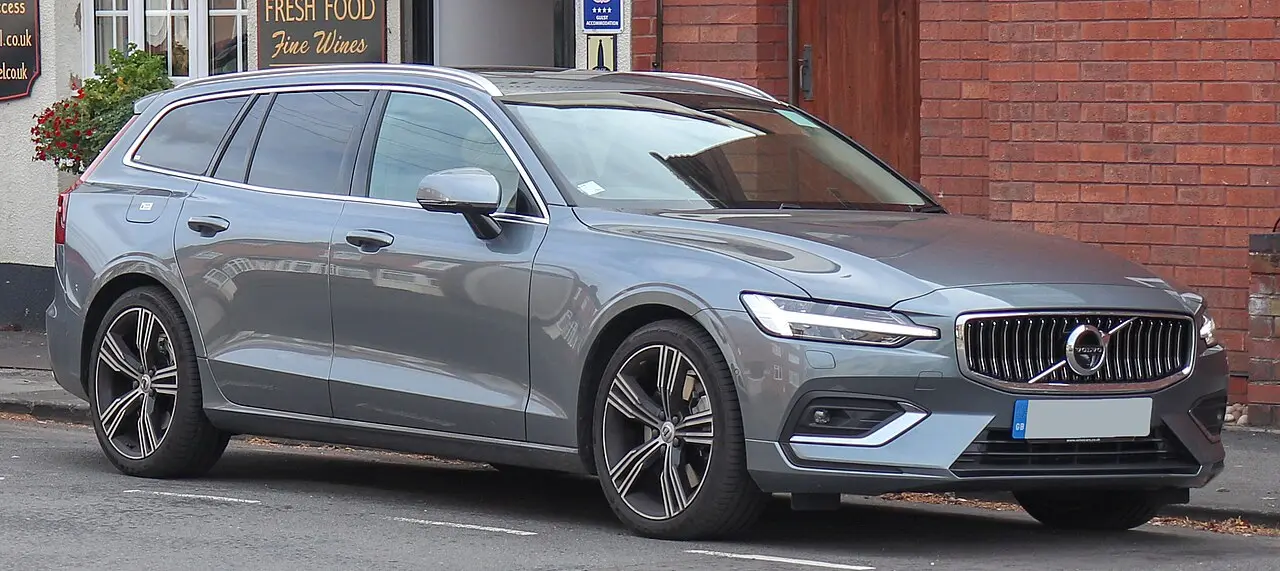
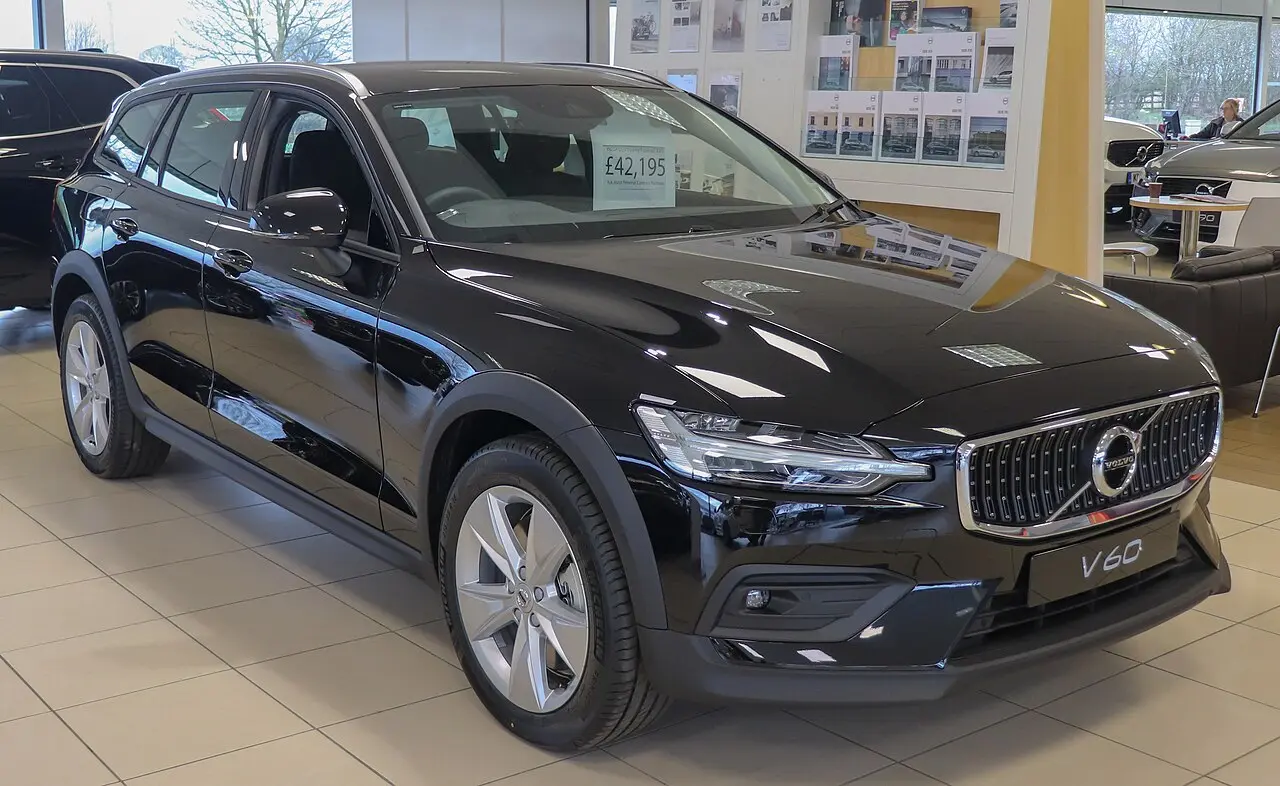
The official data lists 66 versions of the Volvo V60 Cross Country (2015–2026), in the European Union, the United States, and Canada. Each market publishes its own figures, measured on its own test procedure.
At a glance
Years in the data
2015–2026
Markets
European Union, United States, Canada
Engines
2.0 L to 2.5 L
Power
110 kW (150 PS) to 186 kW (253 PS)
Fuels
Hybrid, Diesel, Petrol
Lowest consumption (European Union)
5.7 L/100 km (WLTP)
Lowest consumption (United States)
8.7 L/100 km (EPA)
Lowest consumption (Canada)
8.7 L/100 km (5-cycle)
New registrations in the EU
126,546
What is the Volvo V60 Cross Country?
The V60 Cross Country is a raised, rugged version of Volvo’s V60 estate. It keeps the useful wagon shape and adds styling for an outdoors-focused character. It continues Volvo’s Cross Country tradition, which began with the V70 Cross Country in 1997.
The first generation ran from 2015 to 2018, followed by the second from 2019 onward. EU figures cover 2015–2025, while US and Canadian figures run from 2015 to 2026.
V60 Cross Country generations
The first generation used the P3 platform. The second moved to Volvo’s SPA platform and brought a new generation of V60 design. Both generations kept the estate body with raised, rugged details.
Engines and power
EU versions span 2.0 L to 2.4 L engines, with petrol, diesel and hybrid fuel types listed. Power ranges from 110 kW (150 PS) to 186 kW (253 PS). Diesel versions rated at 140 kW (190 PS), with either a 2.0 L or 2.4 L engine depending on year, feature among the leading EU registration configurations. US listings include petrol and hybrid versions with engines from 2.0 L to 2.5 L; Canadian listings cover petrol versions in that engine-size range.
How economical is the Volvo V60 Cross Country?
The lowest EU consumption listed is 5.7 L/100 km on the WLTP test. The US lowest is 8.7 L/100 km, with a best combined rating of 27 MPG under the EPA procedure. Canada’s lowest is also 8.7 L/100 km, measured on NRCan’s 5-cycle procedure. Europe uses WLTP here, while the US and Canada use EPA and 5-cycle tests; the procedures differ, so figures from different markets are not directly comparable.
Questions and answers
What are the V60 Cross Country generations?
The first generation ran from 2015 to 2018; the second has been built since 2019.
How does the Cross Country differ from a regular V60?
It keeps the V60 estate body and adds a raised stance and rugged styling.
What is the lowest listed V60 Cross Country consumption in the EU?
It is 5.7 L/100 km on the WLTP test.
Why do US, Canadian and European consumption figures differ?
They use different procedures: EPA in the US, NRCan 5-cycle in Canada, and WLTP or NEDC in Europe.
New cars registered in the EU (plus Norway and Iceland), from the European Environment Agency. Figures on the NEDC procedure until 2020 and on WLTP from 2021; versions are grouped by engine and power, with their number of registrations.
Years and version
Engine
Power
Fuel
Consumption (combined)
CO₂
EU registrations
2023–2025
2.0 L
145 kW (197 PS)
Hybrid
6.0 L/100 km WLTP
157 g/km
4,615
2025
2.0 L
184 kW (250 PS)
Hybrid
7.5 L/100 km WLTP
169 g/km
29
2023–2024
2.0 L
184 kW (250 PS)
Hybrid
7.5 L/100 km WLTP
170 g/km
2,026
2022
2.0 L
145 kW (197 PS)
Hybrid
6.0 L/100 km WLTP
157 g/km
3,072
2022
2.0 L
184 kW (250 PS)
Hybrid
7.4 L/100 km WLTP
171 g/km
489
2021
2.0 L
145 kW (197 PS)
Hybrid
5.8 L/100 km WLTP
158 g/km
10,932
2021
2.0 L
184 kW (250 PS)
Hybrid
7.4 L/100 km WLTP
171 g/km
1,614
2021
2.0 L
140 kW (190 PS)
Diesel
5.7 L/100 km WLTP
159 g/km
616
2021
2.0 L
145 kW (197 PS)
Diesel
5.7 L/100 km WLTP
154 g/km
186
2021
2.0 L
184 kW (250 PS)
Petrol
7.5 L/100 km WLTP
174 g/km
114
2021
2.0 L
110 kW (150 PS)
Diesel
5.4 L/100 km WLTP
163 g/km
26
2020
2.0 L
140 kW (190 PS)
Diesel
–
137 g/km
10,935
2020
2.0 L
145 kW (197 PS)
Hybrid
–
135 g/km
1,756
2020
2.0 L
184 kW (250 PS)
Petrol
–
167 g/km
1,322
2020
2.0 L
184 kW (250 PS)
Hybrid
–
152 g/km
1,083
2020
2.0 L
147 kW (200 PS)
Diesel
–
141 g/km
410
2020
2.0 L
110 kW (150 PS)
Diesel
–
139 g/km
218
2020
2.0 L
186 kW (253 PS)
Petrol
–
166 g/km
83
2020
2.0 L
145 kW (197 PS)
Diesel
–
142 g/km
18
2019
2.0 L
140 kW (190 PS)
Diesel
–
137 g/km
18,116
2019
2.0 L
184 kW (250 PS)
Petrol
–
167 g/km
1,034
2019
2.0 L
110 kW (150 PS)
Diesel
–
130 g/km
656
2019
2.0 L
147 kW (200 PS)
Diesel
–
140 g/km
524
2019
2.0 L
180 kW (245 PS)
Petrol
–
159 g/km
62
2019
2.0 L
186 kW (253 PS)
Petrol
–
166 g/km
56
2019
2.4 L
140 kW (190 PS)
Diesel
–
149 g/km
44
United States 7 versions
Model years sold in the USA, from the EPA and the Department of Energy (fueleconomy.gov). MPG on the EPA test; litres per 100 km = 235.215 ÷ MPG.
Years and version
Engine
Fuel
Gearbox
Drive
Consumption (combined)
CO₂
2026SIDI; Mild Hybrid
2.0 L
Hybrid
8-speed automatic
All-wheel drive
26 MPG (9.0 L/100 km) EPA
210 g/km
2025SIDI; Mild Hybrid
2.0 L
Hybrid
8-speed automatic
All-wheel drive
27 MPG (8.7 L/100 km) EPA
206 g/km
2024SIDI; Mild Hybrid
2.0 L
Hybrid
8-speed automatic
All-wheel drive
27 MPG (8.7 L/100 km) EPA
208 g/km
2023SIDI; Mild Hybrid
2.0 L
Hybrid
8-speed automatic
All-wheel drive
26 MPG (9.0 L/100 km) EPA
211 g/km
2022SIDI
2.0 L
Petrol
8-speed automatic
All-wheel drive
25 MPG (9.4 L/100 km) EPA
221 g/km
2020–2021SIDI
2.0 L
Petrol
8-speed automatic
All-wheel drive
25 MPG (9.4 L/100 km) EPA
220 g/km
2019SIDI
2.0 L
Petrol
8-speed automatic
All-wheel drive
25 MPG (9.4 L/100 km) EPA
218 g/km
Canada 7 versions
Model years sold in Canada, from Natural Resources Canada fuel consumption ratings (5-cycle test).
Official figures are measured on standard test procedures and differ between markets. Your consumption depends on how, where and in what conditions you drive.