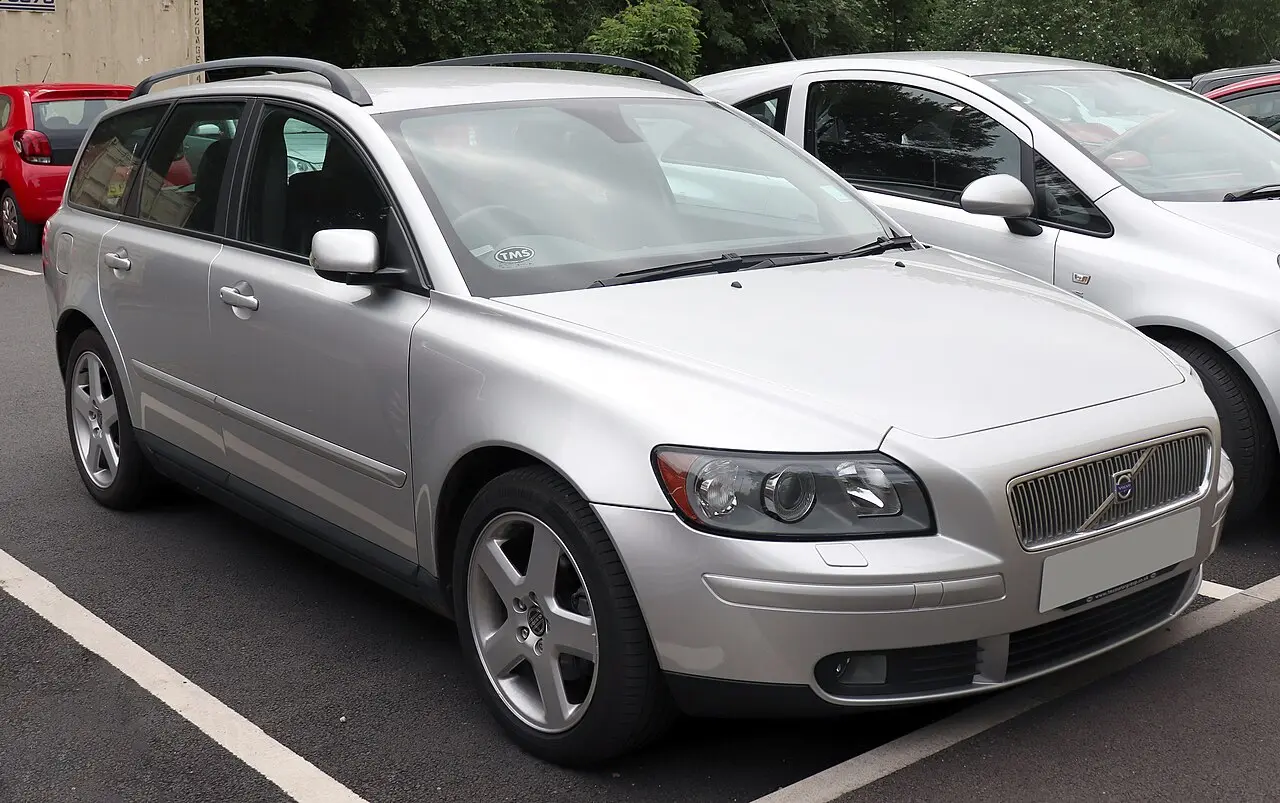
The official data lists 140 versions of the Volvo V50 (2004–2013), in the European Union, the United Kingdom, the United States, and Canada. Each market publishes its own figures, measured on its own test procedure.
At a glance
Years in the data
2004–2013
Markets
European Union, United Kingdom, United States, Canada
Engines
1.6 L to 2.5 L
Power
74 kW (101 PS) to 169 kW (230 PS)
Fuels
Diesel, Petrol, Flex fuel (E85)
Lowest consumption (United Kingdom)
3.8 L/100 km (NEDC)
Lowest consumption (United States)
9.8 L/100 km (EPA)
Lowest consumption (Canada)
9.9 L/100 km (5-cycle)
New registrations in the EU
207,105
What is the Volvo V50?
The V50 is a compact estate, pairing a relatively short body with the long roof and load space that make an estate useful for everyday family life. It sat among Volvo’s smaller cars, below the larger V70, and offered an estate alternative to the S40 saloon.
The V50 was the estate companion to Volvo’s compact S40. Its design brought the brand’s estate-car style into a smaller class, while its range included everyday petrol and diesel engines as well as more powerful petrol versions.
Generation and engines
The V50 had one generation (2005–2011, P1). Volvo introduced it as a compact estate, with both four- and five-cylinder engines available. Its practical estate body brought extra load space in a smaller format than Volvo’s larger estates.
In EU figures, engines range from 1.6 L to 2.5 L, with power from 74 kW (101 PS) to 169 kW (230 PS). UK figures cover the same engine-size range, with listed power from 125 kW (170 PS) to 127 kW (172 PS). Petrol, diesel and flex-fuel E85 versions appear in market figures; the EU list also includes other fuel entries.
Fuel consumption and markets
The UK’s lowest listed V50 consumption is 3.8 L/100 km on the NEDC test. In the US, the lowest listed figure is 9.8 L/100 km on EPA testing; Canada lists 9.9 L/100 km on NRCan’s 5-cycle procedure. Different test procedures mean these results are not directly comparable. Europe uses WLTP or NEDC, the USA uses EPA testing and Canada uses the 5-cycle procedure.
Official EU registration figures cover 2010–2013, UK figures cover 2004–2013, and US and Canadian figures cover 2005–2011. In the EU, the leading registration entries were 1.6 L diesel versions, including a 1.6 L diesel with 84 kW (114 PS) in later listed years.
Questions and answers
Was the Volvo V50 an SUV or an estate?
It was a compact estate, with a long-roof body and a practical load area.
How many V50 generations were there?
The V50 had one listed generation, the P1, spanning 2005–2011.
What was the largest listed V50 engine?
EU and UK figures include engines up to 2.5 L.
What is the lowest listed UK fuel consumption?
The UK VCA figure is 3.8 L/100 km on the NEDC test.
New cars registered in the EU (plus Norway and Iceland), from the European Environment Agency. Figures on the NEDC procedure until 2020 and on WLTP from 2021; versions are grouped by engine and power, with their number of registrations.
Years and version
Engine
Power
Fuel
CO₂
EU registrations
2011
1.6 L
84 kW (114 PS)
Diesel
108 g/km
56,904
2011
2.0 L
110 kW (150 PS)
Diesel
143 g/km
12,332
2011
2.0 L
107 kW (145 PS)
Petrol
176 g/km
2,626
2011
2.0 L
130 kW (177 PS)
Diesel
144 g/km
834
2011
2.0 L
107 kW (145 PS)
Flex fuel (E85)
177 g/km
818
2011
1.6 L
80 kW (109 PS)
Diesel
110 g/km
464
2011
1.6 L
74 kW (101 PS)
Petrol
172 g/km
150
2011
2.5 L
169 kW (230 PS)
Petrol
211 g/km
108
2011
2.0 L
100 kW (136 PS)
Diesel
154 g/km
82
2011
–
–
Diesel
106 g/km
42
2011
–
–
Petrol
183 g/km
16
2011
1.8 L
92 kW (125 PS)
Petrol
174 g/km
12
2010
1.6 L
–
Diesel
113 g/km
66,332
2010
2.0 L
–
Diesel
155 g/km
10,204
2010
2.0 L
–
Petrol
178 g/km
5,140
2010
2.0 L
–
Diesel
143 g/km
3,216
2010
1.6 L
–
Petrol
169 g/km
1,490
2010
1.8 L
–
Petrol
175 g/km
1,068
2010
2.4 L
–
Diesel
172 g/km
710
2010
2.5 L
–
Petrol
213 g/km
342
2010
2.4 L
–
Petrol
212 g/km
274
2010
–
–
Petrol
171 g/km
90
2010
1.8 L
–
Flex fuel (E85)
177 g/km
84
2010
2.0 L
–
Flex fuel (E85)
183 g/km
78
2010
–
–
Diesel
107 g/km
22
2010
–
–
Other fuel
154 g/km
10
United Kingdom 31 versions
New cars on sale in the UK, from the Vehicle Certification Agency. NEDC figures until 2018 and WLTP figures after; years are the editions a version appeared in.
Model years sold in the USA, from the EPA and the Department of Energy (fueleconomy.gov). MPG on the EPA test; litres per 100 km = 235.215 ÷ MPG.
Years and version
Engine
Fuel
Gearbox
Drive
Consumption (combined)
CO₂
2010–2011
2.5 L
Petrol
5-speed automatic
Front-wheel drive
24 MPG (9.8 L/100 km) EPA
230 g/km
2009–20102MODE CLKUP
2.4 L
Petrol
5-speed automatic
Front-wheel drive
24 MPG (9.8 L/100 km) EPA
230 g/km
2010
2.5 L
Petrol
5-speed automatic
All-wheel drive
22 MPG (10.7 L/100 km) EPA
251 g/km
2010
2.5 L
Petrol
6-speed manual
All-wheel drive
22 MPG (10.7 L/100 km) EPA
251 g/km
2010
2.5 L
Petrol
6-speed manual
Front-wheel drive
24 MPG (9.8 L/100 km) EPA
230 g/km
2008–2009
2.4 L
Petrol
5-speed manual
Front-wheel drive
23 MPG (10.2 L/100 km) EPA
240 g/km
2007–2009
2.5 L
Petrol
6-speed manual
Four- or all-wheel drive
20 MPG (11.8 L/100 km) EPA
276 g/km
2007–20092MODE CLKUP
2.5 L
Petrol
5-speed automatic
Four- or all-wheel drive
21 MPG (11.2 L/100 km) EPA
263 g/km
2008–2009
2.5 L
Petrol
6-speed manual
Front-wheel drive
23 MPG (10.2 L/100 km) EPA
240 g/km
20092MODE CLKUP
2.5 L
Petrol
5-speed automatic
Front-wheel drive
23 MPG (10.2 L/100 km) EPA
240 g/km
2007–20082MODE CLKUP
2.4 L
Petrol
5-speed automatic
Front-wheel drive
23 MPG (10.2 L/100 km) EPA
240 g/km
20082MODE CLKUP
2.5 L
Petrol
5-speed automatic
Front-wheel drive
22 MPG (10.7 L/100 km) EPA
251 g/km
2005–2007
2.4 L
Petrol
5-speed manual
Front-wheel drive
22 MPG (10.7 L/100 km) EPA
251 g/km
2006–20072MODE CLKUP
2.5 L
Petrol
5-speed automatic
Front-wheel drive
22 MPG (10.7 L/100 km) EPA
251 g/km
2007
2.5 L
Petrol
6-speed manual
Front-wheel drive
22 MPG (10.7 L/100 km) EPA
251 g/km
2005–20062MODE CLKUP
2.4 L
Petrol
5-speed automatic
Front-wheel drive
22 MPG (10.7 L/100 km) EPA
251 g/km
2006
2.5 L
Petrol
6-speed manual
Four- or all-wheel drive
20 MPG (11.8 L/100 km) EPA
276 g/km
20062MODE CLKUP
2.5 L
Petrol
5-speed automatic
Four- or all-wheel drive
20 MPG (11.8 L/100 km) EPA
276 g/km
2006
2.5 L
Petrol
6-speed manual
Front-wheel drive
23 MPG (10.2 L/100 km) EPA
240 g/km
2005
2.5 L
Petrol
6-speed manual
Four- or all-wheel drive
20 MPG (11.8 L/100 km) EPA
276 g/km
20052MODE CLKUP
2.5 L
Petrol
5-speed automatic
Four- or all-wheel drive
20 MPG (11.8 L/100 km) EPA
276 g/km
2005
2.5 L
Petrol
6-speed manual
Front-wheel drive
22 MPG (10.7 L/100 km) EPA
251 g/km
20052MODE CLKUP
2.5 L
Petrol
5-speed automatic
Front-wheel drive
22 MPG (10.7 L/100 km) EPA
251 g/km
Canada 32 versions
Model years sold in Canada, from Natural Resources Canada fuel consumption ratings (5-cycle test).
Years and version
Engine
Fuel
Gearbox
Consumption (combined)
CO₂
2011Station wagon: Small
2.5 L
Petrol
5-speed automatic
9.9 L/100 km 5-cycle
228 g/km
2010Station wagon: Small
2.4 L
Petrol
5-speed automatic
10.4 L/100 km 5-cycle
239 g/km
2010Station wagon: Small
2.4 L
Petrol
5-speed manual
10.2 L/100 km 5-cycle
235 g/km
2010Station wagon: Small
2.5 L
Petrol
5-speed automatic
10.0 L/100 km 5-cycle
230 g/km
2010Station wagon: Small
2.5 L
Petrol
6-speed manual
10.0 L/100 km 5-cycle
230 g/km
2010Station wagon: Small
2.5 L
Petrol
5-speed automatic
10.9 L/100 km 5-cycle
251 g/km
2010Station wagon: Small
2.5 L
Petrol
6-speed manual
10.7 L/100 km 5-cycle
246 g/km
2009Station wagon: Small
2.4 L
Petrol
5-speed automatic
10.4 L/100 km 5-cycle
239 g/km
2009Station wagon: Small
2.4 L
Petrol
5-speed manual
10.4 L/100 km 5-cycle
239 g/km
2008–2009Station wagon: Small
2.5 L
Petrol
6-speed manual
10.4 L/100 km 5-cycle
239 g/km
2008–2009Station wagon: Small
2.5 L
Petrol
6-speed manual
11.6 L/100 km 5-cycle
267 g/km
2009Station wagon: Small
2.5 L
Petrol
5-speed automatic
10.4 L/100 km 5-cycle
239 g/km
2009Station wagon: Small
2.5 L
Petrol
5-speed automatic
11.4 L/100 km 5-cycle
262 g/km
2008Station wagon: Small
2.4 L
Petrol
5-speed automatic
10.3 L/100 km 5-cycle
237 g/km
2008Station wagon: Small
2.4 L
Petrol
5-speed manual
10.3 L/100 km 5-cycle
237 g/km
2008Station wagon: Small
2.5 L
Petrol
5-speed automatic
10.8 L/100 km 5-cycle
248 g/km
2008Station wagon: Small
2.5 L
Petrol
5-speed automatic
11.3 L/100 km 5-cycle
260 g/km
2005–2007Station wagon: Small
2.4 L
Petrol
5-speed manual
10.7 L/100 km 5-cycle
246 g/km
2007Station wagon: Small
2.4 L
Petrol
5-speed automatic
10.4 L/100 km 5-cycle
239 g/km
2007Station wagon: Small
2.5 L
Petrol
5-speed automatic
10.7 L/100 km 5-cycle
246 g/km
2007Station wagon: Small
2.5 L
Petrol
6-speed manual
10.9 L/100 km 5-cycle
251 g/km
2007Station wagon: Small
2.5 L
Petrol
5-speed automatic
11.4 L/100 km 5-cycle
262 g/km
2007Station wagon: Small
2.5 L
Petrol
6-speed manual
11.8 L/100 km 5-cycle
271 g/km
2005–2006Station wagon: Small
2.4 L
Petrol
5-speed automatic
10.6 L/100 km 5-cycle
244 g/km
2006Station wagon: Small
2.5 L
Petrol
5-speed automatic
10.6 L/100 km 5-cycle
244 g/km
2006Station wagon: Small
2.5 L
Petrol
6-speed manual
10.3 L/100 km 5-cycle
237 g/km
2006Station wagon: Small
2.5 L
Petrol
5-speed automatic
11.6 L/100 km 5-cycle
267 g/km
2006Station wagon: Small
2.5 L
Petrol
6-speed manual
12.0 L/100 km 5-cycle
276 g/km
2005Station wagon: Small
2.5 L
Petrol
5-speed automatic
10.8 L/100 km 5-cycle
248 g/km
2005Station wagon: Small
2.5 L
Petrol
6-speed manual
10.4 L/100 km 5-cycle
239 g/km
2005Station wagon: Small
2.5 L
Petrol
5-speed automatic
12.0 L/100 km 5-cycle
276 g/km
2005Station wagon: Small
2.5 L
Petrol
6-speed manual
11.8 L/100 km 5-cycle
271 g/km
Versions outside these generations
European Union 11 versions
New cars registered in the EU (plus Norway and Iceland), from the European Environment Agency. Figures on the NEDC procedure until 2020 and on WLTP from 2021; versions are grouped by engine and power, with their number of registrations.
Years and version
Engine
Power
Fuel
CO₂
EU registrations
2013
1.6 L
84 kW (114 PS)
Diesel
107 g/km
132
2013
2.0 L
110 kW (150 PS)
Diesel
144 g/km
38
2013
1.6 L
–
Other fuel
99 g/km
10
2012
1.6 L
84 kW (114 PS)
Diesel
108 g/km
36,454
2012
2.0 L
110 kW (150 PS)
Diesel
143 g/km
4,836
2012
2.0 L
107 kW (145 PS)
Petrol
176 g/km
1,702
2012
2.0 L
107 kW (145 PS)
Flex fuel (E85)
177 g/km
222
2012
2.0 L
130 kW (177 PS)
Diesel
143 g/km
165
2012
–
–
Diesel
113 g/km
60
2012
–
–
Petrol
172 g/km
20
2012
2.5 L
169 kW (230 PS)
Petrol
211 g/km
18
United Kingdom 17 versions
New cars on sale in the UK, from the Vehicle Certification Agency. NEDC figures until 2018 and WLTP figures after; years are the editions a version appeared in.
Years and version
Engine
Power
Fuel
Gearbox
Consumption (combined)
CO₂
2013D2 Manual
1.6 L
–
Diesel
Manual
4.3 L/100 km NEDC
114 g/km
2013DRIVe
1.6 L
–
Diesel
Manual
3.8 L/100 km NEDC
99 g/km
2013D3 Auto · D4 Auto
2.0 L
–
Diesel
Automatic
5.8 L/100 km NEDC
154 g/km
2013D3 Manual · D4 Manual
2.0 L
–
Diesel
Manual
5.1 L/100 km NEDC
134 g/km
20132.0 Manual
2.0 L
–
Petrol
Manual
7.6 L/100 km NEDC
176 g/km
2013T5 Auto
2.5 L
–
Petrol
Automatic
9.0 L/100 km NEDC
211 g/km
2012D2 Manual
1.6 L
–
Diesel
6-speed manual
4.3 L/100 km NEDC
114 g/km
2012DRIVe
1.6 L
–
Diesel
6-speed manual
3.8 L/100 km NEDC
99 g/km
2012D3 Auto · D4 Auto
2.0 L
–
Diesel
6-speed automatic
5.8 L/100 km NEDC
154 g/km
2012D3 Manual · D4 Manual
2.0 L
–
Diesel
6-speed manual
5.1 L/100 km NEDC
134 g/km
20122.0 Manual
2.0 L
–
Petrol
5-speed manual
7.6 L/100 km NEDC
176 g/km
2012T5 Auto
2.5 L
–
Petrol
5-speed automatic
9.0 L/100 km NEDC
211 g/km
20042.0 D
2.0 L
–
Diesel
6-speed manual
5.7 L/100 km NEDC
153 g/km
20042.4 (170 bhp)
2.4 L
127 kW (172 PS)
Petrol
5-speed manual
8.6 L/100 km NEDC
204 g/km
20042.4 (170 bhp)
2.4 L
127 kW (172 PS)
Petrol
5-speed automatic
9.2 L/100 km NEDC
220 g/km
2004T5
2.5 L
–
Petrol
6-speed manual
8.8 L/100 km NEDC
209 g/km
2004T5
2.5 L
–
Petrol
5-speed automatic
9.5 L/100 km NEDC
227 g/km
Official figures are measured on standard test procedures and differ between markets. Your consumption depends on how, where and in what conditions you drive.