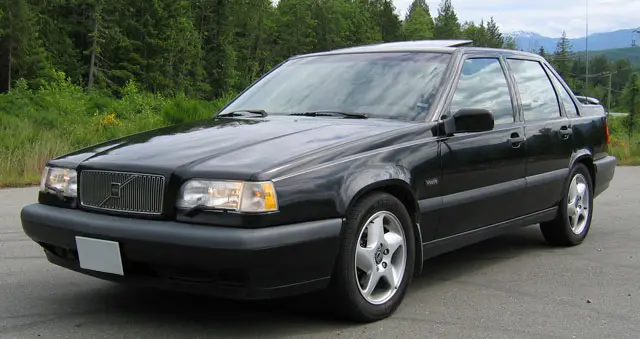
What is the Volvo 850?
The Volvo 850 was a family car offered as a saloon and an estate. It marked a major change for Volvo’s larger cars, with front-wheel drive and a five-cylinder engine mounted across the car. The estate added a generous load area to the saloon’s everyday practicality.
Generations and design
The 850’s P80 generation ran from 1992 to 1997. Volvo introduced the saloon first, followed by the estate. Its transverse five-cylinder layout and Delta-link rear axle shaped the car’s design. The 850 also introduced Volvo’s integrated side-impact protection system and a self-adjusting front seat-belt mechanism. The range later added turbocharged petrol versions and a direct-injection turbo-diesel. The S70 saloon and V70 estate succeeded the 850.
Engines and power
US and Canadian versions listed petrol engines from 2.3 L to 2.4 L. The wider range also included turbocharged petrol engines and a direct-injection turbo-diesel. The five-cylinder layout was a defining feature of the 850 and accompanied its shift to front-wheel drive.
How economical was the Volvo 850?
In the United States, the EPA ratings give a lowest listed combined consumption of 11.2 L/100 km and a best combined rating of 21 MPG. In Canada, the lowest listed consumption is also 11.2 L/100 km, measured using NRCan’s 5-cycle procedure. The EPA and Canadian procedures differ, so the results are not directly comparable.
Where was it sold?
The 850 was listed in the United States from 1993 to 1997 and in Canada from 1995 to 1997. The versions listed in both markets use petrol engines. Saloon and estate body styles offered different ways to balance passenger space and carrying room.
Questions and answers
What years did the Volvo 850 generation cover?
The P80 generation ran from 1992 to 1997.
Was the 850 front-wheel drive?
Yes. Its engine was mounted transversely and drove the front wheels.
What is the best US EPA combined rating listed?
The best listed rating is 21 MPG combined.
Why are the US and Canadian consumption figures not directly comparable?
The US figure uses the EPA procedure, while the Canadian figure uses NRCan’s 5-cycle procedure.