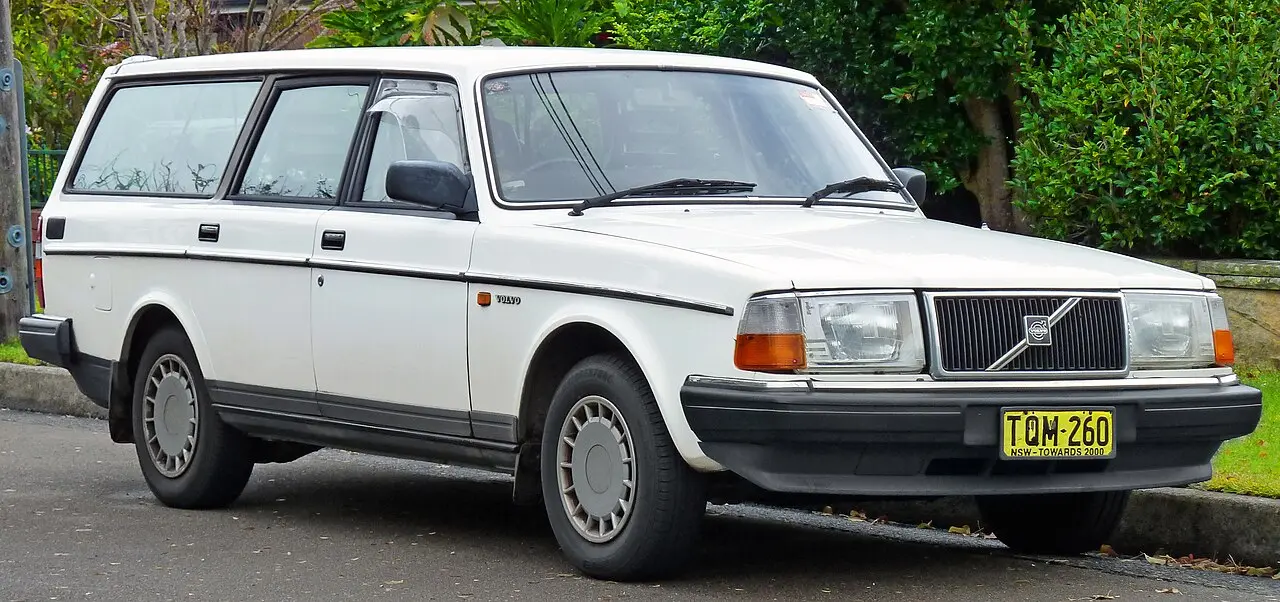
Volvo

Volvo 240

Volvo 240
Photo: OSX / Wikimedia Commons · Public domain

The official data lists 31 versions of the Volvo 240 (1984–1993), in the United States. Each market publishes its own figures, measured on its own test procedure.

At a glance

Years in the data
1984–1993
Markets
United States
Engines
2.1 L to 2.4 L
Fuels
Petrol, Diesel
Lowest consumption (United States)
9.0 L/100 km (EPA)

What is the Volvo 240?

The Volvo 240 is a rear-wheel-drive family car that came as a sedan or estate. Its upright shape, roomy cabin and large bumpers gave it a practical look that became closely associated with Volvo. The model developed the earlier 140 series, with a revised front and chassis influenced by Volvo’s VESC safety concept car.

The 240 name covered several body styles: 242 for the two-door, 244 for the four-door sedan and 245 for the estate.

Generations and engines

The US-market 240 generation covered here ran from 1984 to 1993. Within that span, Volvo continued to offer the sedan and estate body styles associated with the 242, 244 and 245 codes.

US versions used petrol or diesel engines from 2.1 L to 2.4 L. Volvo introduced a new four-cylinder engine series with the 240, and the wider range also included diesel options.

How economical is the Volvo 240?

The best combined US EPA rating is 26 MPG. The lowest listed consumption is 9 L/100 km. The market versions described here use petrol or diesel engines.

EPA figures use the US test procedure. European WLTP and NEDC tests and Canada’s 5-cycle test follow different procedures, so their results are not directly comparable.

Where was the Volvo 240 sold?

In the United States, the 240 was sold from 1984 to 1993 in sedan and estate forms. Its three familiar body codes were 242, 244 and 245.

Questions and answers

What years does this Volvo 240 page cover?

It covers US EPA versions from 1984 to 1993.

What body styles did the 240 name include?

The codes are 242 for a two-door, 244 for a four-door sedan and 245 for an estate.

What is the best combined EPA fuel economy?

The highest combined rating is 26 MPG.

240 240 (1984–1993)

Volvo 240 240
Photo: OSX / Wikimedia Commons · Public domain

Model codes: 242, 244, 245 · Sold in: United States · References: volvocars.com, volvocars.com

United States 31 versions

Model years sold in the USA, from the EPA and the Department of Energy (fueleconomy.gov). MPG on the EPA test; litres per 100 km = 235.215 ÷ MPG.

Years and versionEngineFuelGearboxDriveConsumption (combined)CO₂
1990–1993(FFS) BOSCH · (FFS)2.3 LPetrol4-speed automaticRear-wheel drive20 MPG (11.8 L/100 km) EPA276 g/km
1989–1993(FFS), SIL · (LH-3.1) (FFS), SIL2.3 LPetrol5-speed manualRear-wheel drive21 MPG (11.2 L/100 km) EPA263 g/km
1993(FFS), SIL2.3 LPetrol5-speed manualRear-wheel drive21 MPG (11.2 L/100 km) EPA263 g/km
1991–1992(FFS), SIL2.3 LPetrol5-speed manualRear-wheel drive22 MPG (10.7 L/100 km) EPA251 g/km
1989–1990(EGR) (FFS), SIL · (FFS), SIL · (EGR) (FFS), SIL and 1 more trim2.3 LPetrol5-speed manualRear-wheel drive21 MPG (11.2 L/100 km) EPA263 g/km
1990(EGR) (FFS)2.3 LPetrol4-speed automaticRear-wheel drive19 MPG (12.4 L/100 km) EPA291 g/km
1990(FFS) · (BOSCH) (FFS)2.3 LPetrol4-speed automaticRear-wheel drive19 MPG (12.4 L/100 km) EPA291 g/km
1989–1990(EGR) (FFS), SIL · (EGR) (FFS), SIL2.3 LPetrol5-speed manualRear-wheel drive20 MPG (11.8 L/100 km) EPA276 g/km
1990(FFS), SIL2.3 LPetrol5-speed manualRear-wheel drive21 MPG (11.2 L/100 km) EPA263 g/km
1989–1990(FFS) · (EGR) (FFS)2.3 LPetrol4-speed automaticRear-wheel drive19 MPG (12.4 L/100 km) EPA291 g/km
1989(EGR) (FFS)2.3 LPetrol4-speed automaticRear-wheel drive18 MPG (13.1 L/100 km) EPA307 g/km
1988(FFS), SIL2.3 LPetrol5-speed manualRear-wheel drive21 MPG (11.2 L/100 km) EPA263 g/km
1987–1988(FFS), SIL2.3 LPetrol5-speed manualRear-wheel drive22 MPG (10.7 L/100 km) EPA251 g/km
1988(FFS)2.3 LPetrol4-speed automaticRear-wheel drive19 MPG (12.4 L/100 km) EPA291 g/km
1987(FFS)2.3 LPetrol4-speed automaticRear-wheel drive20 MPG (11.8 L/100 km) EPA276 g/km
1985–1987(FFS)2.3 LPetrol4-speed automaticRear-wheel drive20 MPG (11.8 L/100 km) EPA276 g/km
1985–1986(FFS), SIL2.3 LPetrol4-speed manualRear-wheel drive22 MPG (10.7 L/100 km) EPA251 g/km
1985(FFS,TRBO) CA model2.1 LPetrol4-speed manualRear-wheel drive17 MPG (13.8 L/100 km) EPA325 g/km
1985(FFS,TRBO)2.1 LPetrol4-speed automaticRear-wheel drive17 MPG (13.8 L/100 km) EPA325 g/km
1985(FFS,TRBO)2.1 LPetrol4-speed manualRear-wheel drive17 MPG (13.8 L/100 km) EPA325 g/km
1984(FFS,TRBO) · (FFS,TRBO) CA model2.1 LPetrol4-speed automatic–17 MPG (13.8 L/100 km) EPA325 g/km
1984(FFS,TRBO) · (FFS,TRBO) CA model2.1 LPetrol5-speed manual–18 MPG (13.1 L/100 km) EPA307 g/km
1984(FFS) · (FFS) CA model2.3 LPetrol4-speed automatic–20 MPG (11.8 L/100 km) EPA276 g/km
1984CA model2.3 LPetrol4-speed automatic–19 MPG (12.4 L/100 km) EPA291 g/km
1984(FFS) · (FFS) CA model2.3 LPetrol5-speed manual–23 MPG (10.2 L/100 km) EPA240 g/km
1984CA model2.3 LPetrol5-speed manual–22 MPG (10.7 L/100 km) EPA251 g/km
1984(FFS) · (FFS) CA model2.3 LPetrol4-speed automatic–20 MPG (11.8 L/100 km) EPA276 g/km
1984(FFS) · (FFS) CA model2.3 LPetrol5-speed manual–21 MPG (11.2 L/100 km) EPA263 g/km
1984CA model2.3 LPetrol5-speed manual–22 MPG (10.7 L/100 km) EPA251 g/km
1984(DIESEL)2.4 LDiesel3-speed automatic–24 MPG (9.8 L/100 km) EPA264 g/km
1984(DIESEL)2.4 LDiesel5-speed manual–26 MPG (9.0 L/100 km) EPA243 g/km

Official figures are measured on standard test procedures and differ between markets. Your consumption depends on how, where and in what conditions you drive.