Toyota

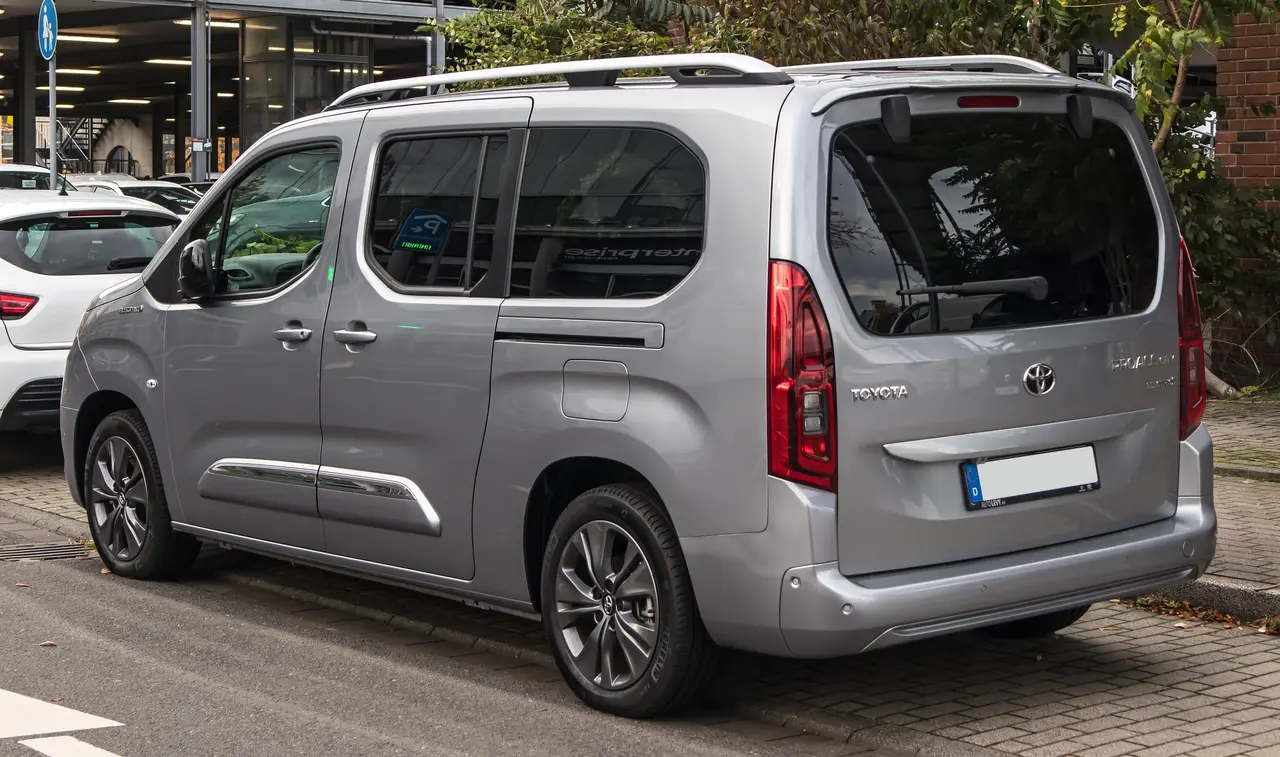
Toyota Proace City Verso

Toyota Proace City Verso
Photo: © M 93 / Wikimedia Commons · CC BY-SA 3.0

The official data lists 37 versions of the Toyota Proace City Verso (2020–2026), in the European Union and the United Kingdom. Each market publishes its own figures, measured on its own test procedure.

At a glance

Years in the data
2020–2026
Markets
European Union, United Kingdom
Engines
1.2 L to 1.5 L
Power
57 kW (77 PS) to 100 kW (136 PS)
Fuels
Diesel, Petrol, Electric
Lowest consumption (European Union)
4.8 L/100 km (WLTP)
New registrations in the EU
91,655

What is the Toyota Proace City Verso?

The Proace City Verso is the passenger-carrying version of Toyota’s compact van. Its tall body and practical cabin suit family journeys and passenger transport. It sits within Toyota’s Proace City range, alongside work-focused van versions, and is part of Toyota Professional’s commercial-vehicle line-up.

Generation and powertrains

The first generation began in 2020 and is still listed today. EU versions include petrol and diesel engines as well as an electric model. The listed combustion-engine sizes span 1.2 to 1.5 litres, with outputs from 57 kW (77 PS) to 100 kW (136 PS). EU figures list the electric version at 100 kW (136 PS); UK figures also cover electric versions at that output.

Fuel consumption and where it was sold

For EU petrol and diesel versions, the lowest listed fuel consumption is 4.8 L/100 km on WLTP. The electric model has no fuel-consumption figure in L/100 km.

Markets and everyday role

The Proace City Verso appears in EU registration figures from 2020 to 2025 and in UK figures from 2024 onward. It brings passenger seating and luggage space to Toyota’s compact van range, with petrol, diesel and electric versions listed in the EU.

Questions and answers

What kind of vehicle is the Proace City Verso?

It is the passenger-carrying version of Toyota’s compact van range, designed as a practical people carrier.

What powertrains are listed?

EU versions include petrol, diesel and electric powertrains. UK figures cover electric versions producing 100 kW (136 PS).

What is the lowest listed fuel consumption?

The EU figure is 4.8 L/100 km on WLTP, for a petrol or diesel version.

Proace City Verso first generation (since 2020)

Toyota Proace City Verso first generation
Photo: © M 93 / Wikimedia Commons · CC BY-SA 3.0

Sold in: European Union and United Kingdom · References: newsroom.toyota.eu, media.toyota.co.uk

European Union 31 versions

New cars registered in the EU (plus Norway and Iceland), from the European Environment Agency. Figures on the NEDC procedure until 2020 and on WLTP from 2021; versions are grouped by engine and power, with their number of registrations.

Years and versionEnginePowerFuelConsumption (combined)CO₂Electric rangeEU registrations
20251.5 L96 kW (131 PS)Diesel5.7 L/100 km WLTP148 g/km–4,655
20251.2 L81 kW (110 PS)Petrol6.5 L/100 km WLTP147 g/km–1,854
20251.5 L75 kW (102 PS)Diesel5.3 L/100 km WLTP140 g/km–1,431
2025Electric motor100 kW (136 PS)Electric19.3 kWh/100 km WLTP0 g/km325 km1,341
2025Electric motor62 kW (84 PS)Electric18.3 kWh/100 km WLTP0 g/km339 km25
2025Electric motor57 kW (77 PS)Electric20.8 kWh/100 km WLTP0 g/km268 km18
20241.5 L96 kW (131 PS)Diesel5.7 L/100 km WLTP149 g/km–9,300
20241.2 L81 kW (110 PS)Petrol6.5 L/100 km WLTP147 g/km–4,355
20241.5 L75 kW (102 PS)Diesel5.4 L/100 km WLTP141 g/km–3,688
2024Electric motor100 kW (136 PS)Electric19.7 kWh/100 km WLTP0 g/km291 km453
20241.5 L96 kW (131 PS)Petrol5.2 L/100 km WLTP140 g/km–11
20231.5 L96 kW (131 PS)Diesel5.7 L/100 km WLTP149 g/km–4,094
20231.2 L81 kW (110 PS)Petrol6.5 L/100 km WLTP148 g/km–3,194
20231.5 L75 kW (102 PS)Diesel5.4 L/100 km WLTP141 g/km–2,741
2023Electric motor100 kW (136 PS)Electric20.1 kWh/100 km WLTP0 g/km277 km659
20231.2 L96 kW (131 PS)Petrol6.9 L/100 km WLTP157 g/km–508
20221.2 L96 kW (131 PS)Petrol6.7 L/100 km WLTP155 g/km–3,036
20221.5 L96 kW (131 PS)Diesel5.0 L/100 km WLTP139 g/km–2,855
20221.2 L81 kW (110 PS)Petrol6.4 L/100 km WLTP148 g/km–2,634
20221.5 L75 kW (102 PS)Diesel4.8 L/100 km WLTP137 g/km–2,045
2022Electric motor100 kW (136 PS)Electric20.3 kWh/100 km WLTP0 g/km273 km218
2022Electric motor57 kW (77 PS)Electric20.0 kWh/100 km WLTP0 g/km277 km153
20211.5 L96 kW (131 PS)Diesel5.1 L/100 km WLTP140 g/km–7,183
20211.2 L81 kW (110 PS)Petrol6.4 L/100 km WLTP150 g/km–6,785
20211.2 L96 kW (131 PS)Petrol6.7 L/100 km WLTP156 g/km–5,876
20211.5 L75 kW (102 PS)Diesel5.0 L/100 km WLTP137 g/km–5,144
20211.5 L96 kW (131 PS)Petrol5.4 L/100 km WLTP140 g/km–13
20201.5 L96 kW (131 PS)Diesel–112 g/km–6,097
20201.2 L81 kW (110 PS)Petrol–123 g/km–5,805
20201.5 L75 kW (102 PS)Diesel–108 g/km–3,400
20201.2 L96 kW (131 PS)Petrol–120 g/km–2,084

United Kingdom 6 versions

New cars on sale in the UK, from the Vehicle Certification Agency. NEDC figures until 2018 and WLTP figures after; years are the editions a version appeared in.

Years and versionEnginePowerFuelGearboxConsumption (combined)CO₂Electric range
2025–2026Design L1 50kWhElectric motor100 kW (136 PS)Electric–18.4 kWh/100 km WLTP0 g/km339 km
2025–2026Icon L1 50kWhElectric motor100 kW (136 PS)Electric–18.2 kWh/100 km WLTP0 g/km342 km
2025–2026Icon L2 50kWhElectric motor100 kW (136 PS)Electric–18.8 kWh/100 km WLTP0 g/km333 km
2024Icon L2 50kWhElectric motor–ElectricAutomatic18.8 kWh/100 km WLTP0 g/km330 km
2024Icon L1 50kWhElectric motor–ElectricAutomatic18.2 kWh/100 km WLTP0 g/km330 km
2024Design L1 50kWhElectric motor–ElectricAutomatic18.4 kWh/100 km WLTP0 g/km330 km

Official figures are measured on standard test procedures and differ between markets. Your consumption depends on how, where and in what conditions you drive.