Saturn

Saturn S-Series

Saturn S-Series
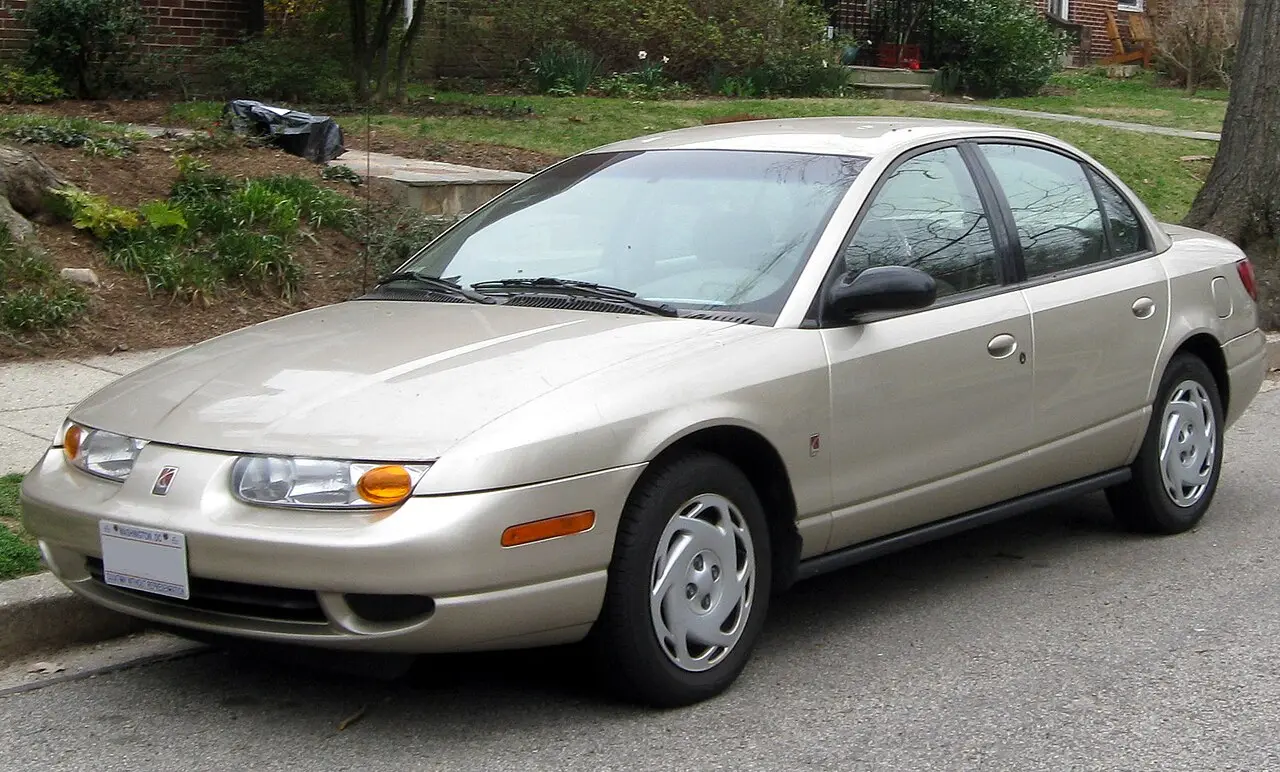
Photo: IFCAR / Wikimedia Commons · Public domain

The official data lists 76 versions of the Saturn S-Series (1991–2002), in the United States and Canada. Each market publishes its own figures, measured on its own test procedure.

At a glance

Years in the data
1991–2002
Markets
United States, Canada
Engines
1.9 L
Fuels
Petrol
Lowest consumption (Canada)
8.0 L/100 km (5-cycle)
Lowest consumption (United States)
8.1 L/100 km (EPA)

What is the Saturn S-Series?

The S-Series was Saturn’s compact-car family, sold in the United States and Canada as a sedan, coupe and station wagon. That choice of body styles gave the range room for everyday passenger use as well as extra cargo space.

Saturn was General Motors’ effort to create a distinct identity for practical small cars. The S-Series reflected that approach with polymer body panels over a steel structure, a feature that set these cars apart. Its compact size and choice of layouts suited a range of daily driving needs.

Generations and engines

The S-Series generations were the first (1995), second (1996–1999) and third (2000–2002). The family retained its compact-car role through these successive generations, with design updates along the way.

The S-Series used a 1.9 L petrol engine.

How economical is the Saturn S-Series?

In the United States, EPA figures cover model years 1991–2002. The best combined rating is 29 MPG, and the lowest listed consumption is 8.1 L/100 km. Canadian NRCan figures cover 1995–2002, with lowest listed consumption of 8 L/100 km on the 5-cycle test.

The EPA and Canadian 5-cycle procedures differ, so these consumption figures are best read within their respective test systems.

Where was the S-Series sold?

The S-Series was sold in the United States and Canada. U.S. EPA figures cover model years 1991–2002; Canadian NRCan figures cover 1995–2002.

Questions and answers

What body styles did the S-Series come in?

It was offered as a sedan, coupe and station wagon.

What engine did the S-Series use?

It used a 1.9 L petrol engine.

What is the best combined EPA rating?

The best combined U.S. EPA rating is 29 MPG.

What are the Canadian consumption figures based on?

The Canadian figures use NRCan’s 5-cycle test.

S-Series first generation (1995)

Sold in: United States and Canada · References: en.wikipedia.org

Show all 9 versions

S-Series second generation (1996–1999)

Sold in: United States and Canada · References: en.wikipedia.org

Show all 37 versions

S-Series third generation (2000–2002)

Saturn S-Series third generation
Photo: IFCAR / Wikimedia Commons · Public domain

Sold in: United States and Canada · References: en.wikipedia.org

United States 3 versions

Model years sold in the USA, from the EPA and the Department of Energy (fueleconomy.gov). MPG on the EPA test; litres per 100 km = 235.215 ÷ MPG.

Years and versionEngineFuelGearboxDriveConsumption (combined)CO₂
2001–2002SOHC, CLKUP1.9 LPetrol4-speed automaticFront-wheel drive26 MPG (9.0 L/100 km) EPA212 g/km
2001–2002SOHC, CLKUP1.9 LPetrol4-speed automaticFront-wheel drive27 MPG (8.7 L/100 km) EPA205 g/km
2000SOHC, CLKUP1.9 LPetrol4-speed automaticFront-wheel drive27 MPG (8.7 L/100 km) EPA205 g/km

Canada 12 versions

Model years sold in Canada, from Natural Resources Canada fuel consumption ratings (5-cycle test).

Years and versionEngineFuelGearboxConsumption (combined)CO₂
2001–2002Compact1.9 LPetrol4-speed automatic8.6 L/100 km 5-cycle198 g/km
2000–2002Compact1.9 LPetrol5-speed manual8.0 L/100 km 5-cycle184 g/km
2001–2002Subcompact1.9 LPetrol4-speed automatic8.9 L/100 km 5-cycle205 g/km
2001–2002Subcompact1.9 LPetrol5-speed manual8.2 L/100 km 5-cycle189 g/km
2002Subcompact · Compact1.9 LPetrol4-speed automatic9.3 L/100 km 5-cycle214 g/km
2002Subcompact · Compact1.9 LPetrol5-speed manual9.2 L/100 km 5-cycle212 g/km
2001Subcompact · Compact · Station wagon: Small1.9 LPetrol4-speed automatic9.1 L/100 km 5-cycle209 g/km
2000–2001Subcompact · Compact · Station wagon: Small1.9 LPetrol5-speed manual8.8 L/100 km 5-cycle202 g/km
2000Subcompact1.9 LPetrol4-speed automatic8.7 L/100 km 5-cycle200 g/km
2000Subcompact · Compact · Station wagon: Small1.9 LPetrol4-speed automatic9.0 L/100 km 5-cycle207 g/km
2000Subcompact1.9 LPetrol5-speed manual8.3 L/100 km 5-cycle191 g/km
2000Compact1.9 LPetrol4-speed automatic8.6 L/100 km 5-cycle198 g/km

Versions outside these generations

United States 15 versions

Model years sold in the USA, from the EPA and the Department of Energy (fueleconomy.gov). MPG on the EPA test; litres per 100 km = 235.215 ÷ MPG.

Years and versionEngineFuelGearboxDriveConsumption (combined)CO₂
1993–1994(TBI) (FFS), 2MODE CLKUP · (FFS), CLKUP1.9 LPetrol4-speed automaticFront-wheel drive26 MPG (9.0 L/100 km) EPA212 g/km
1994(FFS), CLKUP1.9 LPetrol4-speed automaticFront-wheel drive26 MPG (9.0 L/100 km) EPA212 g/km
1994(FFS) (MPFI), CLKUP1.9 LPetrol4-speed automaticFront-wheel drive24 MPG (9.8 L/100 km) EPA230 g/km
1994(FFS), SIL1.9 LPetrol5-speed manualFront-wheel drive28 MPG (8.4 L/100 km) EPA197 g/km
1994(FFS) (MPFI), SIL1.9 LPetrol5-speed manualFront-wheel drive25 MPG (9.4 L/100 km) EPA221 g/km
1993(MFI) (FFS), CLKUP1.9 LPetrol4-speed automaticFront-wheel drive24 MPG (9.8 L/100 km) EPA230 g/km
1993(TBI) (FFS), SIL1.9 LPetrol5-speed manualFront-wheel drive28 MPG (8.4 L/100 km) EPA197 g/km
1993(MFI) (FFS), SIL1.9 LPetrol5-speed manualFront-wheel drive25 MPG (9.4 L/100 km) EPA221 g/km
1993(TBI) (FFS), 2MODE CLKUP1.9 LPetrol4-speed automaticFront-wheel drive26 MPG (9.0 L/100 km) EPA212 g/km
1991–1992(FFS), 2MODE CLKUP1.9 LPetrol4-speed automaticFront-wheel drive26 MPG (9.0 L/100 km) EPA212 g/km
1991–1992(FFS) (MPFI), 2MODE CLKUP1.9 LPetrol4-speed automaticFront-wheel drive24 MPG (9.8 L/100 km) EPA230 g/km
1992(FFS), SIL1.9 LPetrol5-speed manualFront-wheel drive28 MPG (8.4 L/100 km) EPA197 g/km
1992(FFS) (MPFI), SIL1.9 LPetrol5-speed manualFront-wheel drive25 MPG (9.4 L/100 km) EPA221 g/km
1991(FFS)1.9 LPetrol5-speed manualFront-wheel drive27 MPG (8.7 L/100 km) EPA205 g/km
1991(FFS) (MPFI)1.9 LPetrol5-speed manualFront-wheel drive25 MPG (9.4 L/100 km) EPA221 g/km

Official figures are measured on standard test procedures and differ between markets. Your consumption depends on how, where and in what conditions you drive.