Saturn

Saturn Outlook

Saturn Outlook
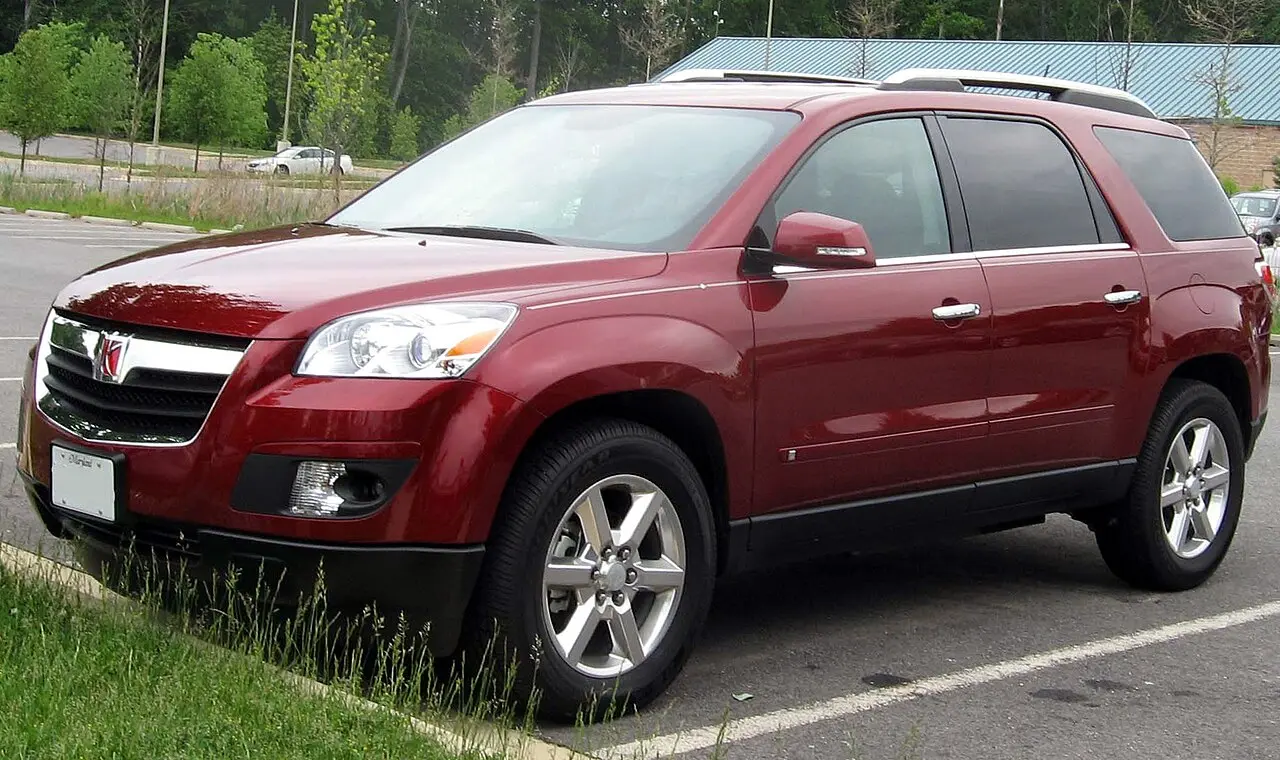
Photo: IFCAR / Wikimedia Commons · Public domain

The official data lists 9 versions of the Saturn Outlook (2007–2010), in the United States and Canada. Each market publishes its own figures, measured on its own test procedure.

At a glance

Years in the data
2007–2010
Markets
United States, Canada
Engines
3.6 L
Fuels
Petrol
Lowest consumption (Canada)
12.3 L/100 km (5-cycle)
Lowest consumption (United States)
12.4 L/100 km (EPA)

What is the Saturn Outlook?

The Outlook was a large crossover SUV with three rows of seating, designed to carry passengers and cargo. Its cabin could be arranged for seven or eight occupants. It became Saturn’s largest vehicle and marked the brand’s move into a larger family crossover segment.

The Outlook replaced the Relay in Saturn’s range and used General Motors’ Lambda architecture, shared across the company’s large crossover family.

Generations and years

The Outlook had one generation, sold from 2007 to 2010 in the United States and from 2007 to 2009 in Canada. It was built on GM’s Lambda platform, a front-drive-based crossover architecture.

Engines and power

The Outlook used a 3.6 L petrol V6 across its range.

How economical is the Saturn Outlook?

The lowest listed US figure is 12.4 L/100 km, and the EPA combined rating reaches 19 MPG. Canada’s lowest listed figure is 12.3 L/100 km on NRCan’s 5-cycle test. EPA and Canadian 5-cycle procedures differ, so each figure is best understood within its own market.

Questions and answers

How many generations of Saturn Outlook were there?

One generation, sold from 2007 to 2010 in the United States and from 2007 to 2009 in Canada.

What engine did the Outlook use?

A 3.6 L petrol V6.

How many people could it carry?

Its three-row cabin could be arranged for seven or eight occupants.

Where was the Outlook sold?

It was sold in the United States and Canada.

Outlook first generation (2007–2010)

Saturn Outlook first generation
Photo: IFCAR / Wikimedia Commons · Public domain

Model codes: GM Lambda · Sold in: United States and Canada · References: en.wikipedia.org

United States 5 versions

Model years sold in the USA, from the EPA and the Department of Energy (fueleconomy.gov). MPG on the EPA test; litres per 100 km = 235.215 ÷ MPG.

Years and versionEngineFuelGearboxDriveConsumption (combined)CO₂
2009–2010CLKUP3.6 LPetrol6-speed automaticFront-wheel drive19 MPG (12.4 L/100 km) EPA291 g/km
20103.6 LPetrol6-speed automaticAll-wheel drive19 MPG (12.4 L/100 km) EPA291 g/km
2009CLKUP3.6 LPetrol6-speed automaticFour- or all-wheel drive19 MPG (12.4 L/100 km) EPA291 g/km
2007–2008CLKUP3.6 LPetrol6-speed automaticFront-wheel drive19 MPG (12.4 L/100 km) EPA291 g/km
2007–2008CLKUP3.6 LPetrol6-speed automaticFour- or all-wheel drive18 MPG (13.1 L/100 km) EPA307 g/km

Canada 4 versions

Model years sold in Canada, from Natural Resources Canada fuel consumption ratings (5-cycle test).

Years and versionEngineFuelGearboxConsumption (combined)CO₂
2009Sport utility vehicle3.6 LPetrol6-speed automatic12.3 L/100 km 5-cycle283 g/km
2009Sport utility vehicle3.6 LPetrol6-speed automatic12.8 L/100 km 5-cycle294 g/km
2007–2008Sport utility vehicle3.6 LPetrol6-speed automatic12.4 L/100 km 5-cycle285 g/km
2007–2008Sport utility vehicle3.6 LPetrol6-speed automatic13.0 L/100 km 5-cycle299 g/km

Official figures are measured on standard test procedures and differ between markets. Your consumption depends on how, where and in what conditions you drive.