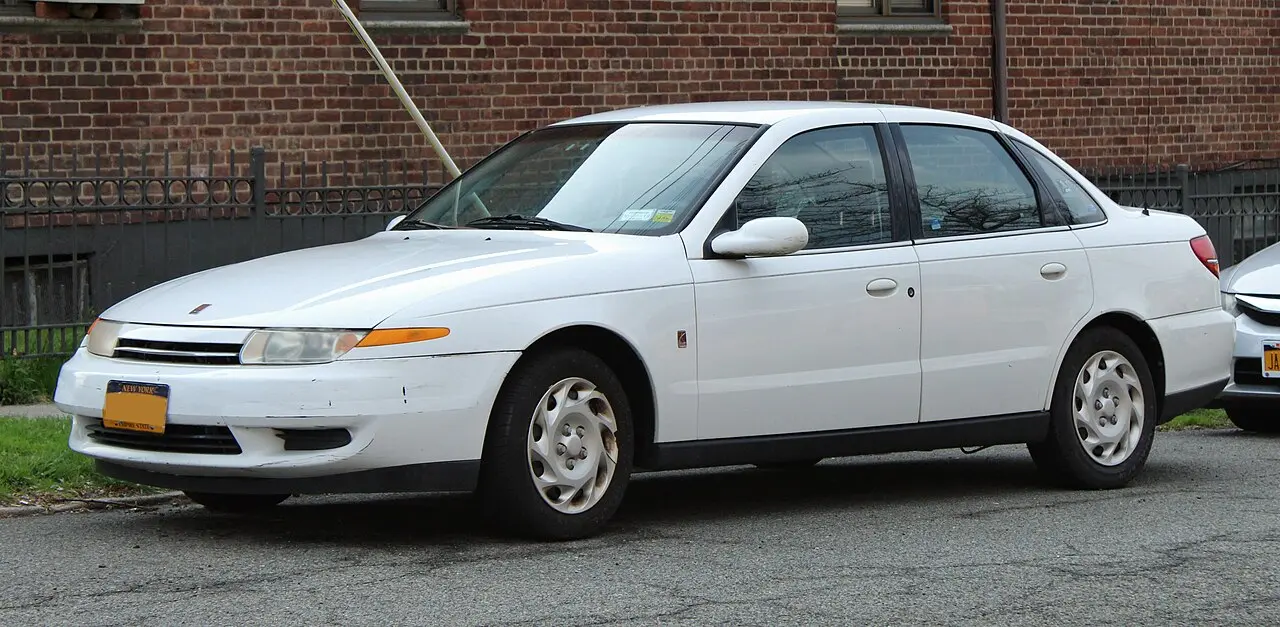
What is the Saturn L-Series?
The L-Series was Saturn’s mid-size car, offered as a four-door sedan and a station wagon. It gave the brand a larger family-car option, with the wagon adding space for luggage and bulky cargo.
The L-Series was a single-generation model, spanning 2000–2005. It used GM’s GM2900 platform, also associated with the Opel Vectra, reflecting the model’s place in a broader GM lineup.
Engines and power
The L-Series used petrol engines from 2.2 L to 3.0 L, with four-cylinder and V6 choices.
The larger body and choice of four-cylinder or V6 engines gave the L-Series a distinct role alongside Saturn’s compact cars.
How economical is the Saturn L-Series?
In the United States, EPA figures cover 2000–2005. The best combined rating is 25 MPG, and the lowest listed consumption is 9.4 L/100 km. Canadian NRCan figures cover the same model years, with lowest listed consumption of 9.8 L/100 km on the 5-cycle test.
The EPA and Canadian 5-cycle procedures differ, so their results are not direct equivalents. European WLTP and older NEDC procedures also differ from the U.S. and Canadian tests.
Where was the L-Series sold?
The L-Series was sold in the United States and Canada. Figures for both markets cover model years 2000–2005.
Questions and answers
What body styles did the L-Series offer?
It was available as a four-door sedan and a station wagon.
How many generations did the L-Series have?
One: the first generation, spanning 2000–2005.
What engine sizes were available?
Petrol engines ranged from 2.2 L to 3.0 L, with four-cylinder and V6 choices.
What is the best combined U.S. EPA rating?
The best combined rating is 25 MPG.