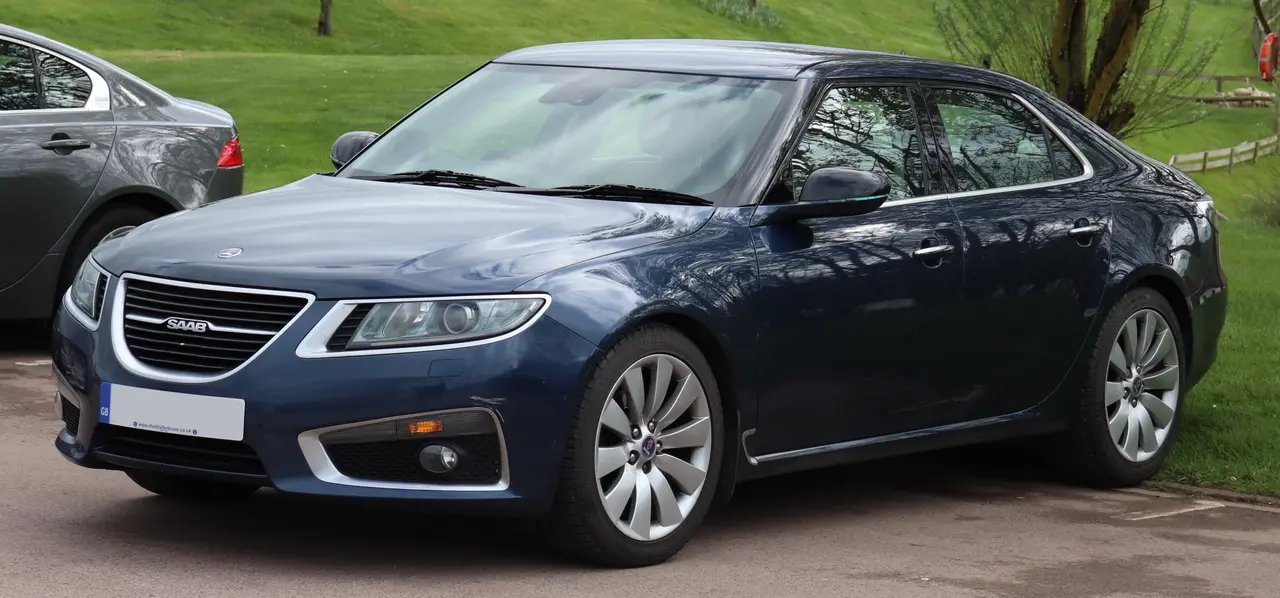
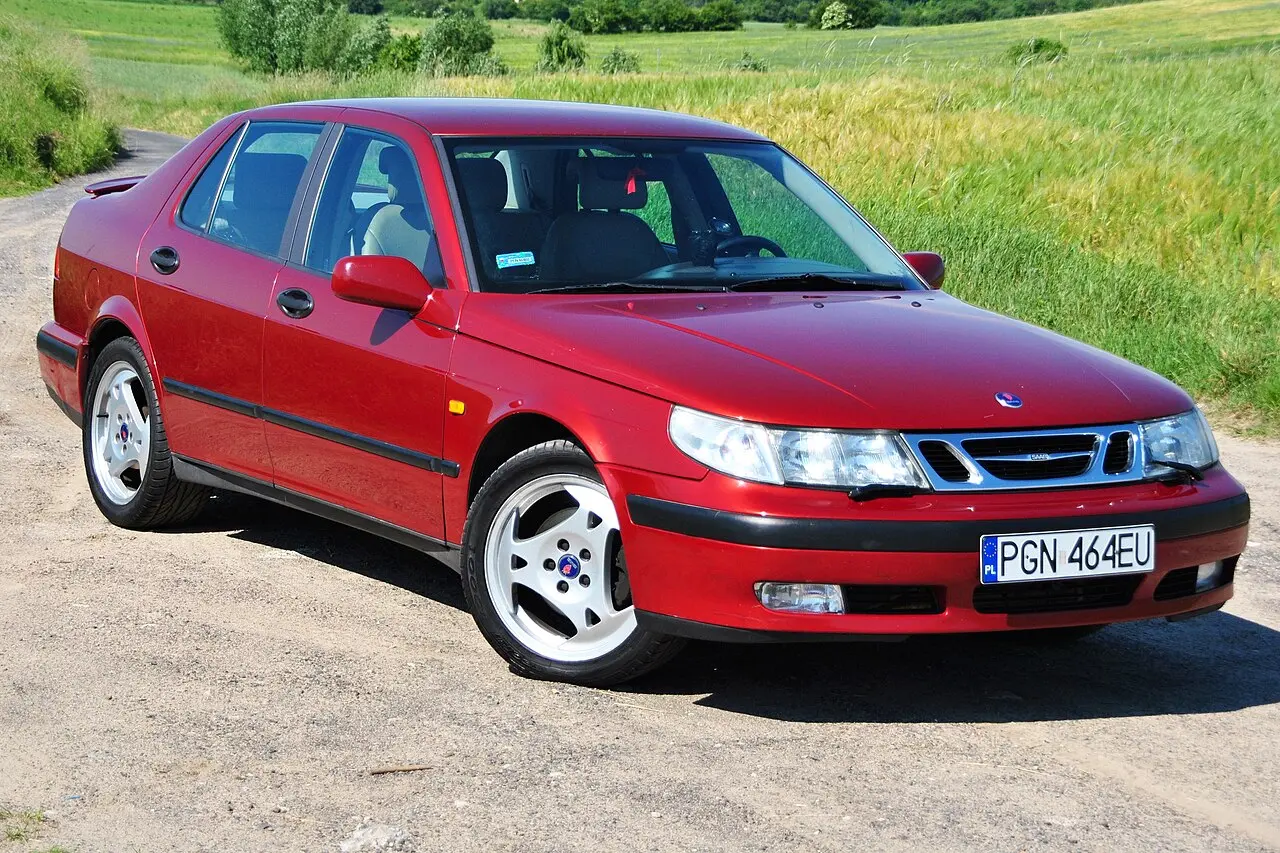
The official data lists 208 versions of the Saab 9-5 (1999–2013), in the European Union, the United Kingdom, the United States, and Canada. Each market publishes its own figures, measured on its own test procedure.
At a glance
Years in the data
1999–2013
Markets
European Union, United Kingdom, United States, Canada
Engines
1.9 L to 3.0 L
Power
90 kW (122 PS) to 191 kW (260 PS)
Fuels
Diesel, Petrol, Flex fuel (E85)
Lowest consumption (United Kingdom)
6.4 L/100 km (NEDC)
Lowest consumption (United States)
9.8 L/100 km (EPA)
Lowest consumption (Canada)
10.0 L/100 km (5-cycle)
New registrations in the EU
15,736
What is the Saab 9-5?
The Saab 9-5 was the larger family car in the maker’s range, offered as a saloon and, in the model line, an estate. It brought together a spacious layout, Scandinavian design and Saab’s long association with turbocharged engines. Powertrains included petrol and diesel, with E85 flex-fuel versions in some markets.
Generations, engines and power
The first generation ran from 1998 to 2010. The redesigned second generation followed from 2010 to 2011. Listed EU engine sizes range from 1.6 L to 2.8 L, with power from 118 kW (160 PS) to 221 kW (300 PS). UK figures include engines from 1.9 L to 3.0 L and power from 90 kW (122 PS) to 191 kW (260 PS). EU and UK listings include petrol, diesel and E85 flex-fuel versions.
How economical is the Saab 9-5?
The lowest listed UK consumption is 6.4 L/100 km on the NEDC test. US EPA figures give a lowest result of 9.8 L/100 km and a best combined rating of 24 MPG. Canada’s NRCan figures give a lowest result of 10 L/100 km on the 5-cycle test. NEDC, EPA and NRCan 5-cycle results use different procedures, so read each figure in the context of its market.
Where was the Saab 9-5 sold?
The market figures cover the EU, UK, United States and Canada. EU registration figures for 2010–2013 total 15,736, with 2.0 L diesels among the leading registered types. UK figures span 2000–2010, US figures 1999–2012 and Canadian figures 1999–2009.
Questions and answers
When did the Saab 9-5 generations run?
The first generation ran from 1998 to 2010; the second from 2010 to 2011.
What power range is listed for the Saab 9-5?
EU figures span 118 kW (160 PS) to 221 kW (300 PS), while UK figures span 90 kW (122 PS) to 191 kW (260 PS).
What is the lowest listed 9-5 consumption?
The UK figure is 6.4 L/100 km on the NEDC test.
Which markets have Saab 9-5 figures?
The figures cover the EU, UK, United States and Canada.
New cars registered in the EU (plus Norway and Iceland), from the European Environment Agency. Figures on the NEDC procedure until 2020 and on WLTP from 2021; versions are grouped by engine and power, with their number of registrations.
Years and version
Engine
Power
Fuel
CO₂
EU registrations
2011
2.0 L
118 kW (160 PS)
Diesel
160 g/km
3,160
2011
2.0 L
162 kW (220 PS)
Petrol
213 g/km
898
2011
2.0 L
162 kW (220 PS)
Flex fuel (E85)
206 g/km
734
2011
2.0 L
140 kW (190 PS)
Diesel
165 g/km
540
2011
2.8 L
221 kW (300 PS)
Petrol
244 g/km
350
2011
–
–
Petrol
207 g/km
150
2011
1.6 L
132 kW (179 PS)
Petrol
179 g/km
116
2011
–
–
Diesel
172 g/km
14
2011
2.0 L
–
Petrol
226 g/km
14
2010
2.0 L
–
Diesel
161 g/km
3,236
2010
2.3 L
–
Petrol
231 g/km
1,564
2010
2.0 L
–
Petrol
208 g/km
1,304
2010
2.0 L
–
Petrol
229 g/km
926
2010
1.9 L
–
Diesel
191 g/km
734
2010
2.0 L
–
Flex fuel (E85)
206 g/km
710
2010
2.8 L
–
Petrol
244 g/km
578
2010
1.6 L
–
Petrol
179 g/km
100
2010
–
–
Other fuel
217 g/km
20
2010
2.3 L
–
Flex fuel (E85)
234 g/km
12
2010
–
–
Petrol
224 g/km
10
United Kingdom 15 versions
New cars on sale in the UK, from the Vehicle Certification Agency. NEDC figures until 2018 and WLTP figures after; years are the editions a version appeared in.
Years and version
Engine
Power
Fuel
Gearbox
Consumption (combined)
CO₂
20101.9TiD (150ps)
1.9 L
110 kW (150 PS)
Diesel
5-speed manual
6.4 L/100 km NEDC
174 g/km
20101.9TiD (150ps)
1.9 L
110 kW (150 PS)
Diesel
5-speed automatic
7.4 L/100 km NEDC
199 g/km
20101.9TiD (150ps)
1.9 L
110 kW (150 PS)
Diesel
5-speed manual
6.8 L/100 km NEDC
184 g/km
20101.9TiD (150ps)
1.9 L
110 kW (150 PS)
Diesel
5-speed automatic
7.6 L/100 km NEDC
204 g/km
20102.0T (150ps)
2.0 L
110 kW (150 PS)
Petrol
5-speed manual
8.6 L/100 km NEDC
204 g/km
20102.0T (150ps)
2.0 L
110 kW (150 PS)
Petrol
5-speed automatic
10.3 L/100 km NEDC
244 g/km
20102.0T (150ps)
2.0 L
110 kW (150 PS)
Petrol
5-speed manual
9.0 L/100 km NEDC
214 g/km
20102.0T (150ps)
2.0 L
110 kW (150 PS)
Petrol
5-speed automatic
10.6 L/100 km NEDC
251 g/km
20102.0T BioPower (180ps)
2.0 L
132 kW (180 PS)
Flex fuel (E85)
5-speed manual
8.6 L/100 km NEDC
204 g/km
20102.0T BioPower (180ps)
2.0 L
132 kW (180 PS)
Flex fuel (E85)
5-speed automatic
10.3 L/100 km NEDC
244 g/km
20102.0T BioPower (180ps)
2.0 L
132 kW (180 PS)
Flex fuel (E85)
5-speed manual
9.0 L/100 km NEDC
214 g/km
20102.0T BioPower (180ps)
2.0 L
132 kW (180 PS)
Flex fuel (E85)
5-speed automatic
10.6 L/100 km NEDC
251 g/km
20102.3T (260ps)
2.3 L
191 kW (260 PS)
Petrol
5-speed manual
8.9 L/100 km NEDC
213 g/km
20102.3T (260ps)
2.3 L
191 kW (260 PS)
Petrol
5-speed automatic
10.2 L/100 km NEDC
244 g/km
20102.3T (260ps)
2.3 L
191 kW (260 PS)
Petrol
5-speed manual
8.9 L/100 km NEDC
214 g/km
United States 4 versions
Model years sold in the USA, from the EPA and the Department of Energy (fueleconomy.gov). MPG on the EPA test; litres per 100 km = 235.215 ÷ MPG.
Years and version
Engine
Fuel
Gearbox
Drive
Consumption (combined)
CO₂
2011–2012SIDI; FFV
2.0 L
Flex fuel (E85)
6-speed automatic
Front-wheel drive
21 MPG (11.2 L/100 km) EPA
263 g/km
2011–2012SIDI; FFV
2.0 L
Flex fuel (E85)
6-speed manual
Front-wheel drive
24 MPG (9.8 L/100 km) EPA
230 g/km
2011
2.8 L
Petrol
6-speed automatic
All-wheel drive
20 MPG (11.8 L/100 km) EPA
276 g/km
2010
2.8 L
Petrol
6-speed automatic
All-wheel drive
20 MPG (11.8 L/100 km) EPA
276 g/km
Versions outside these generations
European Union 10 versions
New cars registered in the EU (plus Norway and Iceland), from the European Environment Agency. Figures on the NEDC procedure until 2020 and on WLTP from 2021; versions are grouped by engine and power, with their number of registrations.
Years and version
Engine
Power
Fuel
CO₂
EU registrations
2013
2.0 L
118 kW (160 PS)
Diesel
154 g/km
24
2013
2.0 L
140 kW (190 PS)
Diesel
167 g/km
14
2013
–
–
Petrol
209 g/km
10
2012
2.0 L
118 kW (160 PS)
Diesel
162 g/km
172
2012
2.0 L
162 kW (220 PS)
Petrol
210 g/km
97
2012
2.0 L
162 kW (220 PS)
Flex fuel (E85)
203 g/km
88
2012
2.0 L
140 kW (190 PS)
Diesel
164 g/km
70
2012
1.6 L
132 kW (179 PS)
Petrol
179 g/km
51
2012
2.8 L
221 kW (300 PS)
Petrol
244 g/km
22
2012
–
–
Petrol
203 g/km
18
United States 1 version
Model years sold in the USA, from the EPA and the Department of Energy (fueleconomy.gov). MPG on the EPA test; litres per 100 km = 235.215 ÷ MPG.
Official figures are measured on standard test procedures and differ between markets. Your consumption depends on how, where and in what conditions you drive.