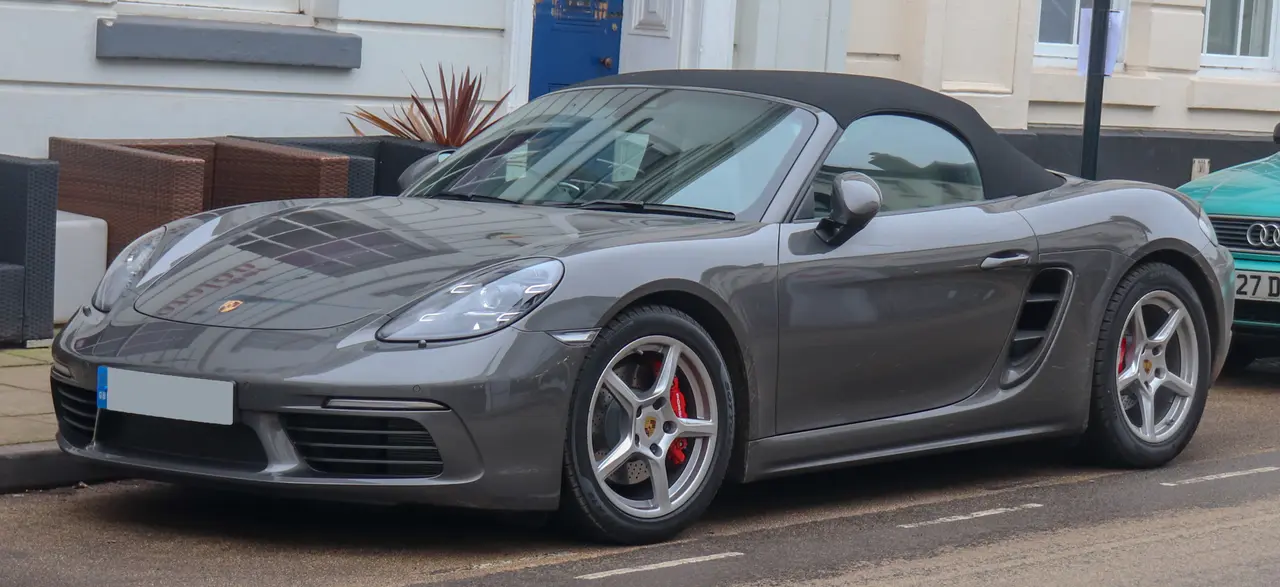
The official data lists 70 versions of the Porsche 718 Boxster (2016–2025), in the European Union, the United Kingdom, the United States, and Canada. Each market publishes its own figures, measured on its own test procedure.
At a glance
Years in the data
2016–2025
Markets
European Union, United Kingdom, United States, Canada
Engines
2.0 L to 4.0 L
Power
220 kW (299 PS) to 368 kW (500 PS)
Fuels
Petrol
Lowest consumption (United Kingdom)
6.9 L/100 km (NEDC)
Lowest consumption (European Union)
8.8 L/100 km (WLTP)
Lowest consumption (United States)
9.8 L/100 km (EPA)
New registrations in the EU
51,750
What is the Porsche 718 Boxster?
The 718 Boxster is a two-seat sports roadster with its engine behind the seats and a fabric roof that opens the cabin. In Porsche’s range, it is the open-top partner to the 718 Cayman coupé. Its compact shape and mid-engine layout make it a distinctive choice for drivers who enjoy open-air motoring.
Porsche added the 718 name to the Boxster and Cayman in 2016. It recalls the marque’s mid-engine 718 racing cars and reflects Porsche’s long connection with motorsport.
718 Boxster generations
The 982 generation ran from 2016 to 2025. The model brought the 718 name and launched with turbocharged flat-four engines. It kept the Boxster’s mid-engine layout, with revised styling and a new engine direction. Higher-performance versions later brought larger engines.
Engines, power and fuel consumption
In European Union registration figures, the 718 Boxster’s petrol engines range from 2.0 L to 4.0 L, with power from 220 kW (299 PS) to 368 kW (500 PS). Its lowest stated EU consumption is 8.8 L/100 km on WLTP. EU figures cover 2016–2025 and record 51,750 registrations. The most registered listed configuration was the 2.0 L petrol rated at 220 kW (299 PS).
Test procedures differ by market. The UK VCA figure is 6.9 L/100 km on NEDC. In the United States, the EPA figure is 9.8 L/100 km, or 24 MPG combined; Canada’s NRCan 5-cycle figure is 10 L/100 km. US and Canadian figures cover 2020–2025.
Where was the 718 Boxster sold?
The 718 Boxster appears in official figures for the European Union, the UK, the United States and Canada. The years shown are 2016–2025 in the EU, 2016–2018 in the UK and 2020–2025 in the US and Canada.
Questions and answers
Is the 718 Boxster a convertible?
Yes. It is a two-seat roadster with a fabric roof.
What engines and power are listed for the 718 Boxster in the EU?
The listed petrol engines range from 2.0 L to 4.0 L, and power ranges from 220 kW (299 PS) to 368 kW (500 PS).
What is its lowest stated EU fuel consumption?
The lowest stated EU figure is 8.8 L/100 km on the WLTP test.
Why do the US and Canadian consumption figures differ?
The EPA procedure in the US, NRCan 5-cycle procedure in Canada, and WLTP and NEDC procedures in Europe differ, so results can vary by market.
New cars registered in the EU (plus Norway and Iceland), from the European Environment Agency. Figures on the NEDC procedure until 2020 and on WLTP from 2021; versions are grouped by engine and power, with their number of registrations.
Years and version
Engine
Power
Fuel
Consumption (combined)
CO₂
EU registrations
2025
4.0 L
368 kW (500 PS)
Petrol
12.7 L/100 km WLTP
288 g/km
930
2025
2.0 L
220 kW (299 PS)
Petrol
9.0 L/100 km WLTP
204 g/km
132
2025
4.0 L
294 kW (400 PS)
Petrol
10.1 L/100 km WLTP
241 g/km
39
2025
2.5 L
257 kW (349 PS)
Petrol
9.7 L/100 km WLTP
222 g/km
11
2024
4.0 L
368 kW (500 PS)
Petrol
12.8 L/100 km WLTP
290 g/km
1,402
2024
2.0 L
220 kW (299 PS)
Petrol
9.0 L/100 km WLTP
204 g/km
1,292
2024
4.0 L
294 kW (400 PS)
Petrol
10.2 L/100 km WLTP
232 g/km
814
2024
2.5 L
257 kW (349 PS)
Petrol
9.7 L/100 km WLTP
221 g/km
83
2022–2023
4.0 L
294 kW (400 PS)
Petrol
10.2 L/100 km WLTP
233 g/km
1,235
2023
2.0 L
220 kW (299 PS)
Petrol
9.0 L/100 km WLTP
204 g/km
975
2022–2023
4.0 L
309 kW (420 PS)
Petrol
10.8 L/100 km WLTP
245 g/km
876
2023
4.0 L
368 kW (500 PS)
Petrol
13.0 L/100 km WLTP
294 g/km
150
2023
2.5 L
257 kW (349 PS)
Petrol
9.7 L/100 km WLTP
220 g/km
70
2022
2.0 L
220 kW (299 PS)
Petrol
8.8 L/100 km WLTP
204 g/km
715
2022
2.5 L
257 kW (349 PS)
Petrol
9.6 L/100 km WLTP
220 g/km
62
2021
4.0 L
294 kW (400 PS)
Petrol
10.2 L/100 km WLTP
233 g/km
2,088
2021
2.0 L
220 kW (299 PS)
Petrol
8.8 L/100 km WLTP
203 g/km
1,464
2021
4.0 L
309 kW (420 PS)
Petrol
10.7 L/100 km WLTP
245 g/km
1,464
2021
2.5 L
257 kW (349 PS)
Petrol
9.6 L/100 km WLTP
221 g/km
104
2019–2020
4.0 L
309 kW (420 PS)
Petrol
–
249 g/km
3,586
2020
2.0 L
220 kW (299 PS)
Petrol
–
181 g/km
2,602
2020
4.0 L
294 kW (400 PS)
Petrol
–
245 g/km
631
2020
2.5 L
257 kW (349 PS)
Petrol
–
194 g/km
524
2020
2.5 L
269 kW (366 PS)
Petrol
–
195 g/km
113
2019
2.0 L
220 kW (299 PS)
Petrol
–
180 g/km
4,620
2019
2.5 L
269 kW (366 PS)
Petrol
–
194 g/km
1,854
2019
2.5 L
257 kW (349 PS)
Petrol
–
189 g/km
292
2018
2.0 L
220 kW (299 PS)
Petrol
–
160 g/km
4,718
2018
2.5 L
269 kW (366 PS)
Petrol
–
187 g/km
2,646
2018
2.5 L
257 kW (349 PS)
Petrol
–
168 g/km
966
2017
2.0 L
220 kW (299 PS)
Petrol
–
159 g/km
6,014
2017
2.5 L
257 kW (349 PS)
Petrol
–
168 g/km
3,332
2017
2.0 L
330 kW (449 PS)
Petrol
–
160 g/km
64
2016
2.0 L
220 kW (299 PS)
Petrol
–
161 g/km
3,446
2016
2.5 L
257 kW (349 PS)
Petrol
–
172 g/km
2,436
United Kingdom 9 versions
New cars on sale in the UK, from the Vehicle Certification Agency. NEDC figures until 2018 and WLTP figures after; years are the editions a version appeared in.
Years and version
Engine
Fuel
Gearbox
Consumption (combined)
CO₂
2016–2018Boxster PDK · Cayman PDK
2.0 L
Petrol
7-speed automatic
6.9 L/100 km NEDC
158 g/km
2018Boxster · Cayman
2.0 L
Petrol
6-speed manual
7.4 L/100 km NEDC
168 g/km
2018Boxster S · Cayman S
2.5 L
Petrol
6-speed manual
8.1 L/100 km NEDC
184 g/km
2018Boxster S PDK · Cayman S PDK
2.5 L
Petrol
7-speed automatic
7.3 L/100 km NEDC
167 g/km
2018Boxster GTS · Cayman GTS
2.5 L
Petrol
6-speed manual
9.1 L/100 km NEDC
207 g/km
2018Boxster GTS PDK · Cayman GTS PDK
2.5 L
Petrol
7-speed automatic
8.2 L/100 km NEDC
188 g/km
2016–2017Boxster · Cayman
2.0 L
Petrol
7-speed manual
7.4 L/100 km NEDC
168 g/km
2016–2017Boxster S · Cayman S
2.5 L
Petrol
7-speed manual
8.1 L/100 km NEDC
184 g/km
2016–2017Boxster S PDK · Cayman S PDK
2.5 L
Petrol
7-speed automatic
7.3 L/100 km NEDC
167 g/km
United States 13 versions
Model years sold in the USA, from the EPA and the Department of Energy (fueleconomy.gov). MPG on the EPA test; litres per 100 km = 235.215 ÷ MPG.
Years and version
Engine
Fuel
Gearbox
Drive
Consumption (combined)
CO₂
2021–2025SIDI
2.0 L
Petrol
7-speed automated manual
Rear-wheel drive
24 MPG (9.8 L/100 km) EPA
233 g/km
2023–2025SIDI
2.0 L
Petrol
6-speed manual
Rear-wheel drive
22 MPG (10.7 L/100 km) EPA
254 g/km
2021–2025SIDI
2.5 L
Petrol
6-speed manual
Rear-wheel drive
21 MPG (11.2 L/100 km) EPA
263 g/km
2021–2025SIDI
2.5 L
Petrol
7-speed automated manual
Rear-wheel drive
22 MPG (10.7 L/100 km) EPA
255 g/km
2021–2025SIDI
4.0 L
Petrol
6-speed manual
Rear-wheel drive
19 MPG (12.4 L/100 km) EPA
285 g/km
2021–2025SIDI
4.0 L
Petrol
7-speed automated manual
Rear-wheel drive
21 MPG (11.2 L/100 km) EPA
260 g/km
2024–2025SIDI
4.0 L
Petrol
7-speed automated manual
Rear-wheel drive
16 MPG (14.7 L/100 km) EPA
342 g/km
2021–2023SIDI
2.0 L
Petrol
6-speed manual
Rear-wheel drive
22 MPG (10.7 L/100 km) EPA
245 g/km
2021–2023SIDI
2.0 L
Petrol
7-speed automated manual
Rear-wheel drive
23 MPG (10.2 L/100 km) EPA
236 g/km
2021–2023SIDI
4.0 L
Petrol
7-speed automated manual
Rear-wheel drive
20 MPG (11.8 L/100 km) EPA
271 g/km
2023SIDI
4.0 L
Petrol
6-speed manual
Rear-wheel drive
19 MPG (12.4 L/100 km) EPA
287 g/km
2021–2022SIDI
4.0 L
Petrol
6-speed manual
Rear-wheel drive
19 MPG (12.4 L/100 km) EPA
286 g/km
2020SIDI
4.0 L
Petrol
6-speed manual
Rear-wheel drive
19 MPG (12.4 L/100 km) EPA
294 g/km
Canada 13 versions
Model years sold in Canada, from Natural Resources Canada fuel consumption ratings (5-cycle test).
Official figures are measured on standard test procedures and differ between markets. Your consumption depends on how, where and in what conditions you drive.