

Who was NSU?
NSU was a German vehicle maker based in Neckarsulm. In 1969, it merged with Auto Union to form Audi NSU Auto Union AG, which joined the Volkswagen Group. The Ro 80’s innovative engineering helped inspire Audi’s “Vorsprung durch Technik” slogan.
Which NSU models are listed?
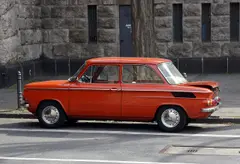
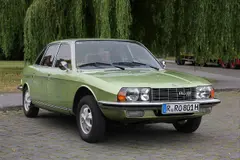
The range spans 1958 to 1977 and centres on two very different cars. The Prinz was NSU’s compact car, running from 1958 to 1973. The Ro 80, produced from 1967 to 1977, was a larger, more ambitious saloon with a distinctive wedge-shaped design and a Wankel rotary engine.
How did the range develop?
For much of this period, the Prinz and Ro 80 showed two sides of NSU: compact motoring and bold engineering. The Ro 80 arrived while the Prinz was still in production, so the change was gradual. The Prinz ended in 1973, and the Ro 80 continued until 1977, when NSU car production came to a close.
Was NSU electric?
The Prinz and Ro 80 were petrol cars. The Ro 80’s Wankel engine was rotary, not electric: it burned fuel to produce power. NSU is remembered both for the compact Prinz and for its experiments with rotary-engine technology.
Where were NSU cars sold?
NSU was a German make whose cars were sold beyond its home market.
Questions and answers
What does NSU stand for?
NSU takes its name from Neckarsulm, the German town where the company was based.
Which NSU model lasted longer, the Prinz or the Ro 80?
The Ro 80 ran from 1967 to 1977, while the Prinz ran from 1958 to 1973.
What was distinctive about the NSU Ro 80?
It paired a wedge-shaped design with a Wankel rotary engine.
Does this NSU range include an electric car?
No. The listed models are the Prinz and Ro 80, both petrol cars.