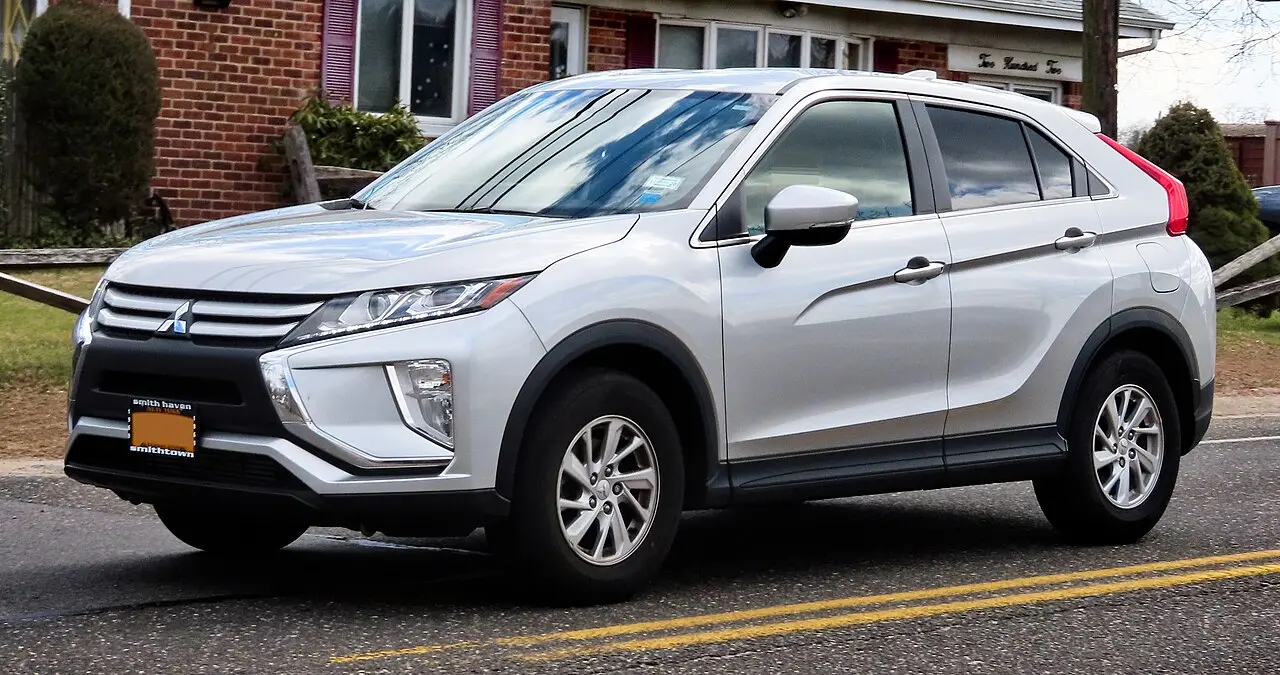
The official data lists 44 versions of the Mitsubishi Eclipse Cross (2017–2026), in the European Union, the United Kingdom, the United States, and Canada. Each market publishes its own figures, measured on its own test procedure.
At a glance
Years in the data
2017–2026
Markets
European Union, United Kingdom, United States, Canada
Engines
1.2 L to 2.4 L
Power
52 kW (71 PS) to 160 kW (218 PS)
Fuels
Plug-in hybrid, Electric, Petrol, Hybrid, Diesel
Lowest consumption (European Union)
1.7 L/100 km (WLTP)
Lowest consumption (United Kingdom)
6.6 L/100 km (NEDC)
Lowest consumption (United States)
8.7 L/100 km (EPA)
Plug-in hybrid, weighted (European Union)
2.0 L/100 km (WLTP)
New registrations in the EU
188,493
What is the Mitsubishi Eclipse Cross?
The Eclipse Cross is a compact SUV with a coupe-like roofline, bringing a more distinctive shape to Mitsubishi’s SUV range. Mitsubishi introduced it in 2017. The name recalls the company’s earlier Eclipse sports car, while the Eclipse Cross itself is an SUV.
The first generation, identified by the GK and GL codes, spans 2018 to today. Its range has included petrol, hybrid and plug-in hybrid versions. In EU registrations, electric versions also appear. The plug-in hybrid pairs an engine with electric drive for journeys that can include electric-only running.
Engines and power
Across EU registrations from 2017 to 2025, the Eclipse Cross spans engines from 1.2 to 2.4 litres and power from 52 kW (71 PS) to 160 kW (218 PS). The fuels include petrol, diesel, hybrid, plug-in hybrid and electric. In the UK, the listed versions are 1.5-litre petrol models rated at 120 kW (163 PS). US and Canadian figures also cover 1.5-litre petrol versions.
How economical is the Mitsubishi Eclipse Cross?
The lowest stated EU figure is 1.7 L/100 km on the WLTP test among petrol, diesel and hybrid versions. The plug-in hybrid’s lowest stated figure is 2 L/100 km WLTP, a weighted result that assumes some driving is electric. These figures describe different powertrains and should not be read as equivalent petrol-only consumption.
In the UK, the lowest stated figure is 6.6 L/100 km on NEDC. The US EPA rates its lowest-consuming version at 8.7 L/100 km, or 27 MPG combined, while Canada’s lowest is 8.9 L/100 km on the NRCan 5-cycle test. WLTP and NEDC are European procedures; the EPA and Canadian 5-cycle procedures measure consumption differently, so the results are not directly comparable.
Where was the Mitsubishi Eclipse Cross sold?
EU registration figures cover 2017–2025, with 188,493 registrations. The UK figures cover 2018–2021, while US and Canadian figures run from 2018 to 2026.
Questions and answers
Is the Eclipse Cross a hybrid?
Some versions are. EU registrations include hybrid and plug-in hybrid models, alongside petrol, diesel and electric versions.
What is the most powerful Eclipse Cross listed?
The EU range reaches 160 kW (218 PS).
How much fuel does the plug-in hybrid use officially?
Its lowest stated EU figure is 2 L/100 km on WLTP, a weighted result that assumes part of the driving is electric.
New cars registered in the EU (plus Norway and Iceland), from the European Environment Agency. Figures on the NEDC procedure until 2020 and on WLTP from 2021; versions are grouped by engine and power, with their number of registrations.
Years and version
Engine
Power
Fuel
Consumption (combined)
CO₂
Electric range
EU registrations
2023–2025
2.4 L
72 kW (98 PS)
Plug-in hybrid
2.0 L/100 km WLTP17.5 kWh/100 km WLTP
46 g/km
45 km
13,370
2025
Electric motor
160 kW (218 PS)
Electric
15.6 kWh/100 km WLTP
0 g/km
624 km
191
2024
1.2 L
52 kW (71 PS)
Plug-in hybrid
2.0 L/100 km WLTP17.5 kWh/100 km WLTP
46 g/km
45 km
6,684
2024
1.2 L
52 kW (71 PS)
Petrol
5.0 L/100 km WLTP
113 g/km
–
11
2022
2.4 L
72 kW (98 PS)
Plug-in hybrid
2.0 L/100 km WLTP17.6 kWh/100 km WLTP
46 g/km
57 km
26,026
2022
2.4 L
130 kW (177 PS)
Plug-in hybrid
2.0 L/100 km WLTP17.5 kWh/100 km WLTP
46 g/km
45 km
900
2022
2.4 L
72 kW (98 PS)
Hybrid
1.7 L/100 km WLTP
166 g/km
–
464
2021
2.4 L
72 kW (98 PS)
Plug-in hybrid
2.0 L/100 km WLTP17.6 kWh/100 km WLTP
46 g/km
49 km
17,497
2021
1.5 L
120 kW (163 PS)
Petrol
7.3 L/100 km WLTP
184 g/km
–
6,962
2021
2.3 L
109 kW (148 PS)
Diesel
7.3 L/100 km WLTP
194 g/km
–
150
2021
2.4 L
72 kW (98 PS)
Hybrid
1.7 L/100 km WLTP19.3 kWh/100 km WLTP
46 g/km
–
54
2021
2.4 L
130 kW (177 PS)
Plug-in hybrid
17.5 kWh/100 km WLTP
46 g/km
45 km
34
2020
1.5 L
120 kW (163 PS)
Petrol
–
163 g/km
–
21,847
2019–2020
2.3 L
109 kW (148 PS)
Diesel
–
183 g/km
–
4,974
2020
2.4 L
72 kW (98 PS)
Hybrid
–
43 g/km
–
10
2019
1.5 L
120 kW (163 PS)
Petrol
–
162 g/km
–
41,163
2019
1.5 L
86 kW (117 PS)
Petrol
–
157 g/km
–
10
2018
1.5 L
120 kW (163 PS)
Petrol
–
156 g/km
–
46,732
United Kingdom 11 versions
New cars on sale in the UK, from the Vehicle Certification Agency. NEDC figures until 2018 and WLTP figures after; years are the editions a version appeared in.
2019Eclipse Cross 3 · Eclipse Cross 4 · Eclipse Cross Black and 1 more trim
1.5 L
120 kW (163 PS)
Petrol
6-speed manual
7.8 L/100 km WLTP
–
2019Eclipse Cross 3 4WD · Eclipse Cross 4 4WD · Eclipse Cross Black 4WD and 1 more trim
1.5 L
120 kW (163 PS)
Petrol
8-speed automatic
8.7 L/100 km WLTP
–
20182 · 3 · 4 and 1 more trim
1.5 L
–
Petrol
6-speed manual
6.6 L/100 km NEDC
151 g/km
20183
1.5 L
–
Petrol
6-speed automatic
6.6 L/100 km NEDC
154 g/km
20183 4WD · 4 · Eclipse Cross First Edition
1.5 L
–
Petrol
6-speed automatic
7.0 L/100 km NEDC
159 g/km
United States 11 versions
Model years sold in the USA, from the EPA and the Department of Energy (fueleconomy.gov). MPG on the EPA test; litres per 100 km = 235.215 ÷ MPG.
Years and version
Engine
Fuel
Gearbox
Drive
Consumption (combined)
CO₂
2024–2026SIDI
1.5 L
Petrol
Continuously variable (CVT)
Four-wheel drive
25 MPG (9.4 L/100 km) EPA
219 g/km
2024–2026SIDI
1.5 L
Petrol
Continuously variable (CVT)
Four-wheel drive
26 MPG (9.0 L/100 km) EPA
211 g/km
2024–2025SIDI
1.5 L
Petrol
Continuously variable (CVT)
Front-wheel drive
26 MPG (9.0 L/100 km) EPA
211 g/km
2022–2023SIDI
1.5 L
Petrol
Continuously variable (CVT)
Front-wheel drive
26 MPG (9.0 L/100 km) EPA
210 g/km
2022–2023SIDI
1.5 L
Petrol
Continuously variable (CVT)
Front-wheel drive
27 MPG (8.7 L/100 km) EPA
203 g/km
2022–2023SIDI
1.5 L
Petrol
Continuously variable (CVT)
Four-wheel drive
25 MPG (9.4 L/100 km) EPA
216 g/km
2022–2023SIDI
1.5 L
Petrol
Continuously variable (CVT)
Four-wheel drive
26 MPG (9.0 L/100 km) EPA
209 g/km
2018–2020SIDI
1.5 L
Petrol
Continuously variable (CVT)
Front-wheel drive
26 MPG (9.0 L/100 km) EPA
210 g/km
2018–2020SIDI
1.5 L
Petrol
Continuously variable (CVT)
Front-wheel drive
27 MPG (8.7 L/100 km) EPA
203 g/km
2018–2020SIDI
1.5 L
Petrol
Continuously variable (CVT)
Four-wheel drive
25 MPG (9.4 L/100 km) EPA
216 g/km
2018–2020SIDI
1.5 L
Petrol
Continuously variable (CVT)
Four-wheel drive
26 MPG (9.0 L/100 km) EPA
209 g/km
Canada 3 versions
Model years sold in Canada, from Natural Resources Canada fuel consumption ratings (5-cycle test).
Years and version
Engine
Fuel
Gearbox
Consumption (combined)
CO₂
2022–2026Sport utility vehicle: Small
1.5 L
Petrol
Continuously variable (CVT)
9.3 L/100 km 5-cycle
216 g/km
2018–2020Sport utility vehicle: Small
1.5 L
Petrol
Continuously variable (CVT)
9.3 L/100 km 5-cycle
216 g/km
2018Sport utility vehicle: Small
1.5 L
Petrol
Continuously variable (CVT)
8.9 L/100 km 5-cycle
208 g/km
Versions outside these generations
European Union 1 version
New cars registered in the EU (plus Norway and Iceland), from the European Environment Agency. Figures on the NEDC procedure until 2020 and on WLTP from 2021; versions are grouped by engine and power, with their number of registrations.
Official figures are measured on standard test procedures and differ between markets. Your consumption depends on how, where and in what conditions you drive.