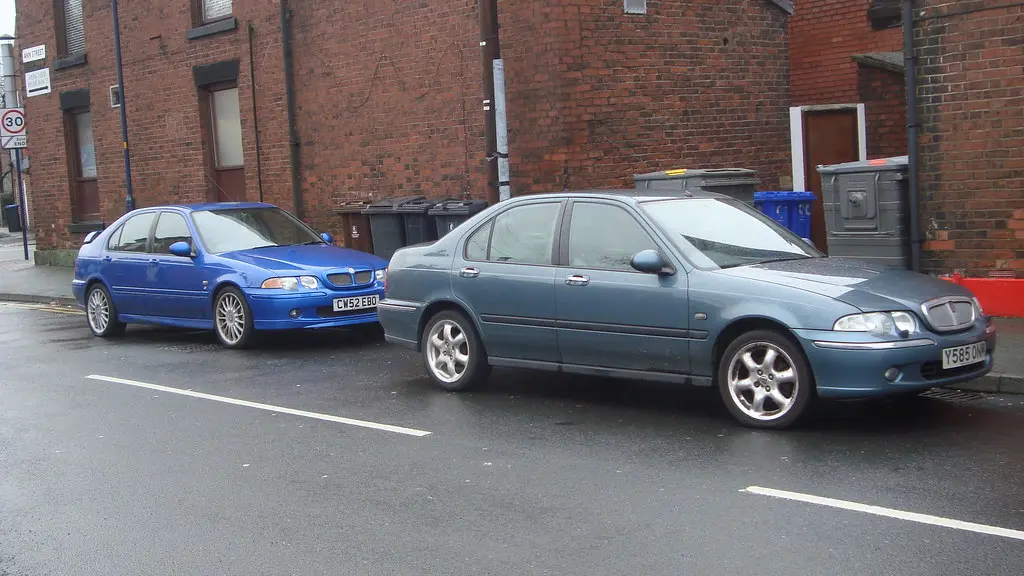
MG

MG Rover 45

MG Rover 45
Photo: kieranwhite599 / Wikimedia Commons · CC BY 2.0

The official data lists 21 versions of the MG Rover 45 (2001–2006), in the United Kingdom. Each market publishes its own figures, measured on its own test procedure.

At a glance

Years in the data
2001–2006
Markets
United Kingdom
Engines
1.4 L to 2.0 L
Power
74 kW (101 PS) to 83 kW (113 PS)
Fuels
Petrol, Diesel
Lowest consumption (United Kingdom)
5.4 L/100 km (NEDC)

What kind of car is the Rover 45?

The Rover 45 was a family car offered as a hatchback or saloon. It continued the Rover 400 line after a facelift and sat below the larger Rover 75 in the range, with a more restrained character than its MG-badged counterpart, the MG ZS.

Generations and design

The 45 belongs to the HH-R generation. It was a facelifted continuation of the Rover 400 rather than an all-new model, with updated styling that brought it closer to the Rover 75. Its hatchback and saloon body styles carried on through the model’s life.

Engines and power

UK versions had petrol or diesel engines from 1.4 L to 2.0 L. Listed power ranges from 74 kW (101 PS) to 83 kW (113 PS).

How economical is the Rover 45?

The lowest listed official consumption is 5.4 L/100 km on the NEDC test. European figures use the NEDC procedure, while the USA uses EPA testing and Canada uses a 5-cycle procedure, so results from those markets are not directly comparable.

UK (VCA) figures cover 2001–2006 and include 21 versions.

Questions and answers

When was the Rover 45 sold?

UK (VCA) figures cover 2001–2006. The HH-R generation is listed as 2001–2005.

What body styles did the Rover 45 have?

It was offered as a hatchback and a saloon.

What engines were available?

UK versions had 1.4 L to 2.0 L petrol or diesel engines.

What is its lowest listed official fuel consumption?

The lowest listed figure is 5.4 L/100 km on the NEDC test.

Rover 45 HH-R (2001–2005)

Model codes: HH-R · Sold in: United Kingdom · References: en.wikipedia.org, rover200.org.uk

United Kingdom 14 versions

New cars on sale in the UK, from the Vehicle Certification Agency. NEDC figures until 2018 and WLTP figures after; years are the editions a version appeared in.

Years and versionEnginePowerFuelGearboxConsumption (combined)CO₂
2001–20041.41.4 L–Petrol5-speed manual7.0 L/100 km NEDC168 g/km
2001–20041.61.6 L–Petrol5-speed manual7.2 L/100 km NEDC172 g/km
20041.6 (from VIN RT559464)1.6 L–Petrol5-speed manual7.0 L/100 km NEDC168 g/km
2001–20041.81.8 L–Petrol5-speed manual7.3 L/100 km NEDC174 g/km
2001–20041.81.8 L–PetrolContinuously variable (CVT)8.5 L/100 km NEDC203 g/km
20042.0 - 74kW2.0 L74 kW (101 PS)Diesel5-speed manual5.4 L/100 km NEDC150 g/km
20042.0 - 83kW2.0 L83 kW (113 PS)Diesel5-speed manual5.6 L/100 km NEDC150 g/km
2001–20042.0 V62.0 L–Petrol5-speed automatic9.3 L/100 km NEDC224 g/km
2002–20042.0 V6 (from VIN RT567813) · 2.0 V6 (from RT567813)2.0 L–Petrol5-speed automatic9.8 L/100 km NEDC234 g/km
2001–20032.02.0 L–Diesel5-speed manual5.4 L/100 km NEDC150 g/km
20011.41.4 L–Petrol5-speed manual7.1 L/100 km NEDC166 g/km
20011.61.6 L–Petrol5-speed manual6.9 L/100 km NEDC170 g/km
20011.81.8 L–Petrol5-speed manual7.1 L/100 km NEDC172 g/km
20012.0 V62.0 L–Petrol5-speed automatic9.4 L/100 km NEDC224 g/km

Versions outside these generations

United Kingdom 7 versions

New cars on sale in the UK, from the Vehicle Certification Agency. NEDC figures until 2018 and WLTP figures after; years are the editions a version appeared in.

Years and versionEnginePowerFuelGearboxConsumption (combined)CO₂
20061.41.4 L–Petrol5-speed manual7.0 L/100 km NEDC168 g/km
20061.6 (from VIN RT559464)1.6 L–Petrol5-speed manual7.0 L/100 km NEDC168 g/km
20061.81.8 L–Petrol5-speed manual7.3 L/100 km NEDC174 g/km
20061.81.8 L–PetrolContinuously variable (CVT)8.5 L/100 km NEDC203 g/km
20062.0 - 74kW2.0 L74 kW (101 PS)Diesel5-speed manual5.4 L/100 km NEDC150 g/km
20062.0 - 83kW2.0 L83 kW (113 PS)Diesel5-speed manual5.6 L/100 km NEDC150 g/km
20062.0 V6 (from VIN RT567813)2.0 L–Petrol5-speed automatic9.8 L/100 km NEDC234 g/km

Official figures are measured on standard test procedures and differ between markets. Your consumption depends on how, where and in what conditions you drive.